 Hable con un agente al (888) 572-7520
  Enviar mensaje a un agente

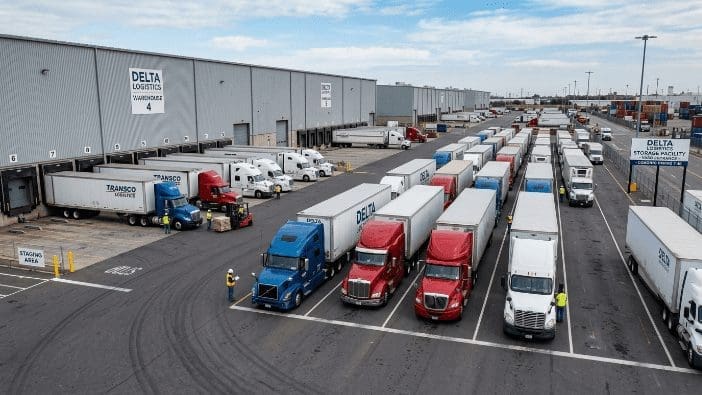

Tariff Shock: U.S. Freight Demand Is Suddenly Surging. Is experiencing one of its most unexpected shifts since the pandemic-era supply chain crisis. While much of the economic conversation remains focused on tariffs, trade policy, and reshoring manufacturing, something different is happening on American highways: more trucks are moving freight, transportation prices are rising again, and logistics capacity is tightening.
At the center of this trend is a new supply chain paradox.
Instead of stockpiling large volumes of goods in warehouses, many companies are now operating with leaner inventories and faster replenishment cycles. The strategy is being driven by multiple pressures, including tariffs, higher storage expenses, elevated borrowing costs, and growing uncertainty in global trade.
The result is a system where products move more frequently, in smaller loads, and with far less time sitting in storage.
That shift is now showing up in freight data across the United States.
According to the Logistics Managers’ Index (LMI), one of the most closely watched indicators in the supply chain sector, the index climbed to 61.5 in February 2026, up from 59.6 in January, with transportation activity playing a major role in the increase.
Transportation prices surged to 76.7, their highest level since March 2022, while transportation capacity dropped to 41.0 — the sharpest contraction since the peak of the post-pandemic freight disruption in 2021.
The Reverse “Just-in-Time” Model
For decades, supply chains operated under the “just-in-time” philosophy: minimize inventory, reduce costs, and keep goods flowing efficiently.
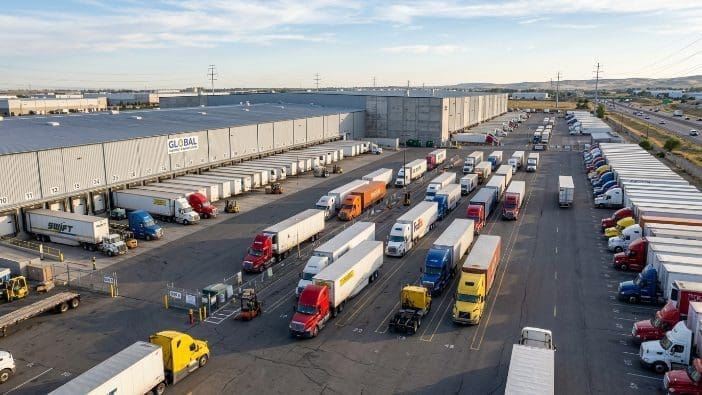
Now, the model appears to be evolving into something more aggressive.
Companies are not only trying to stay efficient — they are also trying to avoid exposure to rising tariff costs and expensive warehousing. Instead of holding large amounts of imported goods for long periods, many businesses are replenishing inventory more frequently and moving products through the supply chain at a much faster pace.
That creates a direct increase in freight activity.
Smaller, faster shipments require more trucking movements, more route coordination, and more pressure on fleets and logistics providers.
The LMI report itself noted that companies are trying to “turn inventories over quickly to keep costs low,” a trend that is placing growing stress on transportation networks.
In practice, trucking has once again become one of the most critical components of the U.S. economy.
Freight Demand Reaches Multi-Year Highs
The latest numbers suggest that the freight market is moving further away from the prolonged “freight recession” that weighed heavily on carriers over the last several years.
In March 2026, the overall LMI climbed again to 65.7 — its highest reading since May 2022.
The strongest pressure appeared in transportation pricing. The transportation prices index jumped to 89.4, a level comparable to the extreme freight volatility seen during the major global logistics disruptions of 2022.
Meanwhile, transportation capacity continued to shrink.
Industry analysts note that the combination of rising freight prices and tightening capacity is often a classic sign that the trucking market is hardening again after a long period of oversupply.
For trucking companies and freight operators, the trend represents a significant change after years of falling spot rates, excess capacity, and margin pressure.
But it also creates new operational challenges.
More Pressure on Drivers and Fleets
Higher freight activity does not necessarily mean easier operations.
The low-inventory model leaves far less room for delays. When businesses carry minimal stock, late deliveries can immediately impact production schedules, retail operations, or distribution networks.
That places additional pressure on:
- Driver Availability,
- Operational Efficiency,
- Transit Times,
- Route Planning,
- Fleet Maintenance,
- And Fuel Consumption.
At the same time, geopolitical uncertainty continues to affect energy markets and transportation costs. Rising diesel prices and ongoing volatility in global supply chains are also influencing freight operations across the United States.
As a result, many companies are prioritizing flexible freight contracts, regional distribution strategies, and faster-response logistics networks capable of adapting to changing demand patterns.
The Tariff Paradox
Tariffs are often associated with slowing trade activity or reducing the flow of imported goods.
But for the U.S. trucking sector, the immediate effect may be the exact opposite.
The effort to avoid tariff exposure, reduce storage costs, and accelerate inventory turnover is creating more movement throughout the domestic logistics system.
The impact is already visible on American roads: more frequent freight movement, higher fleet utilization, and increasing pressure on transportation capacity.
For the trucking industry, the shift marks a major turning point. After several difficult years dominated by weak freight demand and falling rates, speed, availability, and trucking capacity are becoming strategic assets once again.
And that may be one of the biggest economic paradoxes of 2026: trade policies designed to restrict certain global flows are now generating even more trucking activity inside the United States.
 Business hours: Monday to Friday from 8:00 AM to 5:00 PM. California time