 Hable con un agente al (888) 572-7520
  Enviar mensaje a un agente



The commercial vehicle intelligence platform, Altitude by Geotab, analyzed data to assess how prepared the host cities of the 2026 FIFA World Cup are for the surge in transportation demand that the tournament will generate this summer.
Using vehicle data collected between June and July 2025, including periods featuring major sporting and mass-attendance events, Geotab examined the behavior of road networks across the 16 host cities of the tournament. The company stated in a release that this analysis focused on “when sudden increases in activity place pressure on the movement of people, deliveries, and everyday traffic.”
The company raises a key question: when tens of thousands of fans arrive in host cities during the 2026 tournament, how will freight trucks transporting food, goods, and supplies be able to move efficiently?
Based on real-world data gathered through its platform, Geotab’s ranking presents a mixed, though largely challenging, outlook for the host cities, with just over a month remaining before the start of the tournament. These were its main findings.
How well can each host city’s freight network handle the 2026 FIFA World Cup?
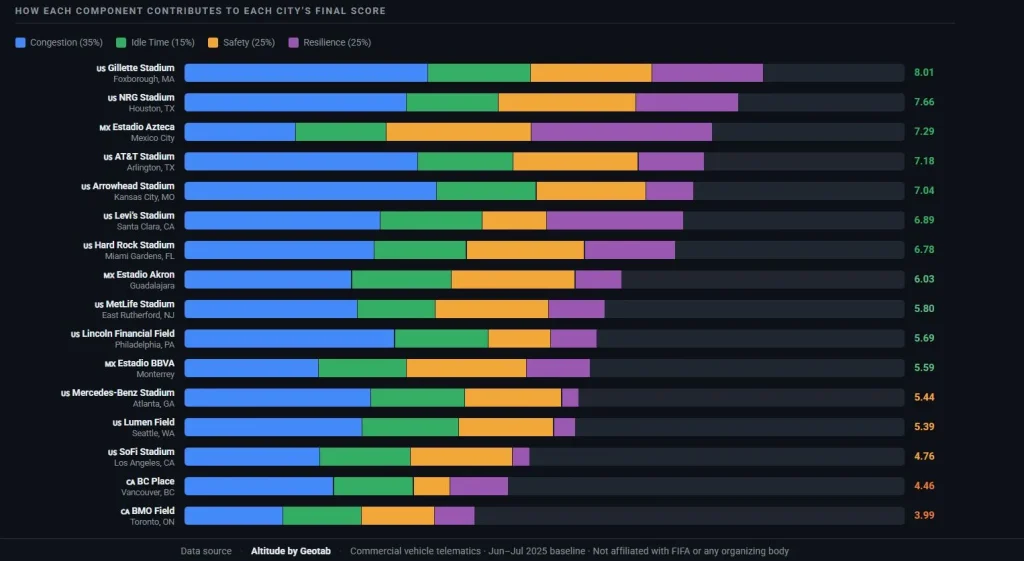
Using a 10-point system, Geotab evaluated four main components: the usual level of road congestion (35%), the amount of time vehicles spend idling with engines running (15%), vehicle driving safety (25%), and the cities’ ability to recover following previous large-scale events (25%).
Each component was measured independently across both geographic scales and then combined; 60% of the weighting corresponds to the area immediately surrounding the stadium (5 km), while 40% corresponds to the broader metropolitan area (20 km), the company explained. This means that a city that manages stadium-area traffic well but struggles across the wider metropolitan region will see this reflected in its score.
The system determined which stadiums/cities received the highest and lowest ratings:
Highest scores
- Gillette Stadium, Foxborough: 8.01
- NRG Stadium, Houston: 7.66
- Azteca Stadium, Mexico City: 7.29
Lowest scores
- SoFi Stadium, Los Angeles: 4.76
- BC Place, Vancouver: 4.46
- BMO Field, Toronto: 3.99
“The world’s most popular sport is coming to cities across North America, and this summer many of them will face an extreme stress test of their infrastructure,” said Mike Branch, Vice President of Data and Analytics at Geotab. “The challenge is ensuring the movement of people, goods, and services during large-scale events. This affects everyone. We want to understand how the road network as a whole manages local traffic, deliveries, and daily commuting in order to help cities improve roadway and route planning.”
Rising stress, traffic, and fuel costs
In addition, Geotab surveyed 3,000 motorists across Canada, Mexico, and the United States to analyze how major events alter normal driving conditions in host cities. The results showed that drivers experience higher stress levels during these events, while fuel consumption and increased traffic rank among their top concerns.
According to Geotab’s data:
- 76% of respondents in Canada, 89% in Mexico, and 79% in the United States said driving stress increases during these types of events.
- Nearly five out of six drivers (83%) in Mexico are concerned about fuel waste caused by delays or idling time when major events increase traffic in their city.
- More than two-thirds of respondents in Canada (67%) and three-quarters of respondents in the United States (76%) share the same concern.
Altitude by Geotab’s assessment of the host cities for the 2026 FIFA World Cup reveals that many of them are expected to face mobility disruptions, especially for commercial vehicle drivers responsible for transporting food, goods, and supplies during peak-demand periods.
 Business hours: Monday to Friday from 8:00 AM to 5:00 PM. California time