 Hable con un agente al (888) 572-7520
  Enviar mensaje a un agente



The trucking business in the United States operates today with virtually no margin for error. For the hundreds of thousands of independent truckers and small fleet owners, the path to profitability and costs analysis has become a daily, penny-by-penny battle. Driving a truck is no longer just a matter of driving skill, but a rigorous exercise in financial management.
The persistent volatility of the spot market and contract rates demands that every operator know their numbers with surgical precision. Many carriers make the critical mistake of evaluating their success based solely on the money in their bank account at the end of the week. However, ignoring long-term equipment wear and tear or hidden regulatory increases is a recipe for technical bankruptcy.
It’s this: moving cargo without knowing the true impact of depreciation and fixed costs completely dilutes the effort of the long-haul driver on American (and worldwide) highways.
To understand where we stand, we must turn to the hard data from the most respected institutions in the industry. The American Transportation Research Institute’s (ATRI) annual report revealed a historic statistic that cannot be ignored. Average operating costs in the heavy trucking industry reached a record high of $1,779 per mile, excluding diesel fuel costs.
This dramatic increase is driven by three key factors: the rising cost of Class 8 truck parts, the widespread increase in liability insurance premiums, and inflationary pressures on preventative maintenance. When a broker offers you a load that pays $2.10 per mile, the deal seems attractive at first glance. However, if you add the price of diesel per mile to the base rate of $1.78, you’ll find you’re losing money on every trip.
For this reason, highly reputable consulting firms like ACT Research warn that companies that don’t adjust their rates to reflect their actual costs will experience severe liquidity problems before the end of the year. The only viable defense in this market is to master your finances through a rigorous methodology.
Financial Tools, Step by Step
To consistently reach your break-even point—the famous break-even where you neither gain nor lose, but cover absolutely everything—you need to implement a practical accounting system. You don’t require a college degree in finance, but rather the discipline to record every expense in two fundamental categories.
Category 1: Fixed Costs. Fixed costs are those financial commitments that you must pay, regardless of whether your truck traveled 10,000 miles or sat idle all month due to lack of cargo. These include the monthly payment on your truck or trailer loan, insurance policies, state permits, electronic logging device (ELD) subscriptions, and basic corporate taxes.
Category 2: Variable Costs. These financial obligations increase or decrease directly with the number of miles you travel on the road. Diesel fuel represents the most significant variable expense, closely followed by tire purchases, preventive maintenance services (such as oil and filter changes), tolls, and the driver’s own travel expenses.
The 9,500-Mile Monthly Example
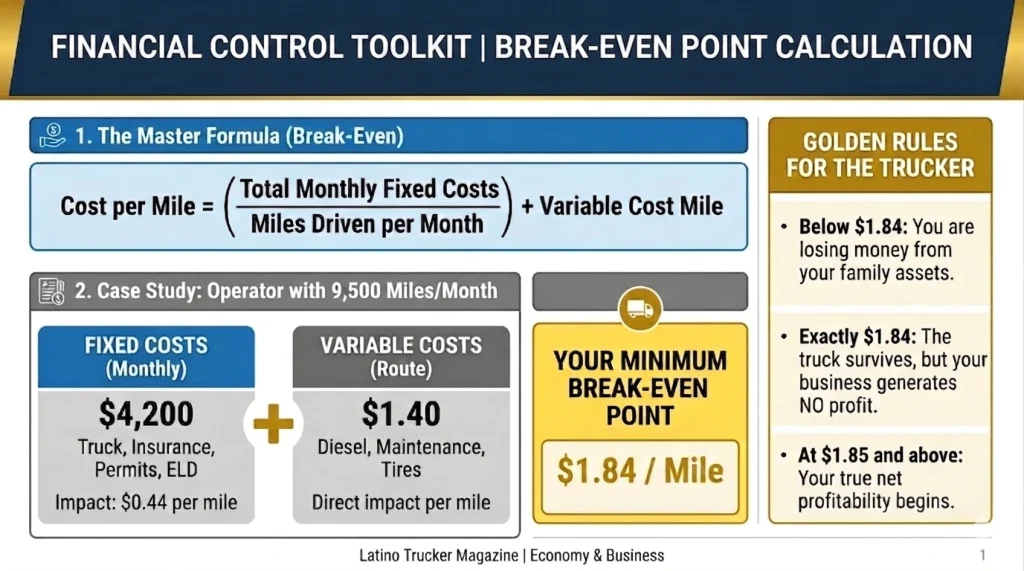
To illustrate how this cost management tool actually works, let’s analyze the typical case of an independent carrier in the United States who averages 9,500 miles per month.
Suppose this carrier has consolidated monthly fixed expenses of $4,200 (financing, insurance, and permits). Dividing $4,200 by the 9,500 miles traveled, we find that their fixed cost per mile is exactly $0.44. On the other hand, after meticulously tracking their variable expenses (diesel, tires, maintenance), they determine that their pure variable cost is $1.40 per mile traveled.
Applying our basic formula, we add both factors ($0.44 + $1.40) and arrive at a true break-even point of $1.84 per mile. Any trip accepted below this figure means the operator is subsidizing the broker’s business with their own money. If the load pays exactly $1.84, the truck survives but doesn’t generate a profit. The real business starts at $1.85.
Cost Protection Strategies
Once you know your magic number, smart cost management empowers you to make data-driven business decisions. According to recommendations from the Owner-Operator Independent Drivers Association (OOIDA), small carriers should prioritize maximum efficiency in maintaining their assets to extend the lifespan of their Class 8 equipment rather than going into debt for new trucks.
Strict preventative maintenance is the best investment for mitigating unforeseen expenses. Regularly analyzing engine oil and maintaining optimal tire pressure can reduce fuel consumption by up to 5% annually, significantly lowering your total variable costs.
Furthermore, having a detailed report of your actual operating expenses gives you a massive competitive advantage when negotiating rates directly with customers or freight brokers. Instead of accepting desperate offers, you can argue with solid accounting evidence why your professional service is worth every penny.
In conclusion, the real secret to success for truckers in the United States isn’t working longer hours and breaking the FMCSA’s duty clock rules, but rather operating with greater financial intelligence. Use this toolkit weekly, keep your records up-to-date, and firmly protect the fruits of your hard work on the road.
 Business hours: Monday to Friday from 8:00 AM to 5:00 PM. California time