 Hable con un agente al (888) 572-7520
  Enviar mensaje a un agente


The intense heat wave sweeping across the United States continues to push temperatures to dangerous levels across much of the country, creating new challenges for the freight transportation industry. As millions of Americans return home following the Independence Day weekend, truck drivers are facing particularly demanding conditions across the South, the Great Plains, and the western United States.
According to weather forecasts, temperatures will exceed 100°F (38°C) across numerous states, while desert areas of the Southwest are once again expected to climb above 110°F (43°C). In the Southeast, high humidity is driving heat index values well above actual air temperatures, making conditions even more dangerous for those working outdoors.
For trucking professionals, extreme heat affects far more than driver comfort. It increases the likelihood of mechanical failures, may require adjustments to driving schedules, and can cause unexpected disruptions along major freight corridors.
Where Will It Be Hottest?
The most severe conditions are expected across:
- Arizona, with highs between 108°F and 115°F.
- Nevada, especially Las Vegas and southern portions of the state.
- California, particularly the Central Valley and desert regions.
- Texas, where much of the state remains above 100°F.
- New Mexico and Utah, with extreme heat expected throughout the week.
- Parts of Oklahoma, Kansas, and Colorado, where strong winds are also increasing wildfire danger.
Across the Southeast—including Florida, Georgia, Alabama, Mississippi, and Louisiana—temperatures may be slightly lower, but humidity is pushing heat index values above 105°F (40°C), significantly increasing the risk of heat exhaustion.
How Extreme Heat Impacts Freight Operations
High temperatures affect nearly every aspect of trucking operations.
Engines run hotter for longer periods, placing additional stress on cooling systems. Tires experience greater pressure as pavement temperatures rise, increasing the risk of blowouts.
Fuel consumption also rises when trucks remain idling in heavy traffic or inspection checkpoints while air conditioning systems operate continuously.
In some freight corridors, road maintenance work may also be temporarily restricted because extreme pavement temperatures can soften or damage asphalt surfaces.
Risks for Drivers
Extreme heat is one of the leading causes of driver fatigue during the summer months.
Dehydration can reduce concentration, slow reaction times, trigger headaches, and cause muscle cramps. In severe cases, it may lead to heat stroke—a medical emergency requiring immediate attention.
Road safety experts recommend:
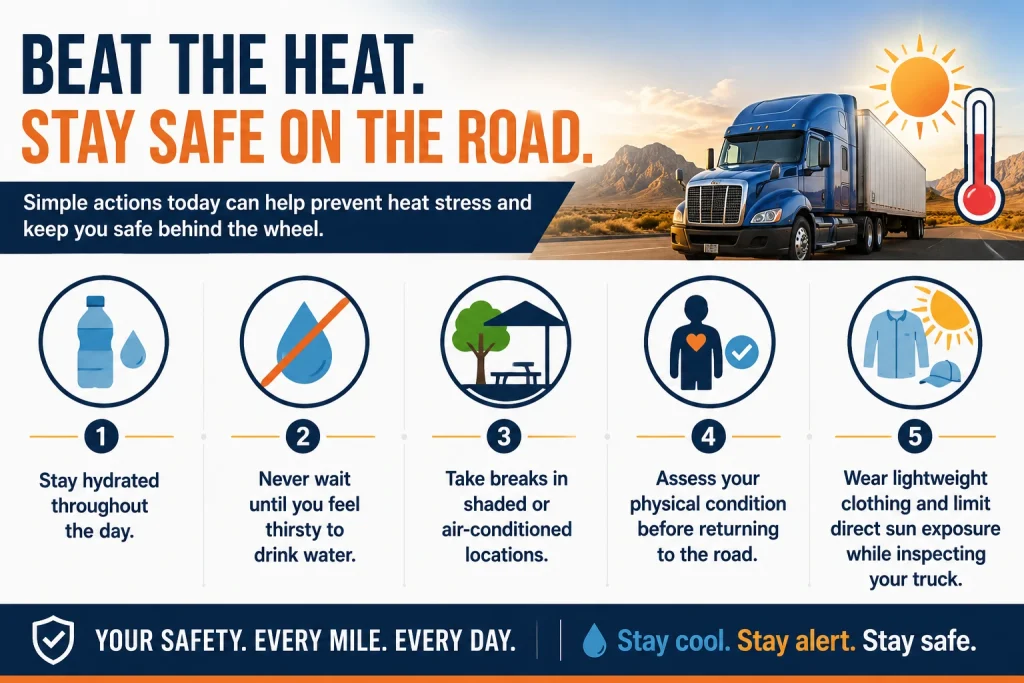
- Stay hydrated throughout the day.
- Never wait until you feel thirsty to drink water.
- Take breaks in shaded or air-conditioned locations.
- Assess your physical condition before returning to the road.
- Wear lightweight clothing and limit direct sun exposure while inspecting your truck.
https://t.co/KSwEPDSvtc It has been reported that 25 people have lost their lives due to an extreme heat wave that has been affecting the U.S. for about a week. pic.twitter.com/TBFJFNpLgL
— Tourism Today News (@ttnews_official) July 6, 2026
Inspect Your Truck Before Every Trip
During periods of extreme heat, spending a few extra minutes on a pre-trip inspection can help prevent costly breakdowns.
Drivers should pay close attention to:
- Coolant level.
- Radiator condition.
- Tire pressure.
- Air conditioning performance.
- Battery condition.
- Engine belts and hoses.
A minor issue that might normally go unnoticed can quickly become a major mechanical failure when temperatures exceed 104°F (40°C).
Wildfires Add Another Layer of Risk
Extreme heat is also significantly increasing wildfire danger across the western United States.
Transportation agencies continue monitoring major corridors in California, Colorado, Arizona, Utah, Nevada, Idaho, Oregon, and Washington, where high temperatures, low humidity, and strong winds create ideal conditions for rapidly spreading fires.
In Colorado, for example, U.S. Highway 550 recently reopened after firefighters gained control of a nearby wildfire. However, transportation officials warned that closures may be reinstated with little notice if weather conditions deteriorate.
For truck drivers, this means staying alert for detours and sudden route changes. Highways are often closed not because flames reach the roadway, but because heavy smoke severely reduces visibility or emergency crews require access to the area.
Careful Planning Will Be Essential This Week
Transportation experts agree that the combination of extreme heat, post-holiday traffic, ongoing road construction, and elevated wildfire risk will make this one of the most challenging weeks of the summer for freight transportation.
Before beginning each trip, drivers should review weather forecasts, check the latest road conditions, identify alternate routes in case of closures, and maintain regular communication with their dispatcher or company.
In an industry where every minute matters, preparing for changing weather conditions can make the difference between a safe delivery and hours of costly delays. Over the coming days, extreme heat will be just as important an operational factor as traffic congestion or road conditions.
Keep Your Insurance Up to Date
Before every trip, make sure your Saint George insurance policy is active and up to date. If you experience any emergency on the road, contact our team immediately using our emergency assistance phone numbers.
 Business hours: Monday to Friday from 8:00 AM to 5:00 PM. California time