 Hable con un agente al (888) 572-7520
  Enviar mensaje a un agente



The 2026 construction season has begun with significant investment in transportation infrastructure across the United States. Texas is emerging as one of the leading states, with a series of projects aimed at expanding highways, rebuilding bridges and improving urban mobility. At the same time, Ohio, Utah, Wisconsin and Minnesota are moving forward with large-scale programs worth billions of dollars.
Although these projects are not part of a single federal initiative, state departments of transportation are advancing major investments simultaneously to modernize strategic corridors, reduce traffic congestion and improve safety for motorists and commercial carriers.
For the trucking industry, these investments present both operational challenges during construction and long-term benefits through a more efficient transportation network.
Texas leads some of the nation’s largest projects
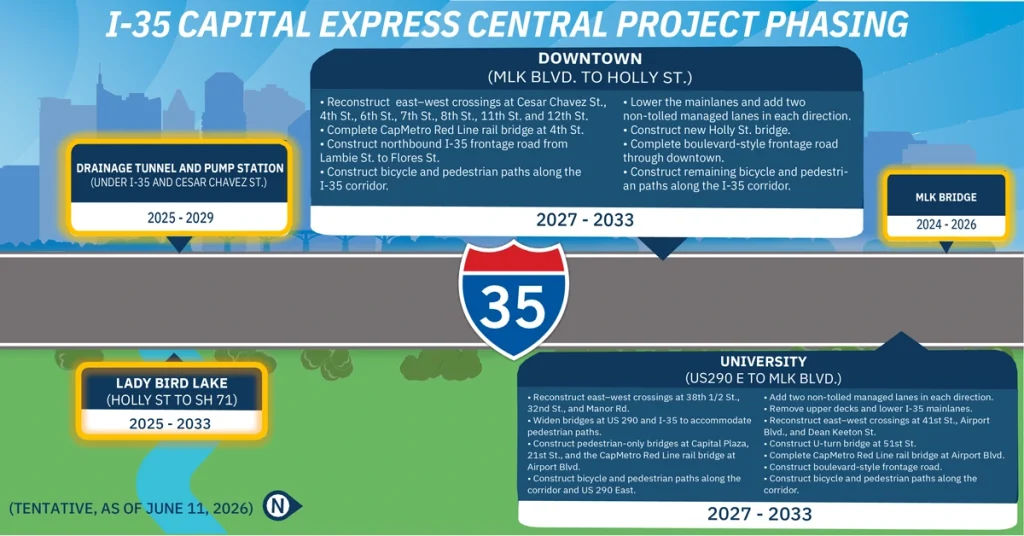
The Texas Department of Transportation (TxDOT) is overseeing several of the country’s largest infrastructure projects. The most significant is the I-35 Capital Express Central Project in Austin, an initiative valued at approximately $4.5 billion that will transform one of the state’s busiest transportation corridors.
The project is part of the modernization of a roughly 79-mile corridor and includes reconstruction of the bridges over Lady Bird Lake, the addition of managed lanes for high-occupancy vehicles, a new urban interchange at Riverside Drive, and improvements for pedestrians and cyclists.
According to TxDOT, the project also includes new pedestrian paths, bicycle infrastructure and accommodations that will support the future integration of Austin’s planned light rail system.
Construction began in 2025 and is expected to continue through 2033. In the meantime, various lane closures and traffic restrictions remain in place throughout the corridor to allow construction to progress.
Expansion projects across Texas
The work extends well beyond Austin.
In the Houston area, TxDOT began expanding a roadway segment during the summer of 2026, increasing capacity from four to six lanes between Interstate 10 and Highway 290, where rapid residential growth has significantly increased traffic volumes.
In Taylor County, the state has invested approximately $125 million to widen Interstate 20 to six lanes and construct a new overpass at Judge Ely Boulevard, a project designed to improve safety and reduce travel times.
Texas is also advancing smaller but locally significant improvements, including new traffic signals and intersection upgrades in communities such as Wimberley, aimed at improving traffic flow and reducing crash risks.
Ohio sets a record investment
Outside Texas, Ohio is carrying out one of the nation’s most ambitious construction programs.
The Ohio Department of Transportation is investing $3.4 billion across 977 projects statewide.
The program includes improvements to 739 bridges and more than 4,500 miles of roadway.
Among the largest projects are the $280 million reconstruction of Interstate 90 in Cuyahoga County and the $274 million expansion of U.S. Route 33.
State officials say the goal is to improve system reliability while enhancing safety and supporting continued economic growth.
Utah expands key transportation links
In Utah, the Department of Transportation is advancing 176 new projects with a combined value of $2.8 billion.
One of the largest investments is the 2100 North Freeway connection in Utah County, a $621 million project that will add new bridges, connect major transportation corridors and include shared-use paths for pedestrians and cyclists.
The state’s strategy combines preservation of existing infrastructure with targeted expansions to reduce congestion in rapidly growing communities.
Wisconsin modernizes major corridors
Wisconsin is planning more than 400 highway improvement projects as part of its statewide infrastructure program.
The largest investment is the $1.7 billion I-94 East-West Project near Milwaukee, which includes interchange reconstruction and major corridor improvements.
Additional projects are underway on Interstate 41, U.S. Route 51 and several key river crossings designed to strengthen regional connectivity.
Minnesota expands its transportation network
Meanwhile, Minnesota is carrying out more than 200 road and bridge projects, along with 51 additional projects involving airports, ports, railroad crossings and public transit infrastructure.
Among the most significant investments is the $195 million reconstruction of Highway 65 in Blaine, which will add four new interchanges to improve safety and reduce congestion.
Additional work is also progressing along Interstate 94, in Moorhead and throughout the Minneapolis metropolitan area.
A major boost for transportation infrastructure
Together, these investments reflect a coordinated effort by multiple states to modernize transportation infrastructure in response to population growth, increasing freight movement and the need for safer roadways.
For the trucking industry, the coming years will bring temporary detours, work zones and traffic restrictions, particularly along strategic freight corridors such as Interstate 35 in Texas and Interstate 94 in Wisconsin. Once completed, however, these projects are expected to increase highway capacity, reduce travel times and improve connectivity between logistics hubs, ports, metropolitan areas and commercial corridors.
Texas is once again playing a central role in that transformation, leading some of the nation’s largest transportation investments and reinforcing its position as one of the most important logistics and infrastructure hubs in the United States.
 Business hours: Monday to Friday from 8:00 AM to 5:00 PM. California time