 Hable con un agente al (888) 572-7520
  Enviar mensaje a un agente

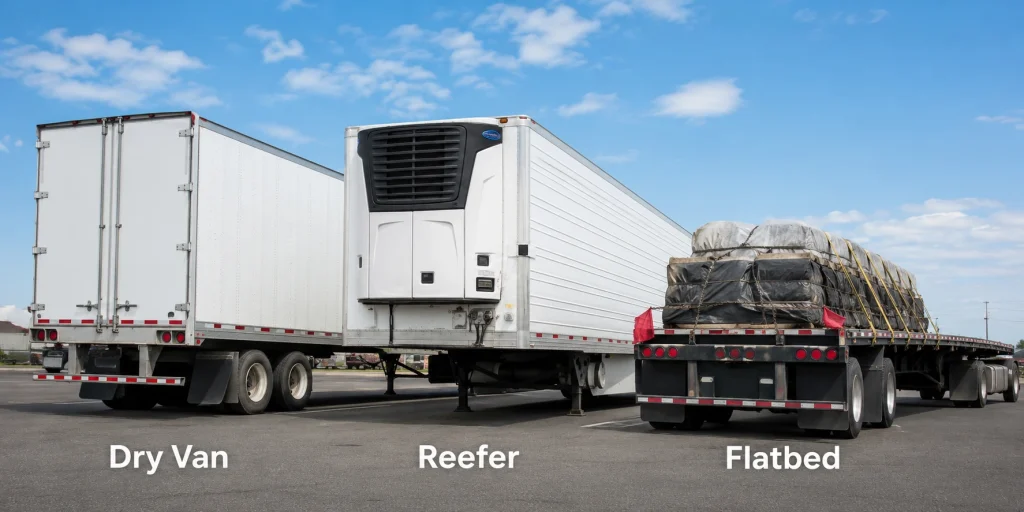

Choosing between a Dry Van, Reefer, or Flatbed can completely change the profitability of a trucking business. For an owner-operator buying a first trailer or a small fleet considering adding new equipment, the decision should not be based solely on which segment offers the highest rate per mile.
A higher rate does not necessarily mean a higher profit.
To understand real profitability, you have to consider how much it costs to keep the equipment running, how much fuel it consumes, how many empty miles the operation generates, how long the truck remains idle, and the potential risks of cargo damage or claims.
That is why there is no single trailer type that is the most profitable for every trucker. Dry Van may make more sense for an operation focused on simplicity and freight volume. Reefer can generate higher revenue but comes with additional costs and responsibilities. Flatbed, meanwhile, can command attractive rates for operators prepared to handle a more specialized operation.
What Does It Really Mean for a Trailer to Be Profitable?
One of the most common mistakes is comparing Dry Van, Reefer, and Flatbed solely by the rate offered for each load.
For a carrier, what really matters is net profit after operating costs.
The main expenses that should be included in the calculation are:
Truck Fuel
Preventive Maintenance and Repairs
Tires
Truck and Trailer Payments or Depreciation
Insurance
Permits and Administrative Costs
Additional Fuel for the Refrigeration Unit, When Applicable
Chains, Straps, Tarps, and Other Cargo-Securement Equipment
Empty Miles (Deadhead)
Unpaid Detention Time
Trailer Washing and Preparation
Potential Cargo Claims
For example, a Reefer load may pay more per mile than a Dry Van load, but that difference can quickly disappear because of long detention times, additional fuel consumption, or higher maintenance costs.
Likewise, Flatbed may offer a higher gross rate, but it requires more work from the driver and careful planning for every load.
The Formula That Matters
When comparing loads, it is important to look beyond the advertised rate per mile:
Approximate net income = load revenue – variable costs – trip-related costs
It is also important to calculate revenue based on all miles driven, not just loaded miles.
A load may pay extremely well but require hundreds of empty miles to pick it up—or leave the truck in a weak freight market afterward. In that case, it could ultimately be less profitable than a load with a lower initial rate.
Dry Van: Simplicity and a Huge Freight Market
A Dry Van is one of the most widely used trailer types in U.S. trucking.
It can haul packaged products, consumer goods, electronics, clothing, nonperishable foods, and a wide variety of freight that does not require temperature control.
Its main advantage is precisely that: the size and diversity of the market.
For an owner-operator, access to a large variety of loads can make route planning easier and help reduce deadhead miles.
Why Can Dry Van Be Profitable?
Compared with Reefer, the equipment is simpler. There is no refrigeration unit to maintain and no additional fuel consumption associated with keeping one running.
Trailer maintenance is primarily focused on traditional components such as brakes, tires, suspension, lights, doors, and structural elements.
Day-to-day operations are also generally straightforward.
That makes Dry Van particularly attractive for truckers looking to control fixed costs and reduce operational complexity.
The Downside: Heavy Competition
The same low barrier to entry that makes Dry Van attractive also means there are many carriers competing for loads.
When there are more trucks than available loads in certain markets, rates can come under pressure quickly, particularly in the spot market.
That is why Dry Van operators need to pay close attention to route selection, origin and destination markets, and empty miles.
A Dry Van running at a moderate rate with consistent freight may ultimately generate better monthly results than another segment offering higher nominal rates but too many unproductive days.
Reefer: Higher Revenue, but Higher Costs
A Reefer, or refrigerated trailer, adds one critical variable to the operation: temperature.
These trailers transport fresh and frozen foods, agricultural products, certain medications, and other goods that must remain within specific temperature ranges during transit.
That additional responsibility often translates into higher rates than Dry Van, but it also increases operating costs.
The trailer itself is more expensive, and the refrigeration unit requires fuel, preventive maintenance, and repairs.
For an owner-operator, that essentially means managing two separate mechanical systems: the truck and the refrigeration unit.
Why Does Reefer Usually Pay More?
Freight that must remain at a specific temperature cannot simply be placed in any trailer.
Specialized equipment is required, and the carrier assumes additional responsibility. A refrigeration-system failure can compromise part or all of the cargo.
Operating a Reefer therefore requires careful attention to equipment condition, refrigeration-unit fuel, temperature, documentation, and the procedures established for each load.
It is also important to understand the exact terms of cargo insurance, because not every policy covers losses caused by temperature changes, mechanical failures, or product deterioration in the same way.
Detention: A Cost That Can Change the Equation
Loading and unloading times are another important consideration.
Distribution centers, cold-storage facilities, processing plants, and food-related facilities can involve long waiting periods.
Even when detention pay is available under a contract, it may not fully compensate for the lost time.
For an owner-operator, every hour spent waiting has a cost: it is an hour the truck is not moving toward the next load.
A Major Reefer Advantage: Flexibility
A refrigerated trailer can also haul certain dry loads when equipment and cargo conditions allow.
That provides additional flexibility.
However, constantly using a Reefer as a Dry Van is not necessarily efficient. Refrigerated trailers are heavier and more expensive than standard dry vans.
Their greatest economic potential therefore comes when operators can regularly take advantage of freight that actually requires temperature control.
Flatbed: Specialization That Can Lead to Better Rates
A Flatbed trailer operates under a very different model.
It is commonly used to transport steel, lumber, machinery, construction materials, pipes, and numerous industrial products or equipment that cannot easily be loaded into an enclosed trailer.
In many markets, that specialization can result in attractive rates.
But Flatbed operations involve much more than simply hooking up the trailer and hitting the road.
Drivers need to understand proper cargo securement, weight distribution, and the correct use of chains, straps, binders, and other securing devices.
When required, drivers must also tarp and untarp the load.
The Extra Work Has Value
One reason Flatbed can offer strong margins is that not every driver wants to perform this type of work.
Securing freight in rain, snow, wind, or extreme temperatures can be physically demanding.
Experience also carries significant value.
Operators who understand the segment can work with industrial customers, manufacturers, infrastructure projects, construction companies, and specialized machinery operations.
That specialization can become a competitive advantage over segments where a much larger number of carriers are available.
Flatbed Also Comes With Risks
Improperly secured cargo can shift during braking, cornering, or sudden maneuvers.
That can damage the freight and, in serious situations, contribute to accidents.
Compliance with cargo-securement requirements is therefore a fundamental part of the business.
Flatbed can also be more sensitive to cycles in industries such as construction, manufacturing, and infrastructure. When activity slows in these sectors, demand for certain types of Flatbed freight may also decline.
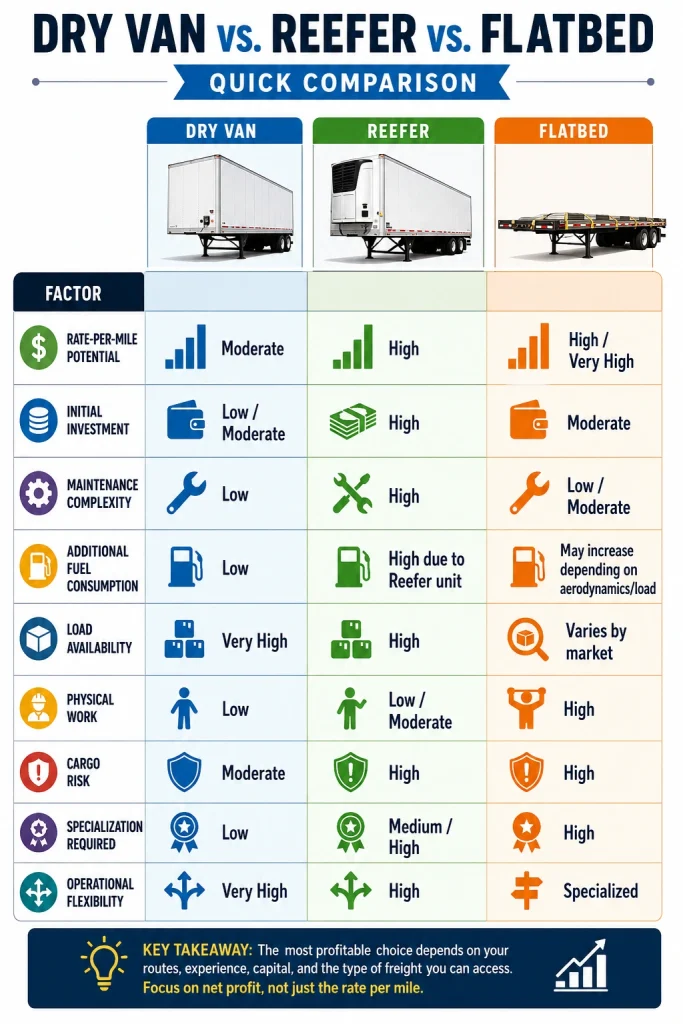
Dry Van vs. Reefer vs. Flatbed: Quick Comparison
So, Which Trailer Makes the Most Money?
There is no universal answer.
Flatbed can offer some of the highest margin potential per mile when the operator has experience, controls costs, and works in markets with strong industrial or construction demand.
Reefer can generate high gross revenue and provide access to essential freight throughout much of the year, but it requires a larger investment and adds fuel, maintenance, and temperature-control risks.
Dry Van may offer lower rates, but it compensates with lower costs, operational simplicity, and an extremely broad freight market, which can be especially valuable for operators seeking predictability.
Before buying a trailer, it makes sense to ask several questions: What freight is most common on the routes where the truck will operate? How much deadhead will be required? How much capital is available for maintenance? How much will the operation cost to insure? Does the driver have experience with specialized freight? How many productive hours can the equipment realistically generate?
Insurance Is Also Part of Profitability
There is another cost that should not be viewed simply as an obligation: commercial insurance.
The type of trailer—and especially the freight being transported—can change the operation’s risk exposure.
A Reefer may face losses involving temperature-sensitive products. A Flatbed introduces risks associated with oversized, heavy, or secured cargo. A Dry Van can also carry high-value goods vulnerable to theft or damage.
Before moving into a new segment or beginning to transport different types of freight, it is important to review whether the existing coverage actually matches the operation.
Saving money on a policy that leaves a significant exposure uncovered can quickly turn a profitable load into a major loss.
Which Trailer Is Best for Beginners?
For many operators entering the industry, Dry Van represents the least complex option, particularly when the goal is to learn how to control costs, negotiate loads, and understand different freight markets without immediately adding the operational risks associated with a specialized segment.
Reefer can be attractive for operators with more capital who are prepared to accept higher maintenance costs in exchange for access to freight that often commands a premium.
Flatbed, meanwhile, can be particularly profitable for drivers with experience in cargo securement who are willing to perform the additional work required by the segment.
But the ultimate question should not simply be:
“Which trailer pays the most per mile?”
The better question is:
“Which one allows me to generate the highest net profit for every mile and every hour my truck is working?”
That distinction matters.
Because in trucking, higher revenue does not always mean higher profit. Controlling fuel costs, maintenance, empty miles, detention time, risk, and insurance can matter far more to annual profitability than simply chasing the highest rate.
 Business hours: Monday to Friday from 8:00 AM to 5:00 PM. California time