 Hable con un agente al (888) 572-7520
  Enviar mensaje a un agente

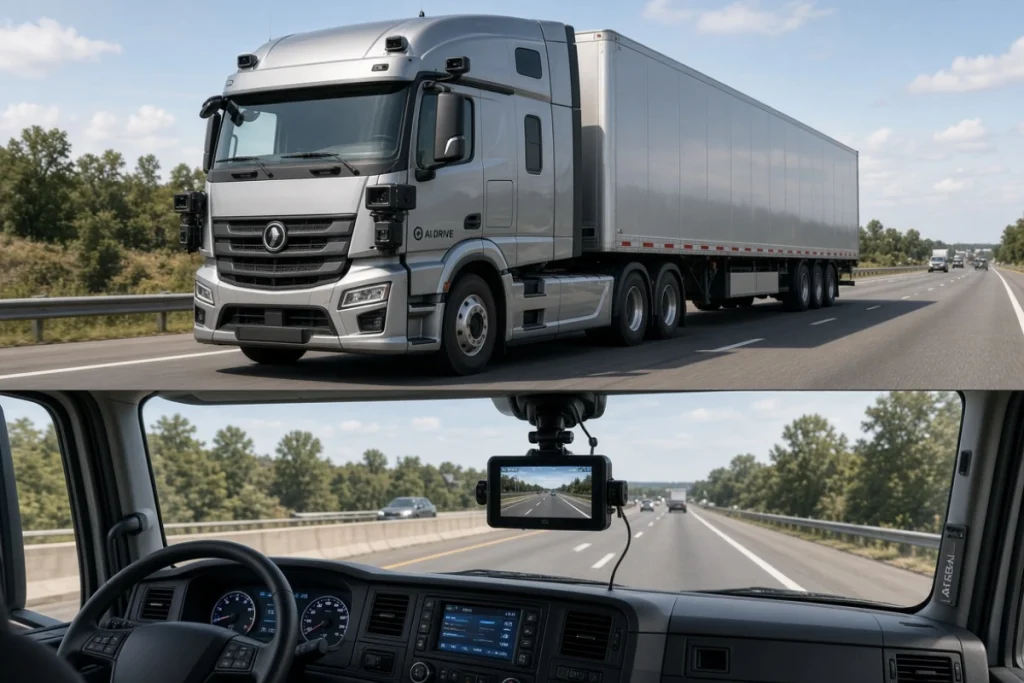

AI-powered dashcams no longer just record — they analyze driver behavior and surrounding conditions in real time to prevent crashes before they happen. According to studies backed by the Federal Motor Carrier Safety Administration (FMCSA), these systems can help avoid thousands of injury crashes and cut miles driven at excessive speed by trucks by as much as 42%.
The financial impact is just as concrete: commercial insurers offer discounts ranging from 5% to 20% on premiums — and up to 30% when combined with telematics — for fleets that install AI cameras, while in Washington the Office of the Insurance Commissioner (OIC) recognizes safety devices as one of the factors insurers weigh when pricing a commercial policy.
What Sets an AI Dashcam Apart From a Regular Camera
A traditional dashcam records continuous video and mainly serves as evidence after a crash. An AI-powered dashcam, by contrast, processes that footage in real time: it detects distracted driving, fatigue, following too closely, lane departure, and collision risk, then alerts the driver before an incident occurs. According to industry-specific guides for 2026, the most advanced systems run more than 30 neural network models simultaneously to process that information in real time.
That shift — from passive recording to proactive intervention — explains why adoption of these cameras has grown so quickly among trucking fleets nationwide, including those operating in Washington.
What Official Studies Say About Crash Reduction
The FMCSA estimates that human error is behind 87% of truck crashes, which in practice means the vast majority of these incidents are preventable with the right tools. Along the same lines, the federal agency calculates that the average cost of an injury crash is $148,279, and a fatal crash involving a large commercial vehicle can reach $3.6 million.
Research backed by the FMCSA and the Virginia Tech Transportation Institute concluded that installing video-based safety monitoring systems on trucks and buses could prevent thousands of fatal crashes and save hundreds of lives per year. A field study published by NHTSA (the National Highway Traffic Safety Administration) on crash avoidance systems for heavy vehicles — which include cameras and automatic emergency braking — drew on a record of more than 3,900 deaths and 95,000 injuries in large truck crashes during 2013 to make the case for this kind of technology.
On the operational side, the FMCSA documented that trucks equipped with video safety systems cut miles driven above 65 mph by 42% — a direct indicator of more cautious driving. Independent industry studies, drawing on data from fleets that have already adopted dual-facing AI cameras, report crash-rate drops of 37% within six months of use and up to 73% at thirty months, with sustained improvement across three key categories: harsh driving events, speeding, and phone use behind the wheel.
The Other Benefit: Protecting Drivers From Unfair Claims
The FMCSA estimates that 80% of truck accidents are caused by other vehicles, not the truck itself. In that context, AI dashcam footage doesn’t just prevent crashes — it also helps exonerate a driver when fault lies with the other vehicle. The FMCSA runs a formal channel for exactly this purpose: the Crash Preventability Determination Program (CPDP), which allows carriers to submit video evidence to dispute fault assigned in certain types of crashes.
According to reports specializing in fleet management, a single exonerated claim thanks to video footage can save a company between $5,000 and $25,000 — an amount that in many cases covers months of camera subscription costs.
How This Affects Insurance Costs in Washington
In Washington, any change to auto insurance rates — including commercial policies — must be filed with and reviewed by the Office of the Insurance Commissioner (OIC) before an insurer can implement it. Within that regulatory framework, installing safety devices such as onboard cameras and GPS tracking systems is recognized as one of the factors insurers consider when reducing claim frequency and, as a result, adjusting the price of a commercial policy.
At the market level, how these discounts are structured varies by insurer and is often paired with telematics systems:
- Discounts for installing AI dashcams typically fall between 5% and 20% of the commercial premium, according to data compiled by industry-specific guides for 2026.
- When video is combined with telematics data (speed, braking, location), some fleet operators report cutting their annual insurance costs by as much as 30%.
- GEICO announced a formal partnership with Motive in November 2025 — one of the leading AI dashcam providers for trucking — to offer new commercial policyholders a discount of up to 10% for sharing camera and ELD (electronic logging device) data through its DriveEasy Pro program.
What Insurers Now Require to Unlock These Discounts
According to industry specialists cited by trucking publications, by 2026 insurers stopped settling for the mere presence of a camera. They now ask for active proof that the data is being used to genuinely reduce risk: a declining frequency of risk events, documented driver-coaching programs, and exoneration statistics. Fleets that can show that full track record — not just the camera itself — are the ones landing the highest discounts, up to 20%, at policy renewal.
Frequently Asked Questions
How much can I save on truck insurance by installing an AI dashcam? Discounts vary by insurer, but typically fall between 5% and 20% of the commercial premium, and can reach 30% when combined with telematics data.
Does the Washington Office of the Insurance Commissioner regulate these discounts? The OIC doesn’t set a specific discount, but it requires every rate or rate change from insurers to be filed and reviewed before it can be applied, and it recognizes safety devices — such as cameras and GPS — as one of the factors insurers use to adjust a policy’s price.
What percentage of truck crashes can be prevented, according to the FMCSA? The FMCSA estimates that human error is behind 87% of truck crashes, meaning the vast majority are technically preventable with the right tools, including AI dashcams.
Does a dashcam only help lower insurance costs, or does it also protect the driver? Both. Beyond the potential premium discount, the FMCSA estimates that 80% of truck crashes are caused by other vehicles, and footage can be used to exonerate the driver through formal channels like the Crash Preventability Determination Program.
 Business hours: Monday to Friday from 8:00 AM to 5:00 PM. California time