 Hable con un agente al (888) 572-7520
  Enviar mensaje a un agente

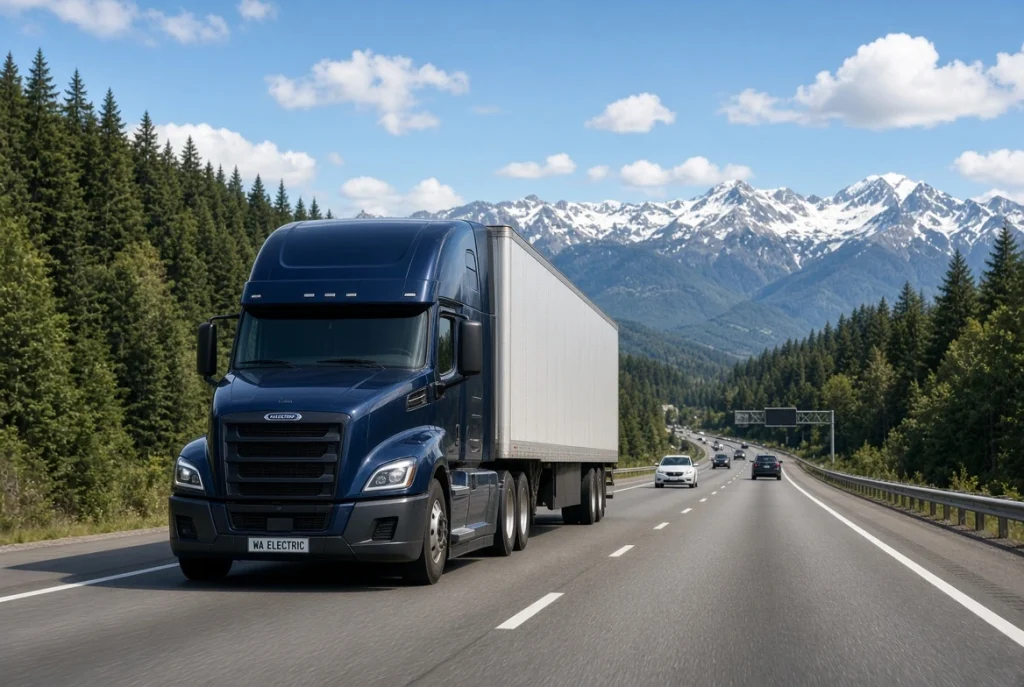

Electric trucks are growing fast on the U.S. West Coast, with California, Washington, and Wisconsin leading national adoption of zero-emission heavy-duty vehicles, according to CALSTART’s June 2026 report. Nationally, zero-emission truck deployments rose from 1.32% to 4.14% of all new truck deployments between the first and second half of 2025. That growth is advancing alongside a 2,500-mile electric and hydrogen freight corridor connecting California, Oregon, and Washington — even as Washington keeps enforcement of its Advanced Clean Trucks (ACT) rule paused through June 2026, amid an ongoing federal legal dispute.
The National Picture: The West Coast Sets the Pace
According to CALSTART’s “Zeroing in on ZETs” report, published in June 2026, zero-emission trucks (ZETs) accounted for 4.14% of all new truck deployments in the United States between July and December 2025, up from just 1.32% in the first half of that same year. California, Washington, and Wisconsin lead national adoption, while Illinois, Michigan, and Washington each surpassed 2,000 cumulative units deployed.
The report also identifies a clear pattern by vehicle type: cargo vans are leading the growth, with 12,158 new deployments in the second half of 2025 — more than double the first half. Medium-duty trucks, meanwhile, are outpacing heavy-duty ones: according to CALSTART, that growth reflects rising fleet confidence in local distribution, municipal services, and regional out-and-back routes, where electric trucks are already better able to meet range, payload, and reliability requirements.
California: The Market Setting the Trend
California remains by far the leading market on the West Coast. According to official figures cited by FreightWaves, one out of six new medium- and heavy-duty trucks sold in California in 2023 was already a zero-emission vehicle, exceeding the state’s target two years ahead of schedule. Daimler, according to an analysis by consulting firm Zeti, holds more than 40% of the U.S. heavy-duty zero-emission truck market, while Tesla began high-volume production of its Semi at Gigafactory Nevada in April 2026.
The California market also landed one of the largest heavy-duty electric truck orders recorded in the state to date in 2026: Big F Transport ordered 40 units and NICA Container ordered 20 more, which will operate out of a new Forum Mobility charging depot in Rancho Dominguez, featuring 14 megawatt-class chargers and capacity for more than 200 zero-emission trucks.
Washington: Between Record Investment and a Regulatory Pause
Washington ranks second nationally in zero-emission truck adoption, according to CALSTART, and in 2026 the state allocated roughly $160 million — drawn from the Climate Commitment Act and the federal Volkswagen settlement — to help companies and drivers purchase electric trucks and charging infrastructure. According to the Washington State Department of Ecology, that’s the second-largest investment of its kind in the country, part of ZEVergreen, a new statewide initiative led by Governor Bob Ferguson.
However, enforcement of the rule requiring manufacturers to sell a growing share of zero-emission trucks — known as Advanced Clean Trucks (ACT) — is going through a period of uncertainty. After U.S. Congressional resolutions in June 2025 revoked the federal waivers underpinning this California-derived rule, Ecology extended its enforcement pause on ACT, Advanced Clean Cars II, and the Heavy-Duty Low NOx Omnibus rule through June 2026, while the legal dispute makes its way through the courts. The Washington Trucking Associations (WTA) is actively pushing for that pause to be extended, citing the lack of charging infrastructure for heavy-duty electric trucks in the state.
The Electric Corridor That Will Connect the Entire West Coast
One of the region’s most ambitious infrastructure projects is the West Coast Truck Charging and Fueling Corridor Project, managed by the California Department of Transportation (Caltrans), which will deploy electric charging and hydrogen fueling stations along 2,500 miles of freight corridors across California, Oregon, and Washington. The project aims to connect major ports, freight hubs, and agricultural regions between the U.S. borders with Mexico and Canada, with construction of the first stations expected to begin in 2026.
Adding to that, the Washington State Department of Ecology confirmed an additional $26.3 million in federal, state, and private funding earmarked for building an electric charging and hydrogen refueling corridor for commercial vehicles spanning the entire West Coast.
What Kind of Electric Trucks Are Already on the Road in the Region
According to CALSTART, nearly all medium- and heavy-duty zero-emission trucks deployed in the U.S. so far are battery-electric, though hydrogen fuel cell technology is also advancing, on a smaller scale: as of June 2025, 197 hydrogen fuel cell heavy-duty trucks had been deployed nationwide, 42 of them added in the first half of that year alone.
On the operational side, companies in the region are already showing concrete adoption cases. Hight Logistics, a California-based drayage company, showcased a new Tesla Semi in 2026 at the TPM logistics conference, using it to haul a customer’s container directly to the event. The company currently operates 25 electric trucks, mostly Volvo VNR Electric models, and plans to add more Tesla Semi units to its fleet.
Why This Matters for Washington and the Pacific Northwest
Transportation is Washington’s largest source of carbon pollution, and heavy-duty vehicles like semi-trucks are the biggest contributor to diesel emissions — one of the most harmful forms of air pollution, linked to health issues ranging from asthma to cancer, according to the state’s own Department of Ecology.
At the same time, Washington’s freight sector faces a real tension between the pace of regulation and the availability of infrastructure: the WTA argues that charging infrastructure for heavy-duty electric trucks is virtually nonexistent in the state, while delayed implementation of similar rules in Oregon further limits charging options for truckers traveling the I-5 corridor through the Pacific Northwest.
Frequently Asked Questions
Which states lead electric truck adoption in the United States? According to CALSTART’s June 2026 report, California, Washington, and Wisconsin lead the nation in zero-emission truck adoption.
Is Washington currently enforcing the Advanced Clean Trucks rule? Not fully. The Washington State Department of Ecology extended its enforcement pause on the rule through June 2026, while a federal legal dispute continues over the waivers that allowed states to adopt California’s standards.
What is the West Coast Truck Charging and Fueling Corridor Project? It’s a project managed by the California Department of Transportation that will deploy electric charging and hydrogen fueling stations along 2,500 miles of freight corridors in California, Oregon, and Washington, with construction expected to start in 2026.
Are electric trucks already used for long-haul routes, or only for urban delivery? For now, adoption is highest in local distribution, municipal services, and regional out-and-back routes, though industry analysis shows the technology is gradually advancing into regional and long-haul freight applications.
 Business hours: Monday to Friday from 8:00 AM to 5:00 PM. California time