 Hable con un agente al (888) 572-7520
  Enviar mensaje a un agente



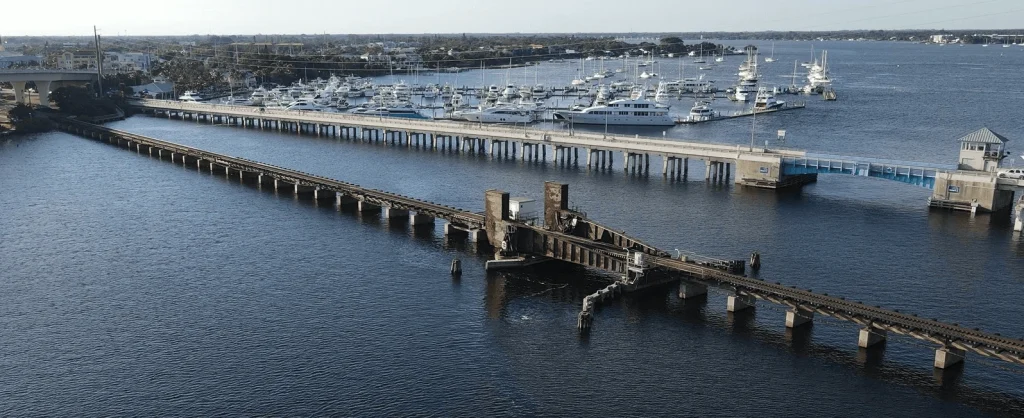
Florida is preparing to replace a piece of infrastructure that has stood for nearly a century. The historic St. Lucie River Railroad Bridge in Stuart will be replaced with a modern structure designed to eliminate one of the major transportation bottlenecks along the state’s East Coast corridor.
The project received an additional $78.9 million in federal funding this week, adding to the $130.5 million awarded in 2023. The total estimated cost of the project now stands at approximately $262 million.
The existing bridge carries both Brightline passenger trains and freight services operated by Florida East Coast Railway (FEC), a critical freight network serving Florida’s East Coast.
The bridge’s age, dimensions, and single-track configuration currently limit capacity along the corridor. The replacement is designed to address those constraints and allow passenger and freight traffic to move more efficiently.
What Will the New Stuart Bridge Look Like?
One of the most significant upgrades will be the addition of double tracks, eliminating the single-track section that currently creates a bottleneck for rail traffic.
This will increase capacity along the corridor and improve the flow of freight trains that play an important role in Florida’s supply chain.
The project will also bring major improvements for vessels traveling along the Okeechobee Waterway, which connects Florida’s East and West coasts.
The horizontal navigation clearance will increase from approximately 50 feet to 90 feet, while the vertical clearance with the bridge closed will rise from 6.5 feet to approximately 17.75 feet above mean high water.
With the increased clearance, it is estimated that more than 90% of vessels will be able to pass underneath the bridge without requiring it to open.
That could significantly reduce interruptions caused by the need to coordinate train movements with marine traffic.
What Does It Mean for Freight and Trucking?
Although the project involves a railroad bridge, its modernization could also bring benefits to trucking and freight movement throughout the region.
Florida East Coast Railway moves freight along a corridor connecting major logistics hubs and ports across the state. Eliminating a single-track section will increase rail capacity and reduce delays in a transportation system where trains and trucks operate as interconnected parts of the same supply chain.
More efficient rail operations can help improve the movement of goods between ports, terminals, warehouses, and distribution centers, where trucks handle much of the first- and last-mile transportation.
The project is also expected to reduce the likelihood of trains remaining stopped for extended periods while waiting to cross the river. That could help reduce blocked railroad crossings on streets in Stuart, which can disrupt road traffic and cause delays for trucks and other commercial vehicles.
For drivers, fewer and shorter blocked crossings can mean less time waiting or searching for alternate routes, particularly in an area where rail, marine, and highway traffic converge along important transportation corridors.
An Upgrade for Florida’s Supply Chain
The existing bridge was built nearly 100 years ago, when freight volumes and transportation demands were dramatically different from those of today.
It is now part of a complex transportation system where freight rail, trucking, passenger rail, and marine traffic all intersect.
For that reason, the project goes beyond simply replacing an aging structure. Double tracks will provide additional rail capacity, while greater vertical and horizontal clearance for vessels will reduce the need to interrupt rail traffic.
For the logistics industry, infrastructure with fewer interruptions can provide greater reliability and predictability for freight movement, especially when multiple transportation modes depend on one another to move goods from ports and terminals to their final destinations.
A $262 Million Investment
The project had already received federal funding in 2023, when $130.5 million was awarded to support the bridge replacement. At the time, the project was estimated to cost approximately $218 million.
As plans advanced, the estimated investment increased to around $262 million, leaving a funding gap of nearly $78 million.
The latest federal allocation of $78.9 million will cover virtually that entire gap and help move forward a project aimed at modernizing a strategic piece of Florida’s transportation infrastructure.
The new bridge will allow freight trains, trucks, and vessels to operate within a transportation network with fewer disruptions and greater capacity, strengthening the infrastructure that supports freight movement in one of the nation’s busiest logistics states.
 Business hours: Monday to Friday from 8:00 AM to 5:00 PM. California time