 Hable con un agente al (888) 572-7520
  Enviar mensaje a un agente

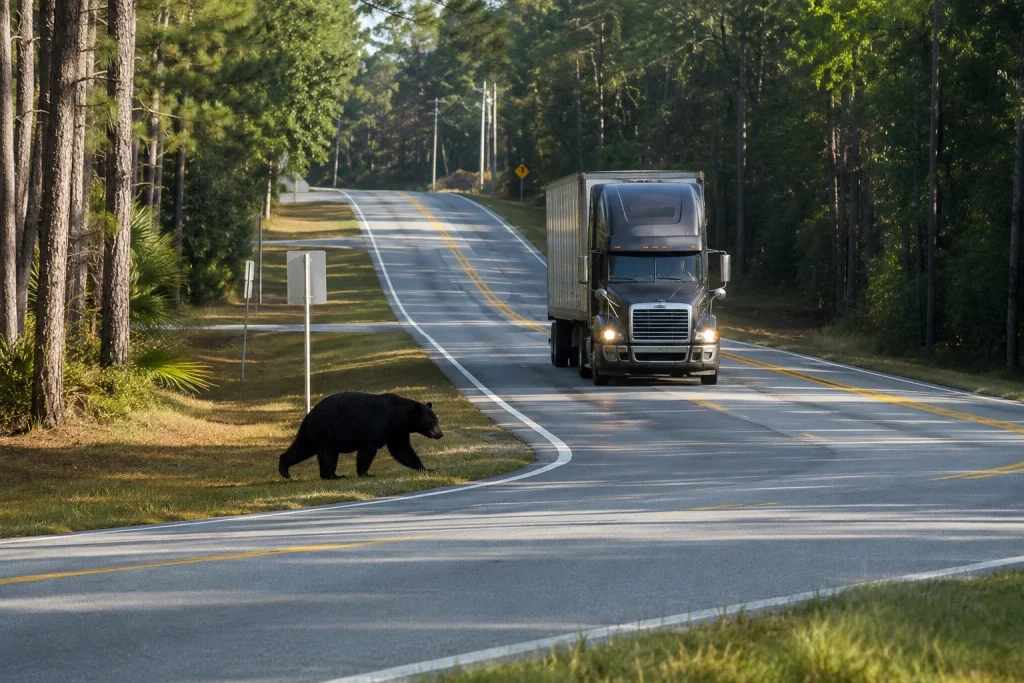

Florida will once again allow black bear hunting this year and will increase the number of available permits. The decision is bringing renewed attention to an issue that also affects those who spend much of their day on the state’s highways: Florida is home to thousands of bears, and encounters involving bears, vehicles and people are becoming increasingly visible.
The 2026 hunting season will run from December 5 through December 27 across four Bear Harvest Zones. The Florida Fish and Wildlife Conservation Commission (FWC) will accept permit applications from September 11 through September 21.
Up to 215 permits will be available this year, compared with 172 in 2025. Of those, 193 will be distributed through a lottery, while another 22 will be reserved for the program covering large private properties.
Last year’s season was Florida’s first regulated bear hunt since 2015. During the 23-day December season, 52 bears were harvested.
But behind the debate over how many bears should be hunted is another issue that is much more immediate for anyone driving through Florida: bears need to move through a landscape increasingly crossed by highways, roads, cities and development.
And that can put them directly in the path of truckers.
About 300 Bears Die on Florida Roads Every Year
Florida has an estimated population of approximately 4,050 black bears, ranging from the Panhandle to South Florida.
That number helps explain why encounters on the road are no longer unusual.
The FWC estimates that about 300 bears are killed by vehicles in Florida every year. Vehicle collisions account for approximately 90% of known bear deaths in the state.
The agency also warns that hitting a bear can cause more vehicle damage than hitting a deer and may result in serious injuries to drivers and passengers.
Crashes can happen on many roads, although there is a particularly significant concentration around the Ocala National Forest.
The combination is difficult: expanding development, heavier traffic, higher speeds and fragmented forests force bears to cross roads as they move through their habitat.
For a trucker, the danger is not limited to hitting the animal.
Seeing a bear suddenly appear on the pavement can trigger an instinctive attempt to swerve. In a tractor-trailer, however, a sudden maneuver can create an even greater danger: loss of control, leaving the roadway, a rollover or a collision with another vehicle.
When Is a Trucker Most Likely to Encounter a Bear?
Black bears can be active throughout the year in Florida, but there are periods when they move around more frequently.
Spring and early summer generally bring increased activity following the slower winter period. Young bears also begin leaving the areas where they lived with their mothers and may show up in unexpected places.
The FWC has warned that sightings during this period can occur even in suburban and urban areas around Jacksonville, Orlando and Tampa.
Time of day also matters.
Bears are especially active around dawn and dusk, and the FWC says this is also when many vehicle collisions occur.
Drivers should reduce their speed on rural roads, in wooded areas, in poorly lit locations and wherever bear-crossing signs are posted.
The Risk Doesn’t End When the Truck Is Parked
For a truck driver, an encounter with a bear does not necessarily happen while driving.
A parked truck can contain exactly what a bear is looking for: food and food-related smells.
Bears have an extraordinary sense of smell and may be attracted not only to food itself, but also to garbage, wrappers, food scraps and other strongly scented items.
This is particularly important for drivers who sleep in their trucks or stop for several hours near natural areas, campgrounds or places with known bear activity.
The FWC’s recommendation is straightforward: a vehicle should never become a food source for a bear.
Before spending the night, drivers should remove food scraps and wrappers, keep food securely stored and avoid leaving coolers or other food containers visible from outside the truck.
The FWC also recommends keeping doors and windows closed and secured overnight when staying in recreational vehicles or cabins in bear country.
What Should You Do if a Bear Approaches Your Truck Looking for Food?
The first rule is simple: do not feed it.
It might seem like an easy way to make the animal leave, but feeding a bear can create exactly the opposite problem.
Once a bear gets food from a person, it may begin associating people and vehicles with food and gradually lose its natural fear of humans.
In Florida, intentionally feeding bears or leaving food or garbage in a way that attracts bears and creates conflicts is also illegal.
If a driver is inside the cab and a bear approaches the vehicle, the safest option is to remain protected inside and make sure the animal has a clear path to leave.
The FWC recognizes non-contact deterrents such as making noise, honking the horn or using an air horn, as long as the person remains in a safe location and the bear has a clear escape route.
But there is one critical point: scaring the bear away will not solve the problem if it still has access to food.
If the bear found garbage, food or another attractant, it has a reason to return.
Once the animal leaves, the priority should be identifying what attracted it and securing or removing that source.
What if You’re Outside the Truck When a Bear Appears?
The situation changes completely if the driver is already outside the vehicle.
The FWC recommends not running.
A black bear can reach speeds of approximately 35 mph, and running may trigger its instinct to chase.
Trying to climb a tree is not a solution either. Black bears are excellent climbers.
If the encounter happens at close range, the driver should remain standing, speak in a calm but firm voice and slowly back away toward the truck or another safe location, while always leaving the bear a clear escape route.
Do not make sudden movements or approach the bear to take pictures.
Some bear behaviors may look threatening without necessarily meaning that an attack is coming. A bear may huff, paw at the ground, snap its teeth or even make a bluff charge—running toward a person before stopping short.
These are signs that the bear needs more space.
Black bear attacks are rare in Florida, but they can happen. The FWC has documented cases involving bites or scratches, particularly when a bear was defending its cubs, a food source or itself.
If a black bear actually attacks, the official recommendation differs from the advice many people have heard about other bear species: do not play dead. Fight back aggressively.
What if You Hit a Bear With Your Truck?
Do not immediately approach the animal.
Even a bear that appears dead or unconscious may be injured and could react defensively.
The FWC recommends keeping your distance and reporting a dead or injured bear, or one blocking a roadway, through the Wildlife Alert Hotline: 888-404-FWCC (3922). Cellphone users can also dial *FWC or #FWC.
When making a report, it is helpful to provide the exact location, whether the bear is alive, whether it is blocking the roadway and its approximate size.
And, of course, after any collision, the driver’s first priority should be maintaining control of the truck and pulling over only when it is safe to do so.
Do Bears Really Approach People?
Yes, although that does not mean they are usually looking to attack.
Black bears generally try to avoid humans. Problems begin when they discover an easy source of food near people.
Garbage, pet food, grill scraps, coolers and other food waste can encourage a bear to remain near people or repeatedly return to the same location.
The FWC sums it up simply: if a bear cannot find food, it will generally move on.
That is why a bear simply walking through an urban area does not necessarily constitute an emergency.
The situation changes when a bear deliberately approaches people, threatens their safety, causes property damage or loses its natural tendency to avoid humans.
Florida Will Issue More Bear Hunting Permits in 2026
Growing contact between people and bears is part of the debate surrounding Florida’s second consecutive hunting season.
Florida will make up to 215 permits available this year, 43 more than the 172 offered in 2025.
The season will run from December 5 through December 27, 2026, across four designated zones.
Last year also brought an unusual development: tens of thousands of people entered the process for the limited number of permits after groups opposed to the hunt encouraged supporters to apply with the intention of obtaining permits and not using them.
This year, some permits will be reserved for large private properties that meet specific requirements involving acreage, habitat, documented bear presence and management plans.
The debate continues to divide two sides.
Supporters of the hunt argue that it is a tool for managing a recovered bear population and increasing encounters with people. Opponents argue that killing bears will not necessarily reduce those conflicts and are calling for greater use of nonlethal measures.
The debate also has a long history. The Florida black bear was listed as a state-threatened species from 1974 until 2012, when authorities removed it from the list after determining that the population had recovered.
For Truckers, the Rule Is Simple: Secure Your Food and Watch the Road
The debate over hunting will continue, but for anyone driving a commercial truck through Florida, there is a much more immediate concern.
There are approximately 4,050 black bears in the state, about 300 are killed by vehicles every year, and bears regularly cross roads while searching for food, mates or new territory.
Drivers should be especially alert around dawn and dusk, particularly on rural and wooded roads and in areas known for bear activity.
And when it is time to park, prevention continues.
Do not leave food scraps around the truck, keep garbage and food secured, avoid leaving coolers visible and never feed a bear. These simple precautions can prevent a routine sighting from becoming a dangerous encounter.
If a bear appears, keep your distance. If it approaches while you are safely inside the truck, the horn may help scare it away as long as it has a clear escape route. If you are outside, do not run—slowly back away toward a safe place.
And if a bear ends up under the wheels of your truck, do not approach it to check its condition.
In Florida, sharing the road with wildlife is part of the job. For a trucker, knowing what to do before encountering a bear can be just as important as spotting one in time. And even more important is having the right insurance coverage and 24/7 support.
 Business hours: Monday to Friday from 8:00 AM to 5:00 PM. California time