 Hable con un agente al (888) 572-7520
  Enviar mensaje a un agente

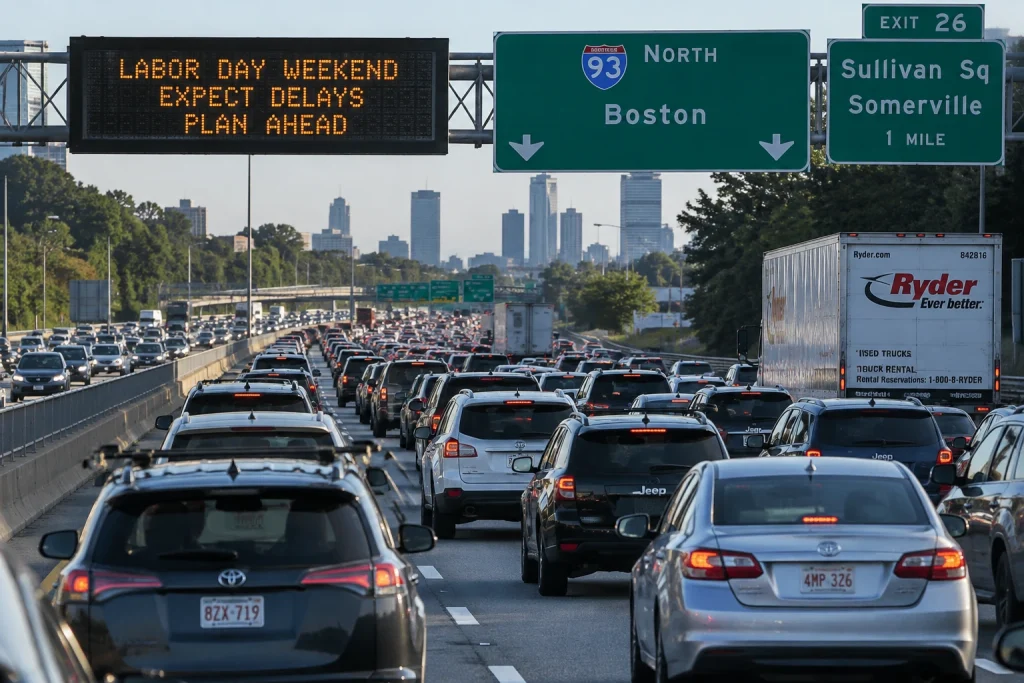

The United States has entered one of the busiest travel weekends of September. Labor Day falls on Monday, September 7, but travel began Thursday, and Friday, September 4, is expected to be one of the most difficult days to navigate the country’s major highways.
The scale of the travel surge can also be seen at airports. The Transportation Security Administration (TSA) expects to screen more than 17 million passengers between Thursday, September 3, and Wednesday, September 9. About 2.8 million passengers are expected to pass through airport checkpoints on Friday alone.
On the roads, meanwhile, holiday traffic is already overlapping with commuters and the normal commercial traffic of a typical Friday.
INRIX, a company specializing in mobility analytics, warns that Labor Day creates a particular traffic pattern: millions of people try to leave major cities within a relatively short window. Many began their trips after work Thursday, while others will hit the road throughout Friday.
For the trucking industry, that means continuing to operate on highways carrying far more passenger vehicles than usual.
Seattle, Boston, New York, Los Angeles and Florida: Where to Watch
The heaviest congestion will not be evenly distributed across the country.
INRIX identifies several corridors that have historically experienced major Labor Day delays, particularly routes connecting Seattle, Boston, New York, Los Angeles, Tampa and Orlando.
In Washington, one of the areas to watch is I-90 into Seattle. During the most recent Labor Day return period analyzed by INRIX, trips along that corridor took approximately twice as long as usual.
A similar situation occurred between Boston and Manchester on I-93, another corridor where travel times doubled.
In New York, recreational travel toward The Hamptons via the Long Island Expressway creates one of the holiday’s major traffic bottlenecks.
In California, INRIX recommends paying particular attention to the Los Angeles-to-Palm Springs corridor on I-10, while in Florida, the Tampa-Orlando connection on I-4 is once again among the routes to watch.
That does not mean those exact delays will occur again this year. These are corridors identified by INRIX based on traffic patterns observed during the previous Labor Day period and considered particularly vulnerable to the concentrated travel expected this weekend.
Timing Matters This Friday
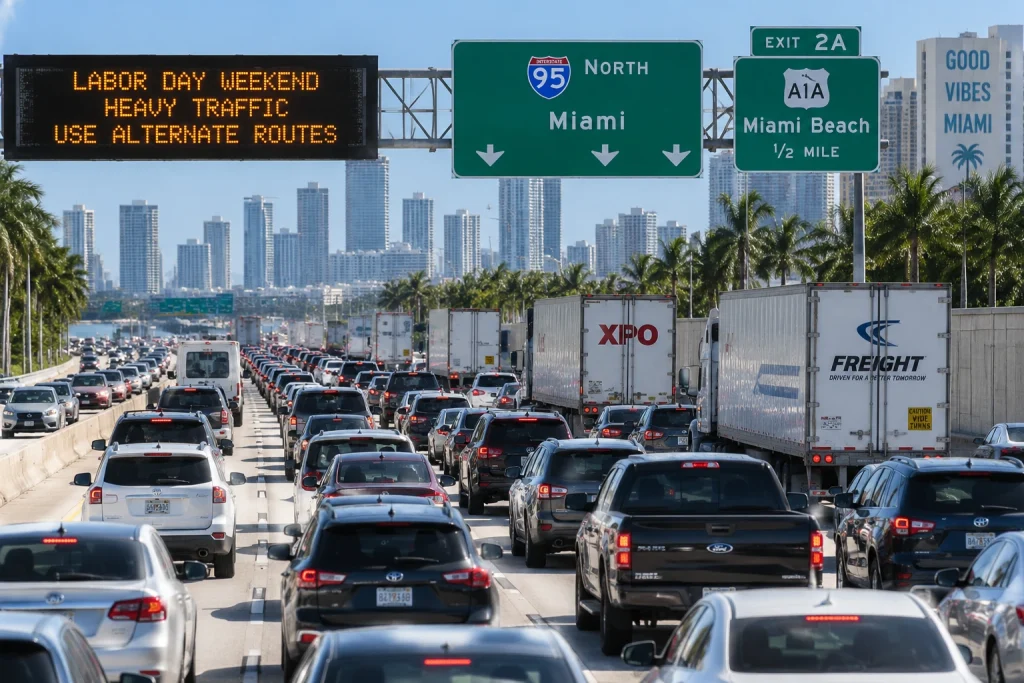
Friday, September 4, will be particularly challenging because two different traffic flows will overlap: people still commuting to and from work and travelers beginning their Labor Day trips.
For that reason, morning travel is recommended. Traffic is expected to begin building around midday and remain heavy through the early evening.
Holiday travel estimates place the most difficult period on Friday between noon and 8 p.m. On Thursday, the first major travel surge occurred between 2 p.m. and 7 p.m.
The pattern will change Saturday. Travel toward beaches, parks and recreational destinations is expected to increase mainly from late morning through the afternoon.
Sunday should be the easiest day to drive, although congestion may still develop around tourist destinations and major events.
Return traffic will begin Monday. INRIX recommends returning before late morning or waiting until the evening, as the afternoon is expected to be the most difficult period for travelers heading back into major cities.
Labor Day traffic begins to pick up
Seattle and Orlando Among the Most Popular Destinations
AAA booking data provides another indication of where some of that traffic is heading.
Seattle is the most-booked domestic destination for Labor Day 2026, followed by Orlando, Boston, Denver and New York.
Chicago ranks sixth, followed by Anaheim-Los Angeles, Las Vegas, Anchorage and Atlanta.
Friday is also expected to be the busiest day for rental-car pickups during the holiday period, according to Hertz forecasts included in Labor Day travel reports.
That means thousands of additional vehicles will be joining regular traffic, many driven by travelers navigating cities and highways they do not use every day.
For professional drivers, the impact is different from that experienced by tourists: an extra hour stuck in metropolitan traffic can affect a delivery window, the next pickup and the schedule for the entire day.
Traveling This Labor Day Will Also Cost More
Congestion is not the only change compared with last year.
AAA reported that domestic flights, hotels and fuel will be more expensive than during Labor Day 2025, although international airfare and cruises departing from U.S. ports are cheaper.
The average domestic round-trip flight costs around $750, up 2% from last year.
For the 10 most popular domestic destinations, the average is close to $800, approximately 20% higher than in 2025. U.S. hotel rates are up an average of 9%.
International flights, by contrast, are approximately 4% cheaper, while cruises departing from U.S. ports are also down about 4%.
On the road, however, another major cost is emerging.
AAA reported Thursday that the national average price for regular gasoline had reached $4.14 per gallon, four cents higher than the previous week.
Last Labor Day, the national average was $3.19.
If current prices hold, this will be the most expensive Labor Day for gasoline ever recorded in the United States. The previous record was $3.82 per gallon, set in 2012.
AAA attributes the increase primarily to high oil prices, which remain around $90 per barrel.
The Federal Government Is Also Preparing for the Travel Surge
The scale of the weekend is also reflected in measures announced by the federal government.
On Thursday, September 3, the U.S. Department of Transportation announced a $481 million investment to improve airport infrastructure and safety across the United States, unveiled ahead of what the agency described as a busy Labor Day travel weekend.
Through the Federal Aviation Administration (FAA), 191 grants will be distributed to airports in 36 states and two territories.
Among the largest investments are $100 million for Hartsfield-Jackson Atlanta International Airport; $32.5 million for Louisville Muhammad Ali International Airport; $30.3 million for San Diego International Airport; $14.2 million for Milwaukee Mitchell International Airport; and $8.7 million for El Paso International Airport.
The funds can be used for terminals, runways, taxiways, baggage systems, ground access and other airport infrastructure and safety improvements.
While Millions Travel, Freight Keeps Moving
Labor Day is a federal holiday, but a significant portion of the U.S. trucking industry will continue operating throughout the weekend.
Food, refrigerated products, fuel, supermarket goods, industrial supplies and other freight will continue moving along the highways while millions of Americans travel for the holiday.
And traffic is not the only issue.
Operating hours at warehouses, distribution centers and receivers may change during the holiday. Some will operate with reduced staffing, while others will remain closed Monday.
Overhaul issued a specific warning for carriers and shippers: before departing with loads scheduled for Friday, September 4, or Monday, September 7, it recommends confirming the receiver’s operating hours directly.
The reason goes beyond avoiding a long wait. A load that cannot be delivered may end up parked for hours or even throughout the entire holiday weekend.
Labor Day Also Increases Cargo Theft Risk
Long holiday weekends are particularly sensitive periods for cargo theft.
Overhaul continues to rate the risk of cargo theft as high during the second half of 2026, with Labor Day among the periods requiring increased attention.
The company recorded 605 incidents during the second quarter. CargoNet, meanwhile, documented 677 thefts linked to supply chains in the United States and Canada during the same period.
The problem is no longer limited to cutting a lock and stealing a trailer.
The FBI warned this year about a sharp increase in strategic cargo theft facilitated by digital tools. Criminals can impersonate legitimate carriers, compromise broker accounts, post fraudulent loads, alter documentation and redirect freight to different destinations.
According to the FBI, estimated cargo theft losses in the United States and Canada reached nearly $725 million in 2025, a 60% increase from the previous year.
During a long holiday weekend, when some facilities operate with fewer employees and certain loads remain stationary for longer periods, that risk becomes particularly important.
A Different Weekend on America’s Highways
For those who continue working, Labor Day changes normal road conditions.
There are more passenger vehicles, more rental cars, more families taking long-distance trips and more drivers traveling on roads they may not know well.
The data shows where extra attention may be needed: Seattle, Boston, New York, Los Angeles, Tampa and Orlando are among the areas connected to some of the corridors most vulnerable to holiday traffic.
Friday will be one of the key travel days. Sunday should provide a somewhat quieter window, while Monday will bring the major return-home traffic surge.
 Business hours: Monday to Friday from 8:00 AM to 5:00 PM. California time