 Hable con un agente al (888) 572-7520
  Enviar mensaje a un agente

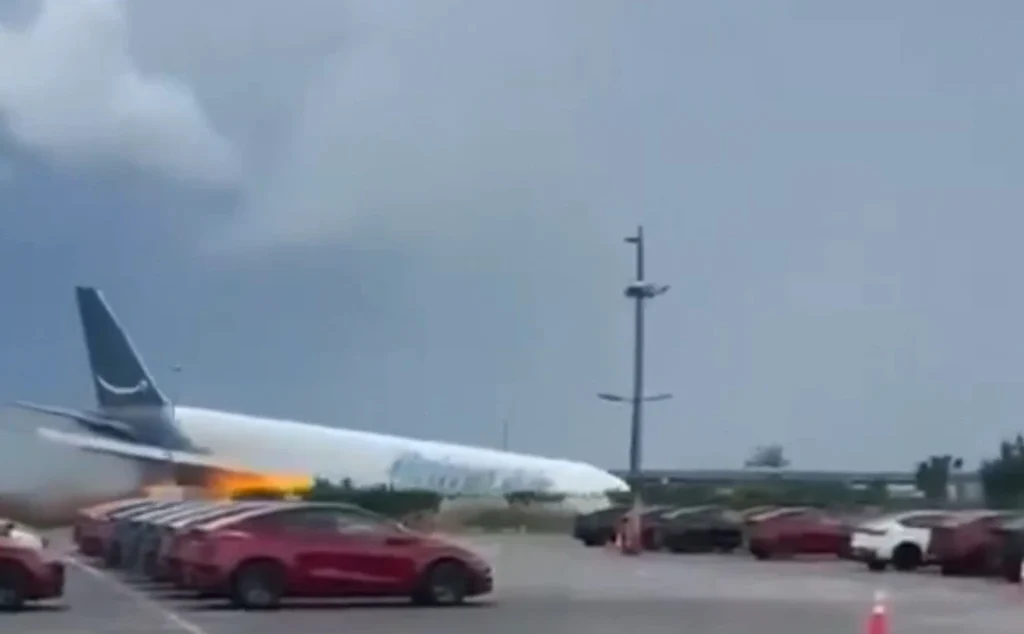

One day after the Boeing 767 cargo plane overran the runway at Miami International Airport (MIA) and reached a nearby road, the central question is no longer what happened, but how an aircraft was able to leave the runway with enough speed to cross the airport perimeter and reach an area used by vehicles.
The National Transportation Safety Board (NTSB) began investigating 21 Air Flight 7598, operated for Amazon Air, and one of the first elements drawing attention is how fast the aircraft was still traveling as it reached the end of the runway.
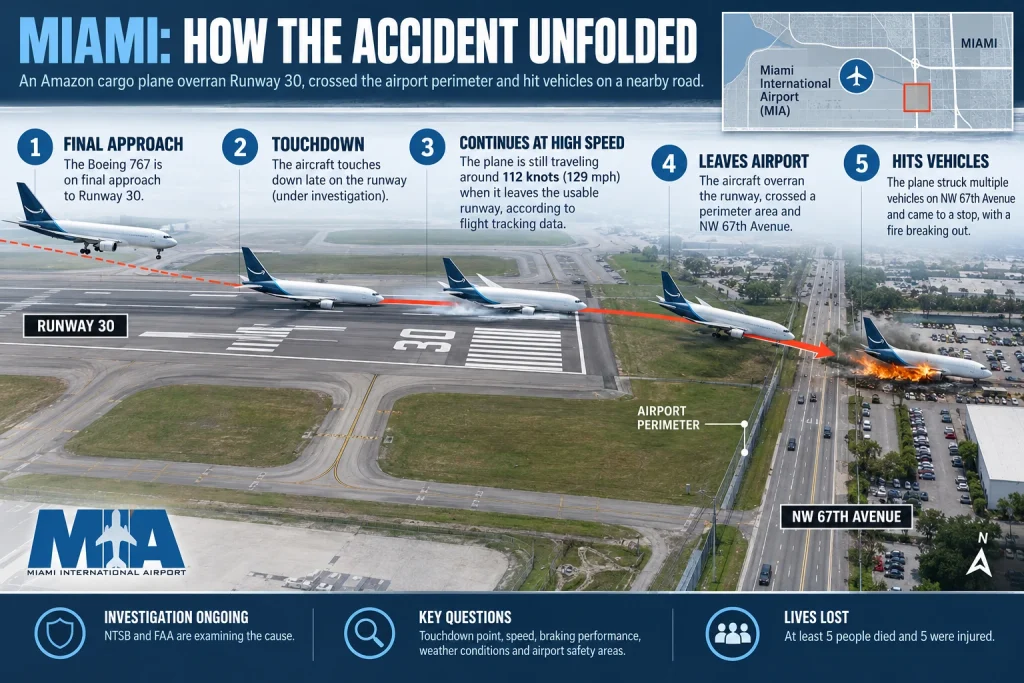
Data from Flightradar24 indicated that the Boeing 767 was traveling at 112 knots—about 129 mph—when it left the usable portion of Runway 30. The last available tracking data still showed it moving at 69 knots.
This was not simply an aircraft that needed a few extra feet to stop. Investigators now have to determine why it reached the end of the runway carrying so much energy.
Did the Plane Touch Down Too Late?
One of the key questions investigators will examine is exactly where the Boeing 767 first touched down.
Images available so far appear to show the cargo aircraft remaining airborne over a considerable portion of the runway before touching down. That alone does not establish the cause of the accident, but it makes the touchdown point a critical part of the investigation.
Steve Arroyo, a retired United Airlines pilot and aviation safety expert interviewed by the Associated Press, explained that an aircraft is normally expected to touch down within the first 3,000 feet of the runway.
“Did the aircraft land within the required touchdown zone?” Arroyo asked.
If it did not, investigators will likely examine why the crew continued the landing rather than executing a go-around—aborting the landing, climbing again and making another approach.
Mary Schiavo, a pilot and former inspector general of the U.S. Department of Transportation, pointed to another detail visible in video footage: the aircraft appears to have “floated” above the runway for an extended period before fully putting its landing gear on the ground.
Every second spent in the air means less runway remains available for braking.
Speed, Wind, Storms and Braking
The touchdown point, however, will be only one piece of the puzzle.
Investigators will also have to reconstruct the aircraft’s approach speed and configuration, as well as the operation of its spoilers, thrust reversers, antiskid system and brakes. Landing weight and runway surface conditions will also be examined.
Weather conditions will be another important factor.
The weather report around the time of the accident showed thunderstorms at the airport, winds of 17 knots with gusts of up to 26 knots and cumulonimbus clouds in the area.
That makes a recent federal safety warning particularly relevant.
The NTSB Had Already Warned About Wet-Runway Risks
On May 26, 2026—just over three months before the Miami accident—the NTSB issued three safety recommendations to the Federal Aviation Administration (FAA) related to runway overruns during heavy rainfall.
The agency called for changes to the Runway Condition Assessment Matrix, or RCAM, because its investigations found that the current method may not adequately account for the progressive loss of tire friction as rainfall intensity increases.
Put simply, a runway that becomes increasingly wet may provide progressively less braking capability than some calculations anticipate.
The NTSB said the existing system “increases the risk of a runway overrun” under certain heavy-rain conditions. Those recommendations followed the agency’s examination of 11 runway overrun events between 2008 and 2022.
There is currently no evidence that this issue caused the Miami accident. But the timing makes runway conditions and actual braking performance important factors for investigators to examine.
What Happens When the Runway Ends?
This is where another major issue emerges—one that matters to people traveling outside an airport as well.
An aircraft that cannot stop should not immediately encounter a road filled with vehicles. Airports have safety areas designed to reduce the consequences of runway excursions.
There is also a specific technology known as an Engineered Materials Arresting System (EMAS).
An EMAS uses crushable material installed beyond the end of a runway. When an aircraft enters the area, its landing gear sinks into the material, creating resistance that helps slow and stop the plane when there is not enough runway remaining.
Miami International did not have this type of system at the end involved in Sunday’s accident, according to the Associated Press. The FAA has installed or certified EMAS systems at more than 120 U.S. airports and credits them with helping save hundreds of lives.
That does not mean an EMAS would necessarily have stopped this Boeing 767, particularly given the speed at which it apparently left the usable runway. Determining that would require technical calculations that are not yet publicly available.
But after an aircraft crossed the airport perimeter and reached a road, the safety protections beyond the end of the runway will inevitably become part of the discussion.
This video shows the exact moment the Amazon Prime Air Boeing 767 freighter overran the end of the runway at Miami International Airport.
— Turbine Traveller (@Turbinetraveler) September 7, 2026
An EMAS (Engineered Materials Arresting System) could potentially have made a significant difference here. The parking lot lies approximately… pic.twitter.com/BqYObps3LH
Could It Happen Again?
Yes. Runway excursions are not unprecedented.
That is precisely why regulations exist governing runway safety areas, landing distances, go-around procedures and aircraft arresting systems. The NTSB continues to study runway overruns because they continue to occur.
The Miami accident also demonstrates that the danger does not necessarily end with passengers and crew members.
When a major airport is surrounded by roads, warehouses, logistics centers and industrial areas, a severe enough runway excursion can put people who are not even inside the airport at risk.
Miami is an especially important example.
MIA is integrated into a massive logistics network, with warehouses, cargo companies and a constant flow of commercial vehicles around its perimeter. Sunday’s Boeing 767 accident occurred precisely at that intersection between aviation and ground transportation.
A Question That Matters to Truckers, Too
For the trucking industry, the accident raises an uncomfortable question: What protects a driver traveling on a road located beyond the end of an airport runway?
Airport safety standards are intended to give an aircraft that overruns a runway space to decelerate before reaching people, buildings or infrastructure outside the airport. But what happened in Miami showed the potential consequences when those layers of protection are unable to contain an aircraft.
The cargo jet was still traveling at approximately 112 knots, or 129 mph, when it left the usable runway, according to Flightradar24. It continued beyond the airport area and reached a road used by workers and businesses nearby.
The NTSB must now reconstruct the landing second by second: where the aircraft touched down, its speed at touchdown, how much runway remained, when braking began, whether the aircraft’s systems operated correctly, how wind and runway conditions affected stopping performance, and what happened once the plane reached the end.
The FAA, meanwhile, faces a broader question: Are existing protections sufficient when the end of a runway is close to roads and major logistics areas?
It is still too early to assign responsibility to the pilots, the aircraft, the weather, airport infrastructure or a combination of factors.
But one fact already stands out from the available data: the Boeing 767 did not reach the end of the usable runway at low speed. It was still moving extraordinarily fast.
The fact that an aircraft traveling at that speed was able to cross the boundary of one of the nation’s busiest airports and reach vehicles on the ground turns the Miami investigation into more than a search for the cause of a single accident.
It also raises a much larger question: What needs to change to prevent it from happening again?
 Business hours: Monday to Friday from 8:00 AM to 5:00 PM. California time