
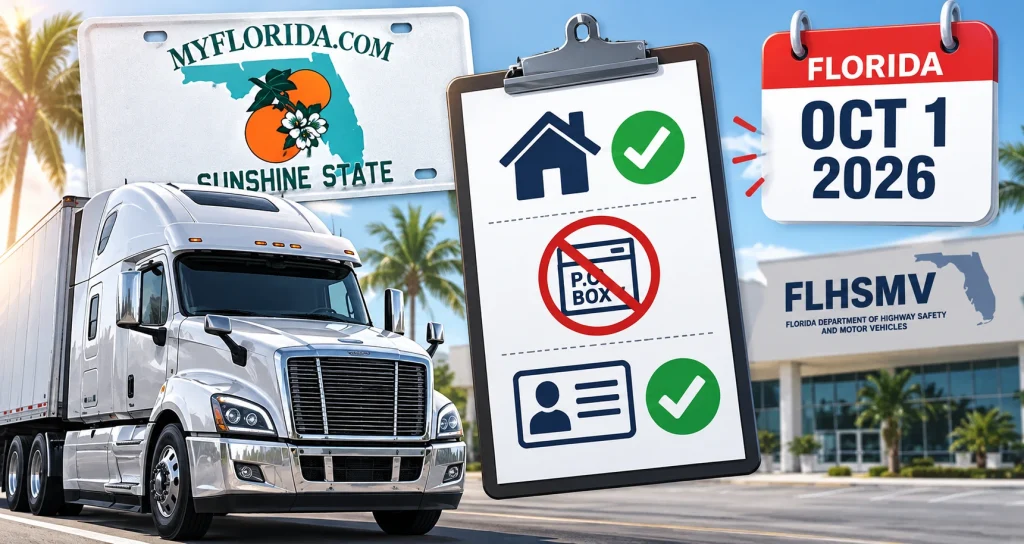

Truckers and transportation companies registering vehicles in Florida should prepare for a change taking effect in just a few weeks. Beginning October 1, 2026, the state will impose new identification and address requirements for vehicle registration applications as part of a broader overhaul of rules administered by the Florida Department of Highway Safety and Motor Vehicles (FLHSMV).
The change is included in SB 488, a comprehensive transportation law approved by the Florida Legislature and enacted as Chapter 2026-39. Among other provisions, the law amends Section 320.02 of the Florida Statutes, which governs vehicle registration.
One key point is that the change is not limited to passenger cars. The provision applies to the registration of motor vehicles and therefore can also affect pickups, trucks and other commercial vehicles, depending on who owns the vehicle and how it is registered.
What Changes on October 1?
The new version of Section 320.02 of the Florida Statutes requires a registration application to include the physical street address of the owner’s permanent residence in Florida or the address of the owner’s permanent place of business in the state.
The law also adds a specific requirement for individuals applying for registration.
Applicants must provide proof of address satisfactory to FLHSMV and establish their identity using one of the documents permitted under the law.
Those documents include a valid REAL ID driver’s license or identification card issued by Florida or another state; a valid, unexpired U.S. passport; or, for certain foreign nationals, a valid foreign passport accompanied by a current Form I-94 issued by U.S. authorities.
This could be particularly important for people who previously used an address that did not clearly establish their permanent Florida residence.
The Florida Senate’s official summary of SB 488 confirms that one of the purposes of the legislation is to modify documentation and address requirements for vehicle registration applicants.
Does the New Rule Apply to Trucks?
Yes. Section 320.02 generally requires the owner or person responsible for a motor vehicle operated on Florida roads to register that vehicle, unless an exception provided by law applies.
That means an owner-operator who personally owns and registers a truck should pay particular attention to the new requirements when completing a registration transaction covered by these provisions.
The law does not create a general exemption simply because a vehicle is a commercial motor vehicle.
There is, however, an important distinction when the registered owner is a company.
What About Trucks Registered to a Company?
The legislation distinguishes between individual applicants and businesses.
For a company, the application must identify the address of its permanent place of business in Florida. The company must also provide a Federal Employer Identification Number (FEIN) when applicable, demonstrate that it is authorized to do business in Florida, or provide a Florida municipal or county business license or business tax receipt number.
As a result, a truck registered directly to an LLC, corporation or other business entity is not subject to exactly the same personal documentation requirements as an owner-operator registering a vehicle in their own name.
This distinction is especially important for fleets.
Before registering a new vehicle or changing registration information, companies should make sure their listed business address and corporate information are accurate and can be verified.
What About Trucks Registered Under IRP?
Interstate trucking adds another layer to the registration system.
Commercial vehicles operating in multiple states may be registered through the International Registration Plan (IRP), which apportions registration fees among the jurisdictions in which a commercial vehicle operates.
SB 488 itself contains several changes specifically affecting motor carriers in addition to the general vehicle registration requirements. The Florida Senate’s official page for the legislation lists both Section 320.02, which governs vehicle registration, and Section 320.03, which addresses tax collector responsibilities and the International Registration Plan, among the affected statutes.
That makes it particularly important not to confuse personal vehicle registration requirements with those that apply to fleets or carriers operating under IRP.
Interstate carriers should review their specific situation with FLHSMV or their registration agent before assuming that documents previously accepted will continue to be sufficient after October 1.
Be Careful With P.O. Boxes
Another practical issue comes directly from the language of the new law: the registration application must identify a street address, meaning a physical address.
This is especially relevant for independent drivers who receive business correspondence through a P.O. Box, private mailbox or mail-forwarding service.
A mailing address may be useful for receiving correspondence, but it does not automatically replace the physical address required by law to establish a permanent residence or permanent place of business.
Owner-operators who use mail-forwarding services or mailing addresses should therefore check in advance which address currently appears on their documents and vehicle records.
What Documents Should Truckers Prepare?
The law specifically identifies acceptable documents for establishing identity or legal presence, but leaves FLHSMV responsible for determining what constitutes “proof of address satisfactory to the department.”
For that reason, truckers should check the latest instructions directly with the Florida Department of Highway Safety and Motor Vehicles or the appropriate county tax collector before completing a registration transaction.
Drivers should not assume that any utility bill, lease, bank statement or similar document will automatically be accepted simply because it contains an address. The document must meet the criteria applied by the department at the time of registration.
For truckers, the best preparation is to make sure the address listed in their records reflects their actual situation and to have both the required identification and acceptable proof of address available.
License Plate Rules Are Changing Too
SB 488 also includes a clarification that may be relevant to truckers who use frames around their license plates.
Florida continues to prohibit altering, covering or obstructing the proper visibility of a license plate. However, the new legislation clarifies that using a license plate frame or decorative border is not, by itself, a violation, as long as it does not block essential information.
According to the official SB 488 summary, a frame may be used as long as it does not obstruct the license plate number or validation sticker.
In other words, having a frame around the plate is not necessarily the problem. The issue is whether the accessory covers or makes it difficult to read information that Florida law requires to remain visible.
A Broader Law for Florida Trucking
The address and registration requirements are only one part of SB 488.
The legislation also changes rules directly affecting motor carriers, including provisions involving the Florida Motor Fuel Use Tax Act, carrier licensing, fuel tax decals, tax returns and certain recordkeeping requirements.
According to the official legislative record, the bill passed 36-0 in the Florida Senate and 108-1 in the House of Representatives. It became Chapter No. 2026-39 and has a general effective date of October 1, 2026.
For owner-operators and small trucking companies based in Florida, that date is now approaching quickly, making this a good time to review the documentation used to register their vehicles.
The key point is straightforward: starting in October, registering a truck in Florida will require closer attention to the physical address and documentation identifying the vehicle’s owner.
Owner-operators who register trucks personally should make sure they can properly document their residence. Companies should verify that their business address and corporate documentation are current. Carriers operating under IRP should confirm the requirements that apply to their specific business structure and operations before beginning a registration transaction.
Official registration information and updates are available through the Florida Department of Highway Safety and Motor Vehicles, while the full text, legislative history and related documents for SB 488 are available through the Florida Senate.