 Hable con un agente al (888) 572-7520
  Enviar mensaje a un agente


Major U.S. airlines have already started responding to rising fuel costs with a straightforward strategy: reviewing individual routes and cutting operations that no longer generate sufficient margins.
According to Reuters, American Airlines, United Airlines and Southwest Airlines are adjusting capacity plans while attempting to pass some of their higher costs on through fares. American estimates that current fuel prices could add roughly $1 billion to its fourth-quarter costs. United has removed some December flights, while Southwest has cut its planned 2026 capacity growth roughly in half.
The reasoning behind those decisions will sound familiar to any trucking company: if an operation no longer covers its costs and produces an acceptable margin, it may be time to reconsider it.
Trucking fleets, however, face a different challenge. An airline can reduce frequencies or temporarily remove a route from its schedule. A carrier with committed freight, regular customers and existing contracts cannot always simply stop running.
Diesel changes the math for trucking
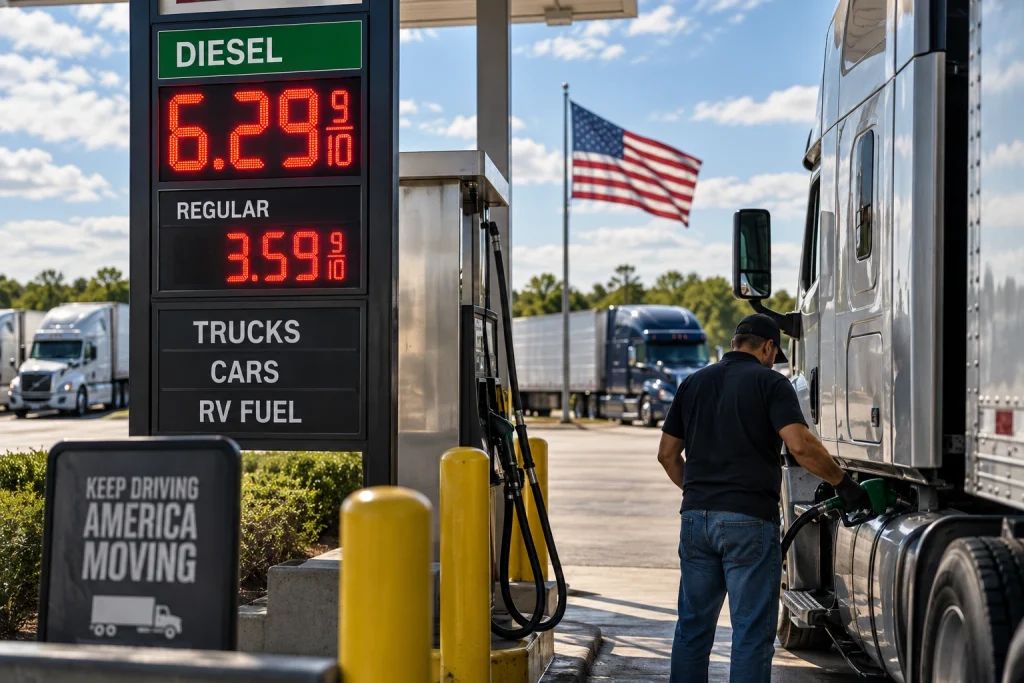
The pressure is particularly intense because U.S. diesel has climbed above $6 per gallon, amid broader disruptions in the global fuel market.
Reuters reported that global diesel prices reached record levels amid supply disruptions related to the conflicts in Iran and Ukraine. In the United States, refineries are operating at particularly high rates, yet inventories remain about 15% below the five-year seasonal average.
The situation could persist. Another Reuters analysis reported that U.S. diesel inventories were at their lowest September level since 1982 and that the global shortage could continue into 2027.
For a fleet consuming thousands or tens of thousands of gallons each week, even relatively small price increases can quickly change the economics of a trip.
And the fuel shock is hitting trucking at a particularly difficult time.
According to DAT Freight & Analytics, national spot rates fell across all three major equipment types in August. Average linehaul rates for dry vans dropped 20 cents to $2.19 per mile, reefers fell 14 cents to $2.61, and flatbeds declined 20 cents to $2.70.
That leaves many fleets dealing with two pressures simultaneously: much more expensive fuel and freight rates that are not necessarily rising fast enough to compensate.
Can fleets pass higher fuel costs on to customers?
One of the industry’s first lines of defense is the fuel surcharge, which allows carriers to pass some of the change in diesel costs on to customers.
Weekly diesel prices published by the U.S. Energy Information Administration (EIA) are widely used throughout the industry to track fuel costs.
But a fuel surcharge does not automatically solve the problem. Its effectiveness depends on the structure of each contract, the benchmark being used, how frequently the surcharge is updated and how much of the increase the carrier can actually recover.
The problem can be particularly difficult for smaller carriers and owner-operators, which may have less bargaining power and less capacity to temporarily absorb higher costs.
A Reuters Breakingviews analysis found that freight transportation is shouldering a disproportionate share of the increase in U.S. fuel spending, reflecting just how central diesel is to moving goods.
Not every mile is worth the same
When diesel prices surge, an empty mile is no longer just an operational inefficiency. It becomes an increasingly expensive one.
That makes metrics such as cost per mile, revenue per mile, empty miles and fuel consumption per mile even more important, along with the profitability of individual lanes.
The U.S. Department of Energy recommends using telematics to analyze routing, scheduling and driving behavior. These systems can help identify unnecessary mileage, improve planning and detect driving habits that increase fuel consumption.
There are also simpler ways to reduce consumption. The Department of Energy notes that proper tire inflation can improve efficiency, while unnecessary idling can consume between 0.25 and 1 gallon of fuel per hour.
Idle reduction is significant enough that the Department of Energy maintains a dedicated program focused on technologies that reduce fuel use when heavy-duty vehicles are stationary.
The American Trucking Associations also points to technologies including improved aerodynamics, fuel-efficient tires, idle-reduction systems, speed governors and lightweight equipment as ways to reduce fuel consumption.
With diesel above $6 a gallon, efficiency improvements that may have seemed marginal when fuel was cheaper can add up to significant savings across an entire fleet.
Rethinking routes, loads and customers
This is where the comparison with airlines becomes particularly relevant.
United is reviewing routes whose margins have deteriorated because of higher fuel costs. American and Southwest are also adjusting capacity to protect profitability, according to Reuters.
For a trucking company, the equivalent is determining which lanes still make financial sense.
A load may carry an attractive rate but become far less profitable once fuel, deadhead miles, tolls, driver hours, maintenance and the cost of the return trip are included.
The question is no longer simply how much a load pays, but how much is left after completing the entire trip.
Rail gains an advantage
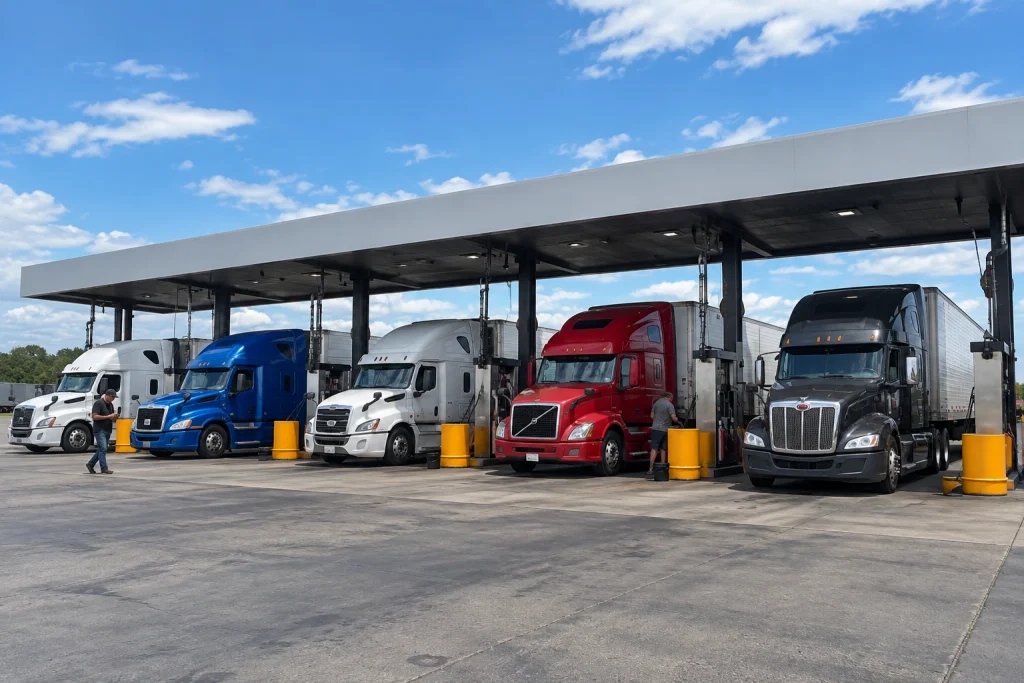
Higher diesel prices are even beginning to influence how some shippers move freight.
Union Pacific has seen some customers shift freight from trucks to rail because of rail’s greater fuel efficiency, according to Reuters.
That creates another challenge for carriers. They not only have to absorb or pass along higher fuel costs, but also remain competitive with other transportation modes on corridors where rail is a viable alternative.
The impact reaches farms and reefer freight
Higher fuel costs are not limited to general freight.
Reuters reported that record diesel prices are squeezing U.S. farmers during the 2026 harvest. Fuel is needed both to operate agricultural equipment and to move crops by truck.
The pressure can be particularly significant for perishable products, which must move from farms to distribution centers, supermarkets and other destinations under temperature-controlled conditions.
Reefers also need energy to maintain cargo temperatures, making fuel consumption, waiting times and operating efficiency even more important.
Washington has responded to the fuel crunch
The scale of the disruption was also reflected in a recent federal action.
On September 17, the U.S. government temporarily eased certain hours-of-service restrictions for drivers transporting gasoline and diesel to help facilitate fuel distribution amid supply disruptions, according to Reuters.
The move came as diesel reached record levels and concerns grew about its impact on transportation, agriculture and other parts of the economy.
Fleets cannot control fuel prices — but they can control their miles
Airlines are demonstrating one response to a fuel shock: taking a fresh look at the profitability of every operation.
The equation is different for trucking, but the principle is similar.
Reviewing fuel surcharges, contracts and rates; reducing empty miles and idling; planning where to fuel up; monitoring tires and maintenance; using telematics; calculating the true cost of individual lanes; and avoiding loads that lose money after all expenses are included become increasingly important when diesel remains this expensive.
DAT Freight & Analytics Trendlines provides regular data on freight rates and capacity, while the U.S. Energy Information Administration publishes weekly regional diesel prices.
Those are two numbers fleets should be watching together.
Because the rate per mile tells you how much is coming in. The price of fuel helps determine how much is left.
 Business hours: Monday to Friday from 8:00 AM to 5:00 PM. California time