 Hable con un agente al (888) 572-7520
  Enviar mensaje a un agente

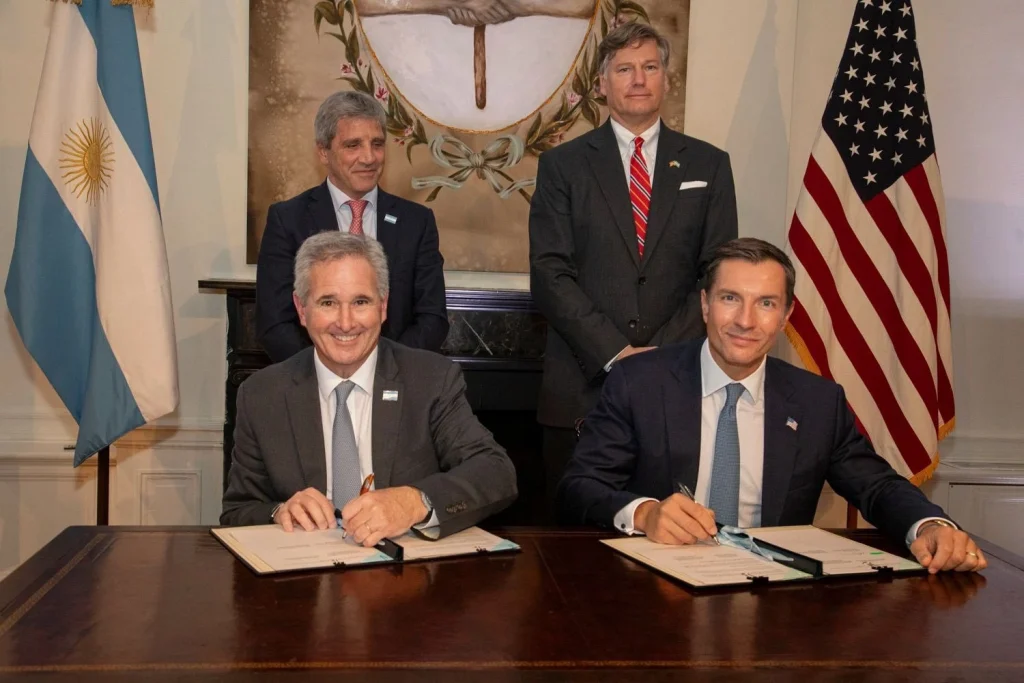

At a time when international conflicts are once again exposing the vulnerability of some of the world’s most important energy routes, the United States has launched an initiative much closer to home.
It is called the Andes-Atlantic Corridor, an ambitious agreement that brings together freight rail, ports, pipelines, power grids and digital infrastructure to connect vast oil and gas resources and lithium- and copper-rich regions with the Atlantic and Western markets.
For the United States, the project has two major implications: it could create billions of dollars in opportunities for U.S. companies while strengthening energy and critical-mineral supply chains within the Western Hemisphere.
The corridor is not simply about building a railroad, improving a port or financing a pipeline. The idea is to connect these different pieces of infrastructure to create a new route to market for resources that have become increasingly important to the global economy.
The U.S. Department of State describes it as an initiative designed to connect Argentina’s critical-mineral-rich northwest and the Vaca Muerta energy basin with Atlantic ports and Western markets through rail, pipeline, port, power and digital infrastructure.
Washington specifically says the project is intended to strengthen supply chains for lithium, copper, oil and gas, unlock billions of dollars in investment and expand opportunities for U.S. companies.
If the planned investments and infrastructure projects move forward, the Andes-Atlantic Corridor could reshape for decades how strategic energy and mineral resources from the Western Hemisphere reach international markets.
What Is the Andes-Atlantic Corridor?
— U.S. Export-Import Bank (@EximBankUS) September 23, 2026
The United States and Argentina formally launched the corridor on September 23, during the High-Level Week of the United Nations General Assembly.
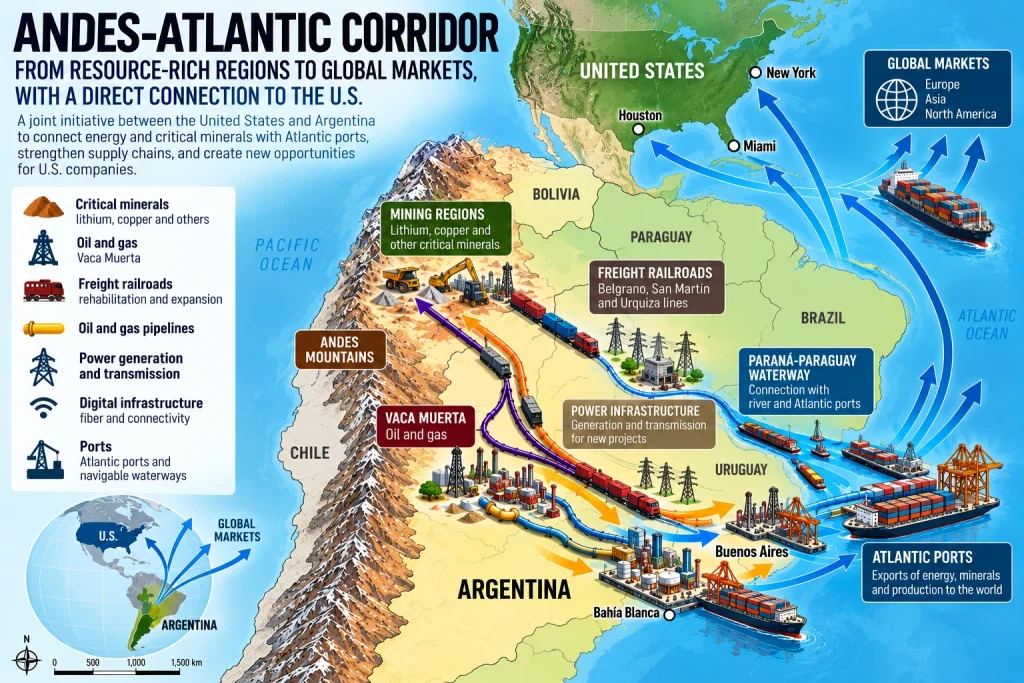
Its scale becomes easier to understand by looking at a map.
Argentina stretches along the Andes Mountains, and many of its most important energy and mineral resources are located deep in the country’s interior, hundreds or even thousands of miles from major ports.
In the west lies Vaca Muerta, one of the world’s major unconventional oil and gas formations. Farther north are important lithium- and copper-rich regions.
The challenge is not simply extracting those resources. They also have to be moved efficiently and competitively to market.
The Andes-Atlantic Corridor is designed to connect those producing regions with inland ports along the Paraná-Paraguay Waterway and with Atlantic ports through a network that includes freight rail, oil and gas pipelines, power generation and transmission, port infrastructure and digital systems.
The joint statement from both governments says U.S. and U.S.-backed investment will seek to increase mineral, oil and gas exports through investments in railroads, waterways, ports, pipelines and energy infrastructure.
Why Does It Matter to the United States?
🇦🇷🤝🇺🇸 El Corredor Andes-Atlántico integra grandes polos productivos y estratégicos del país, desde las provincias mineras del noroeste hasta Vaca Muerta, con los puertos del Atlántico, a través de trenes, ductos, infraestructura energética y conectividad digital.
Más inversión… https://t.co/kAOyzVkpHD
— Embassy of Argentina in USA (@ARGinUSA) September 24, 2026
The answer is spelled out in U.S. government documents: energy, critical minerals, supply chains and opportunities for American companies.
The new corridor is the first Partnership for Global Infrastructure and Investment corridor in the Western Hemisphere. According to the State Department, it will deepen economic integration between the two countries and connect investors with opportunities across the energy, mining, infrastructure and technology sectors.
That means the United States is not simply helping finance infrastructure.
It could also gain access to new supply chains within the Western Hemisphere while U.S. companies participate in building the infrastructure needed to develop them.
The international context makes that possibility particularly significant.
Hormuz, Bab al-Mandab and the Vulnerability of Global Energy Routes
Conflicts in the Middle East have once again put the spotlight on two small points on the map with an outsized influence on the global economy: the Strait of Hormuz and the Bab al-Mandab Strait.
Hormuz is one of the world’s most important maritime routes for oil and liquefied natural gas. Bab al-Mandab connects the Red Sea with the Gulf of Aden and is another critical route for international energy shipments and global trade.
When conflict or restrictions disrupt these routes, the consequences can quickly extend far beyond the Middle East.
The Andes-Atlantic Corridor does not mean Argentina will replace Middle Eastern producers, and neither government has presented the project that way.
But the current international environment helps explain why diversifying sources and transportation routes for energy and critical minerals has become increasingly important.
In this case, those resources are much closer to the United States — within the Western Hemisphere.
El Corredor Andes-Atlántico: El nuevo eje geopolítico que redefine la estrategia logística de Argentina https://t.co/xEyntL3xul
— ARA202 (@ytbara202) September 24, 2026
Vaca Muerta: Building a Route for Energy
Vaca Muerta holds vast oil and natural gas resources, but turning that potential into large-scale exports requires much more than drilling wells.
It requires pipelines, processing facilities, power, roads, freight rail and export terminals.
One of the major projects associated with this broader strategy is Argentina LNG, a $51 billion integrated development led by YPF in partnership with Italy’s ENI and the United Arab Emirates’ XRG.
The Export-Import Bank of the United States (EXIM) has already issued a non-binding indicative term sheet for up to $6 billion for the project.
And this is where an important part of the equation for the United States becomes clear: the proposed financing is intended to support the purchase of U.S. goods and services needed for infrastructure development and production activities.
In other words, expanding Argentina’s energy export capacity could also generate business for U.S. companies.
U.S. Companies Are Already Winning Contracts
U.S.-based McDermott has been awarded a contract for the engineering, procurement, construction and commissioning of a natural gas liquids fractionation and gas treatment facility.
Pumpco, a subsidiary of MasTec, is also participating with Bonatti and Contreras Hnos. in an engineering, procurement and construction contract worth more than $1 billion for Argentina LNG’s export pipeline system, subject to a final investment decision.
That helps illustrate how the model works.
The United States can help mobilize infrastructure financing; that infrastructure can enable greater energy production and exports while simultaneously creating demand for U.S. engineering, equipment, technology and services.
Up to $7 Billion to Help Move the Corridor Forward
The financial scope goes beyond Argentina LNG.
EXIM and Argentina signed the U.S.-Argentina Build the Future Framework, which provides for up to $7 billion in financing by 2027 for projects designed to expand infrastructure and productive capacity.
The U.S. International Development Finance Corporation (DFC) and the U.S. Trade and Development Agency (USTDA) could also participate, alongside private-sector investors.
The joint statement says the United States intends to use these financing and technical-assistance tools to support the corridor’s development.
Freight Rail Is Part of the Map, Too
The corridor does not end with pipelines.
Argentina has launched efforts to rehabilitate and expand the Belgrano, San Martín and Urquiza freight rail lines, infrastructure that could be particularly important in reducing transportation costs for mining and agricultural production.
Additional rail connections are also being considered from Vaca Muerta to Bahía Blanca, Buenos Aires-area ports and other strategic ports along the waterway.
The goal is to move oil, gas, lithium, copper and agricultural products more efficiently from producing regions to ports.
That is why the corridor is more than a single infrastructure project. It proposes integrating transportation and energy systems that have historically operated separately.
Lithium and Copper: The Other Major Piece
The agreement explicitly includes critical minerals. The United States and Argentina plan to identify opportunities to develop mining and mineral processing while diversifying global supply chains.
Lithium and copper are central to that strategy.
That means a railroad that lowers transportation costs for a mine, a new transmission line that makes a project viable or a port capable of handling larger volumes can all become part of a much larger system.
The pieces of the map begin to connect: Vaca Muerta, lithium, copper, freight rail, pipelines, the waterway, Atlantic ports, electricity and digital infrastructure.
The First of Its Kind in the Western Hemisphere
Another detail helps put the project’s significance into perspective.
The Andes-Atlantic Corridor joins a network of strategic economic corridors backed by the United States around the world.
They include the Lobito Corridor in Africa, the Luzon Economic Corridor in the Philippines, the India-Middle East-Europe Economic Corridor and the Trans-Caspian Trade Route.
The U.S.-Argentina joint statement explicitly places the new corridor within that broader global strategy.
But this one has a distinction of its own: it is the first in the Western Hemisphere.
Washington is already preparing the next steps. A U.S. delegation including representatives from the State Department, DFC and EXIM is scheduled to travel to Buenos Aires, Jujuy and Salta in October to identify and advance potential transactions.
The United States and Argentina will also organize roadshows connecting U.S. companies with investment opportunities and active concession tenders.
Could It Really Change the Map?
There is still a considerable distance between launching an economic corridor and building all the infrastructure it envisions. Some projects still require final financing, concessions, approvals, investment decisions and years of construction.
But the project’s potential scale is not measured only by the money announced.
At one end are vast resources of oil, natural gas, lithium and copper. At the other are ports capable of providing access to international markets. Between them lie thousands of miles of infrastructure.
The United States wants to participate in building that connection with its own financing, technology and companies while strengthening supply chains for resources it considers strategic.
And all of this is happening at a time when international conflicts are once again demonstrating that energy security depends not only on how much oil, gas or critical minerals exist, but also where they come from and which routes can get them to market.
If the planned investments ultimately become railroads, pipelines, power grids and ports, the Andes-Atlantic Corridor could do much more than accelerate one country’s exports.
It could help create a new route for energy and critical minerals across the Western Hemisphere — and reshape for decades the logistics network connecting the United States to some of the world’s most strategic resources.
Joint Statement on the Launch of the Andes-Atlantic Corridor
 Business hours: Monday to Friday from 8:00 AM to 5:00 PM. California time