 Hable con un agente al (888) 572-7520
  Enviar mensaje a un agente



Artificial Intelligence can now create fake photographs, videos, and documents with an astonishing level of realism. For truck owners and transportation companies, this creates a new risk: manipulated images that could be used to exaggerate damage, alter evidence, or support fraudulent claims.
Fortunately, modern accident investigations no longer rely on a single photograph. Today’s investigators use multiple technologies and independent data sources to detect manipulation and establish what actually happened.
For any trucking company, an accident is already stressful enough. Drivers must be checked for injuries, cargo secured, authorities contacted, and extensive paperwork completed. Now there’s another question to consider: what happens if someone tries to rewrite reality using AI?
This is no longer science fiction. Consumer AI tools can add damage to a vehicle, change a license plate, replace backgrounds, or even generate an entirely fictional accident scene in just minutes.
That doesn’t mean fooling a professional investigation is easy. It does mean trucking companies should be aware of a risk that barely existed only a few years ago.
AI Can Alter Images in Minutes
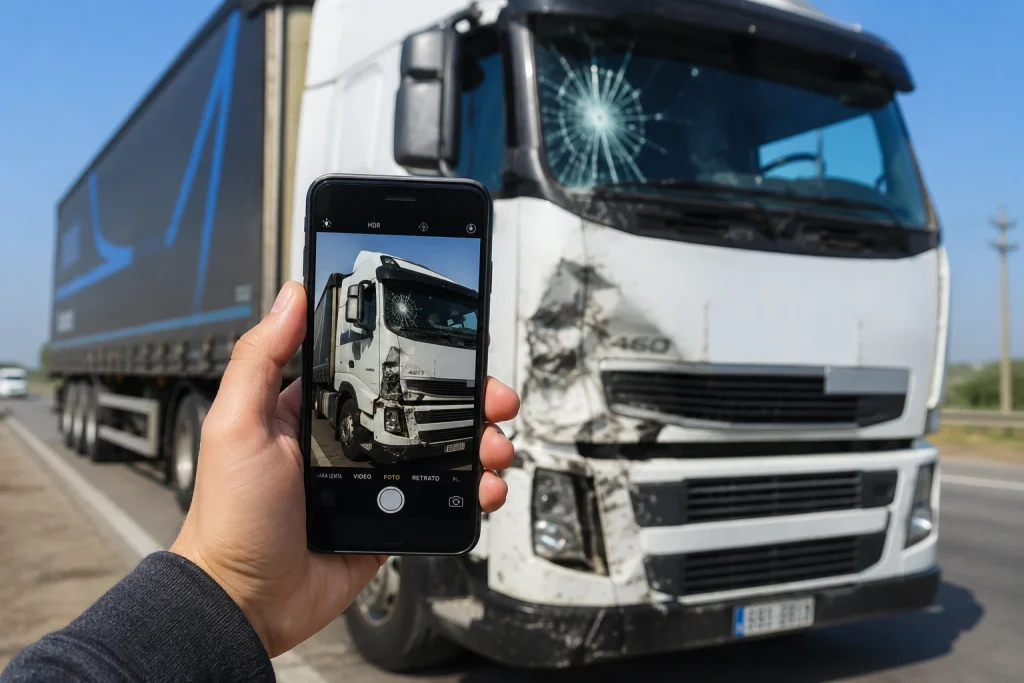
Generative AI technology is advancing at an extraordinary pace. With just a few written prompts, many platforms can remove objects, add dents to a truck, shatter a windshield, change lighting conditions, or recreate an entirely different environment.
The technology can also manipulate repair estimates, invoices, documents, and even produce convincing fake videos known as deepfakes.
According to the Coalition for Content Provenance and Authenticity (C2PA), the rapid growth of AI-generated media has led to the development of international standards designed to verify the origin and authenticity of digital images and files.
For trucking businesses, the concern goes beyond insurance fraud. A company could face a claim supported by manipulated images intended to inflate damages, change how an accident appears to have occurred, or increase the value of a lawsuit.
Technology Also Protects Trucking Companies
The good news is that a single photograph rarely determines the outcome of a serious investigation.
Today’s accident investigations typically combine evidence from many independent sources before reaching any conclusion.
Electronic Logging Devices (ELDs), GPS records, truck telematics, dashcam footage, surveillance cameras from nearby businesses or fuel stations, toll records, mobile phone data, and witness statements all help investigators reconstruct what actually happened.
Altering one photograph may be relatively easy. Consistently manipulating every one of those independent data sources is far more difficult.
That is why an impressive-looking image alone is rarely enough to prove how a crash occurred.
Fake Images Leave Digital Fingerprints
Many people assume AI-generated images are impossible to detect.
In reality, most leave behind digital traces.
Digital forensic specialists can examine metadata, compression artifacts, reflections, shadows, textures, pixel patterns, lighting inconsistencies, and other technical indicators that often reveal image manipulation.
More organizations are also adopting automated tools capable of identifying AI-generated content before it becomes part of an investigation.
The National Association of Insurance Commissioners (NAIC) notes that Artificial Intelligence is transforming how insurers evaluate claims, helping accelerate legitimate cases while improving the detection of suspicious activity through advanced image and data analysis.
Likewise, the National Institute of Standards and Technology (NIST), through its AI Risk Management Framework, recommends systems that verify the authenticity of digital content and reduce risks associated with malicious AI use.
Fraud Is Evolving—So Are Investigations
The National Insurance Crime Bureau (NICB) has repeatedly warned that fraud evolves alongside technology. Every new tool used to deceive investigators eventually leads to new methods for detecting deception.
Today, investigators do far more than review photographs sent from a smartphone.
They compare physical vehicle damage with electronic vehicle records, telematics data, GPS locations, travel times, nearby surveillance footage, and digital evidence collected from multiple devices.
When those independent sources fail to match the submitted images, additional forensic analysis usually follows.
Creating a convincing fake photograph is one thing. Creating an entire network of matching evidence is something else entirely.
How Truck Owners Can Protect Themselves
For trucking companies, the strongest defense is still creating their own evidence immediately after an accident.
Take photographs from multiple angles, record video, preserve the original files without editing them, back up GPS and ELD data, and securely store dashcam footage.
These records can become extremely valuable if the facts of an accident are later disputed.
It is also important to report the accident promptly and retain every document related to the incident.
The more authentic evidence available, the harder it becomes for manipulated images to distort what actually happened.
Artificial Intelligence will continue improving, and fake images will almost certainly become even more convincing. However, real accidents leave behind much more than photographs. Electronic records, GPS history, telematics, surveillance footage, witness testimony, and forensic analysis together create a body of evidence that is extraordinarily difficult to fake consistently.
For trucking companies, the best protection remains the same as it has always been: document everything, preserve original records, and act quickly. In a world where images can be manipulated within seconds, the truth depends not on a single photograph, but on the complete trail of evidence that supports it.
 Business hours: Monday to Friday from 8:00 AM to 5:00 PM. California time