 Hable con un agente al (888) 572-7520
  Enviar mensaje a un agente



When U.S. Immigration and Customs Enforcement (ICE) confirmed it had transferred detainees from Alligator Alcatraz at the start of hurricane season, most of the attention focused on the political debate surrounding the facility. Behind that decision, however, lies a different story: one of the most complex logistical operations a government agency can undertake.
Moving hundreds of people from a detention center is not as simple as putting them on a bus and driving to another location. It is a carefully planned operation involving specialized vehicles, security escorts, command centers, route analysis, and coordination among multiple agencies.
ICE did not disclose how many detainees were relocated or which facilities received them. The agency also did not specify what types of vehicles were used during the operation. However, the federal government maintains an online Detainee Locator System that allows individuals to check where detainees are being held.
The Vehicles Commonly Used by ICE
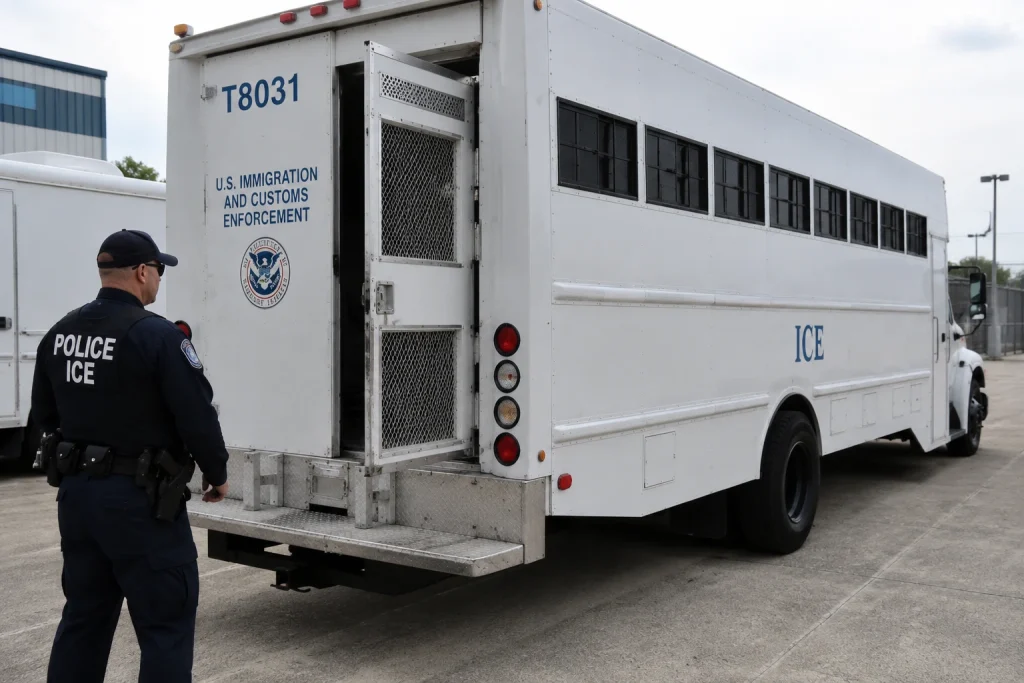
Most ground transfers of detainees in the United States are conducted using buses specially adapted for federal custody operations.
While they may appear similar to standard buses, these vehicles often feature reinforced interior compartments, direct communication systems connected to operational centers, surveillance cameras, security partitions, and designated areas for custody personnel.
For smaller-scale movements, ICE and its contractors may also use secure transport vans and utility vehicles operated by private companies working with the Department of Homeland Security (DHS).
Depending on the number of detainees being moved, an evacuation can require multiple buses traveling simultaneously as part of a coordinated convoy.
How a Transfer Convoy Operates
When large groups of detainees are relocated, transport vehicles rarely travel alone.
A typical convoy includes transportation units, support vehicles, and security personnel.
In many cases, lead and trailing vehicles are used to maintain control of the route and allow for a rapid response if any incident occurs during transit.
Operations centers continuously monitor each vehicle’s location through GPS tracking and real-time communication systems.
The goal is to ensure that every vehicle reaches its destination safely, without disruptions or unexpected route deviations.
The Challenge of Route Selection
The location of Alligator Alcatraz creates additional logistical challenges.
The facility is situated in the Everglades, a vast wetland area west of Miami where road access is more limited than in many other parts of Florida due to the surrounding protected national park lands.
When a tropical storm threatens the region, planners must evaluate which highways are likely to remain operational, which roads may become flooded, and which transportation corridors can support a rapid evacuation.
For authorities, the storm itself is not the only concern. They must also account for traffic generated by civilian evacuations, preventive road closures, and restrictions imposed by emergency management agencies.
The Logistics Behind Custody Operations
Another lesser-known aspect of detainee transfers is that the operation does not end when the vehicles arrive at their destination.
Receiving facilities must have available capacity, sufficient personnel, medical services, identification systems, and intake procedures ready to process incoming detainees.
Each individual must be re-entered into the federal detention system, with documentation, health status, and housing assignments verified upon arrival.
For this reason, evacuation operations are often planned several days in advance.
What the Transportation Industry Can Learn
From a logistics perspective, the evacuation of Alligator Alcatraz is an example of high-complexity transportation planning.
The same factors that affect a federal agency also impact trucking companies and freight operators: route availability, weather conditions, real-time communication, operational flexibility, and coordination among multiple stakeholders.
While millions of people watch the path of a storm on weather maps, convoys, command centers, and planning teams are already working behind the scenes to ensure that people and assets reach safety before severe weather turns highways into barriers.
The evacuation carried out by ICE serves as a reminder that when a hurricane approaches, logistics is no longer an administrative task—it becomes a critical operation where every vehicle, every route, and every minute matters.
 Business hours: Monday to Friday from 8:00 AM to 5:00 PM. California time