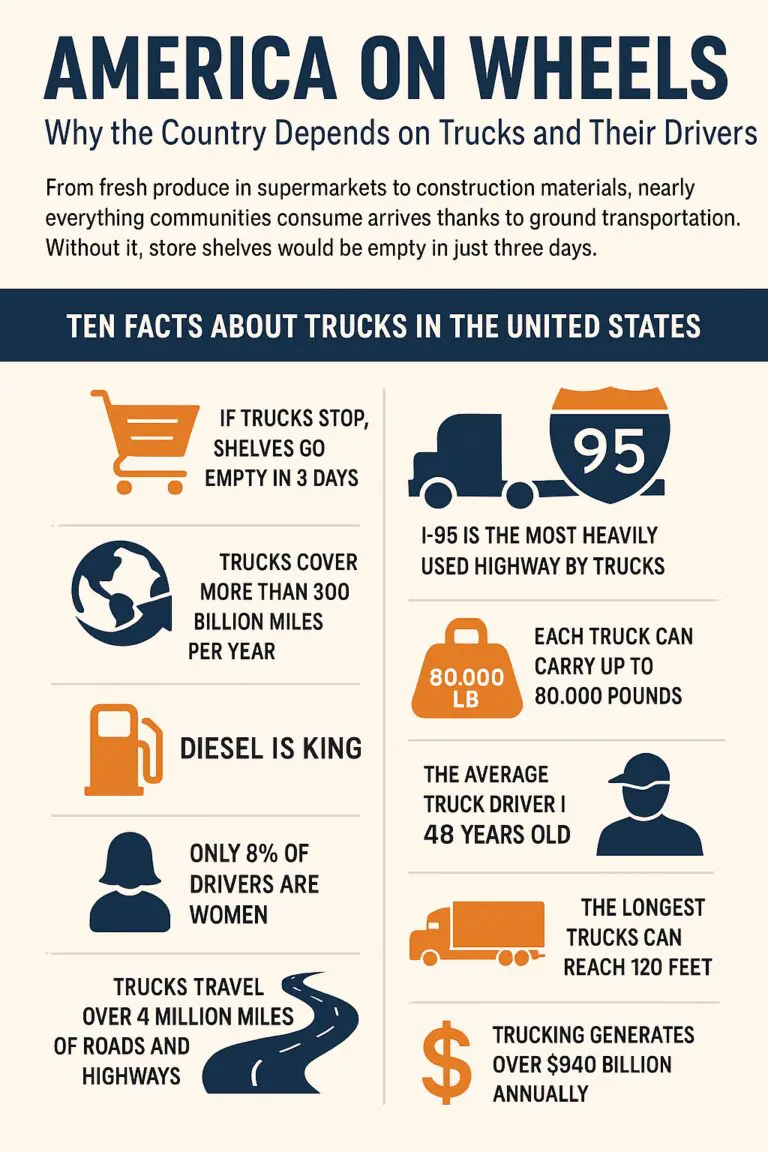
From fresh produce in supermarkets to construction materials, nearly everything communities consume arrives thanks to ground transportation. Without it, store shelves would be empty in just three days.
Though they often go unnoticed, trucks and their drivers are the backbone of the U.S. economy. From fresh groceries in supermarkets to building materials, almost everything consumed across American communities is delivered by truck. Without this vast network of vehicles and drivers on the road day and night, the daily functioning of cities and towns across the country would be seriously disrupted.

72.6% of all domestic freight in the U.S.
According to the American Trucking Associations (ATA), 72.6% of all domestic freight in the U.S. is transported by truck. That amounts to more than 11.4 billion tons of goods moved every year.
It’s estimated that every community in the country relies on trucking to receive at least 80% of its essential goods. From medicine to food, electronics to fuel—everything rolls in on wheels.
The trucking industry also employs more than 8.4 million people, including roughly 3.5 million professional drivers. This silent workforce ensures life continues uninterrupted in a nation that moves at breakneck speed.

Ten Facts About Trucks in the United States
If trucks stop, shelves go empty in 3 days: A complete halt in road transportation would lead to shortages in less than a week, especially in food, medicine, and fuel.
I-95 is the most heavily used highway by trucks: This major interstate runs along the East Coast, connecting major cities like Miami, Washington D.C., New York, and Boston.
Trucks cover more than 300 billion miles per year: That’s equivalent to circling the globe over 1.2 million times.
Each truck can carry up to 80,000 pounds (36 metric tons): This is the maximum weight allowed without special permits, though some trucks are built for much heavier loads.
Diesel is king: Most trucks run on diesel engines for their power and durability, although electric and hydrogen-powered vehicles are gaining ground.
The average truck driver is 48 years old: Trucking is one of the professions with the oldest workforce, raising concerns about a lack of younger replacements.
Only 8% of drivers are women: Although that number is growing, the industry remains overwhelmingly male-dominated.
The longest trucks can reach up to 120 feet (36 meters): These are known as “road trains” and are more commonly found on rural routes, especially in states like Texas and Arizona.
Trucks travel over 4 million miles of roads and highways: The U.S. has one of the largest and most complex roadway networks in the world.
Trucking generates over $940 billion annually: It’s a cornerstone of the American economy, accounting for nearly 80% of all freight transportation revenue.

Roads in U.S.: Special Report 2026 on Their Current State
New official reports and civil engineers warn of the need to improve roads and bridges. They highlight the hidden costs of freight transport and the urgent investment gap.
The most popular truck brands in the U.S.
If you ask different truck drivers what the perfect truck is, each one will likely have a different answer, for this reason, we present a list of the most popular truck brands in the U.S.

In brief: advances and challenges in the U.S. trucking automation and safety
Automation corridor, Tesla under probe, and speed limiter rules, are the latest updates in the transportation industry.

How to prevent allergies and flu on the road
Here are some measures to stay healthy and reduce, as much as possible, the risk of seasonal allergies as a trucker.

Spring cleaning tips for truckers
Spring has arrived, and with it, the ritual of cleaning, an opportunity to make way for cleanliness, order, and self-care in all aspects of life.

Geopolitical tensions drive oil surge and pressure U.S. economy
The current state of geopolitics, its impact on the U.S. economy, and the pressure facing the Federal Reserve.