 Hable con un agente al (888) 572-7520
  Enviar mensaje a un agente

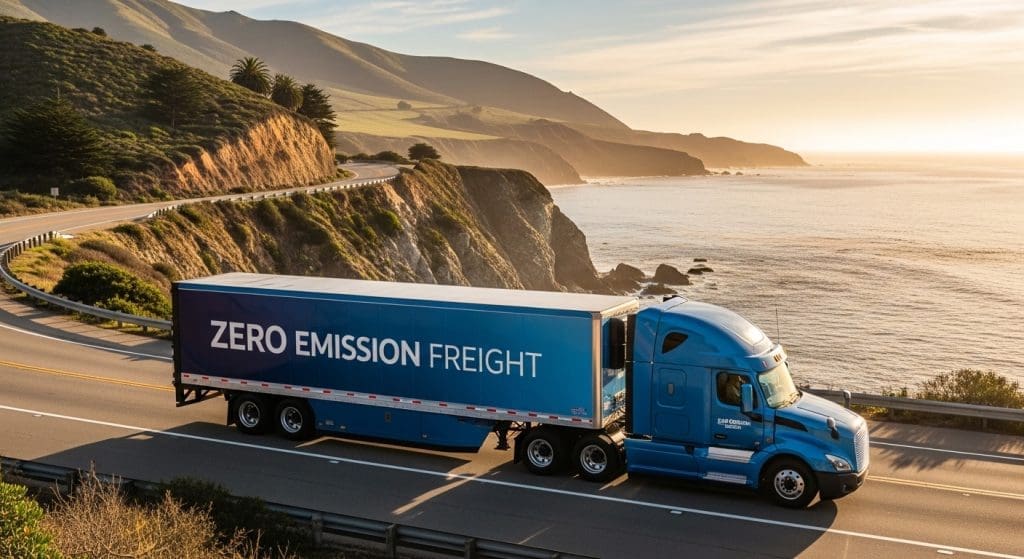

For decades, California operated as a policy laboratory for the rest of the United States. What CARB—the state’s air agency—decided in Sacramento ultimately shaped fleet decisions in New York, Oregon, and Washington. That dynamic broke in 2025, and 2026 is the year when the consequences are being felt across every truck dealership and freight terminal in the country.
The conflict is easy to describe but difficult to resolve: California wants trucks to go electric, while the federal government under Donald Trump wants them to remain diesel-powered. The problem is that between these two positions stand tens of thousands of fleet operators who must decide today which vehicles they will purchase for the next decade.
For more than 50 years, California held a special permit—known as a waiver—that allowed it to set its own vehicle emissions standards, stricter than federal rules. This mechanism, backed by the Clean Air Act, became the regulatory engine behind initiatives such as the Advanced Clean Trucks (ACT) rule, which required manufacturers to sell increasing percentages of electric trucks each year.
Under this framework, California had proposed that 35% of new vehicle sales be zero-emission by 2026, with a phased elimination of gasoline-powered vehicles by 2035. Nearly 20 states had adopted these same standards.
That changed in June 2025. President Trump signed Congressional Review Act resolutions that invalidated the EPA waivers supporting CARB’s heavy-duty truck regulations. Without those authorizations, the Clean Air Act prohibits CARB from enforcing such emissions rules.
The Department of Justice responded decisively, filing a lawsuit against California to block the enforcement of its truck standards. The federal government argued that the state was attempting to bypass the prohibition through agreements with manufacturers, known as the Clean Truck Partnership.
California’s (partial) retreat
Legally cornered, CARB gave ground. California agreed to formally repeal large portions of its controversial Advanced Clean Fleets electric truck mandate as part of a legal settlement, after a coalition of 17 states led by Nebraska—along with trucking industry groups—filed lawsuits against it.
In October 2025, CARB voted to repeal requirements affecting private and federal fleets after failing to secure federal authorization under the Clean Air Act. However, the regulation remains relevant, as it continues to apply directly to state and municipal fleets operating heavy-duty vehicles in California.
Still, California has not fully abandoned the fight. The governor signed an executive order to maintain the state’s climate goals, and CARB announced it will pursue new regulatory pathways to reintroduce similar requirements in the future.
The domino effect across states
The most revealing aspect of the conflict is what happened in states that had followed California. The Advanced Clean Trucks regulation had been adopted by ten other states: Massachusetts, New Jersey, New York, Oregon, and Washington had already implemented it starting with the 2025 model year, while Vermont, Colorado, Maryland, New Mexico, and Rhode Island had set implementation dates between 2026 and 2027.
However, legal uncertainty and the lack of electric charging infrastructure pushed several of them to reverse course. At least six of the eleven states that had adopted California’s standards took steps to suspend or delay implementation, including Oregon, Vermont, and Pennsylvania. In Washington, legislation was introduced to directly repeal the adoption of CARB rules.
The real problem: fleets don’t know what to buy
Behind the political debate lies a very real operational crisis. Regulatory fragmentation is a tangible risk if states continue down divergent paths while awaiting a final resolution. Fleets and manufacturers may need contingency plans for multiple regulatory scenarios in 2026 and beyond.
Historically, California has held unique authority under the Clean Air Act to set its own vehicle emissions standards through a federal authorization process. This mechanism allowed the state to influence national markets by establishing stricter requirements that other states could adopt. Recent EPA actions signal a potential narrowing of that authority—particularly when state programs affect interstate operations.
In practice, a carrier operating between California, Nevada, and Texas could be subject to three different—and potentially conflicting—regulatory frameworks.
The federal EPA: selective deregulation
The Trump administration has not only revoked California’s waivers—it is also reshaping federal standards themselves. EPA leadership has made clear its intention to roll back its own environmental regulations to support businesses. For the trucking sector, key issues include the NOx rule for heavy-duty vehicles and the 2009 endangerment finding on greenhouse gases.
However, there are limits to this deregulation. The EPA indicated it would likely scale back costly portions of the NOx regulation for heavy-duty trucks, although it has not yet announced specific changes.
Who pays the cost of uncertainty?
In the best-case scenario, this clash could push the federal government and California toward a compromise—perhaps a single national standard that is ambitious but includes more realistic implementation timelines, giving the industry time to adapt. In the worst-case scenario, prolonged litigation and political back-and-forth could delay emissions progress, leaving all stakeholders in limbo and undermining investment through policy whiplash.
For now, the biggest losers are small and mid-sized carriers, which lack the legal teams and financial capacity to navigate this uncertainty. Buying an electric truck in a state that may not require it tomorrow, or investing in diesel on routes that could ban it later, is a gamble no one wants to take. In an industry where trucks last ten to fifteen years, policy is playing out in real time—and time is running out.
 Business hours: Monday to Friday from 8:00 AM to 5:00 PM. California time