 Hable con un agente al (888) 572-7520
  Enviar mensaje a un agente

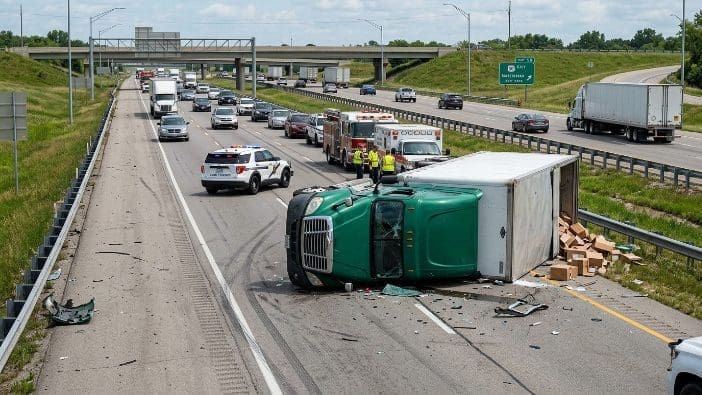

The Federal Motor Carrier Safety Administration (FMCSA) is moving forward with an ambitious research initiative aimed at understanding how truck drivers’ work schedules influence crash risk.
The study, titled “Crash Risks by Commercial Motor Vehicle Driver Schedules,” represents one of the most significant efforts in recent years to assess the real impact of fatigue and working conditions on roadway safety.
The announcement was formalized through the Federal Register, confirming that the agency will continue collecting data following a public comment period that began in November 2025.
Critical questions for the industry
At its core, the study seeks to answer key questions that have long concerned the trucking sector:
What types of schedules generate the highest risk? How do rest breaks, downtime, and shift length affect driver performance? And which variables should be prioritized to improve road safety?
A data-driven approach
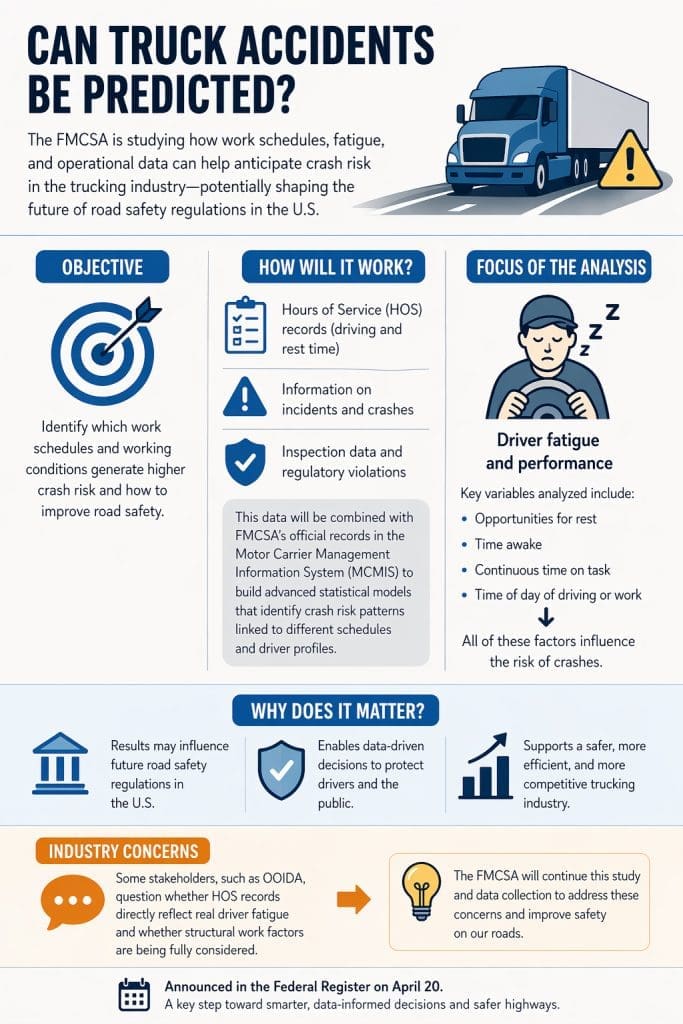
To answer these questions, the FMCSA will rely on a large volume of electronically collected operational data. Key sources include:
- Duty logs detailing driving and rest hours
- Crash and incident reports
- Inspection data and regulatory violations
Participating carriers will provide this information, which will be processed through third-party telematics providers. The data will then be integrated with the agency’s official records stored in the Motor Carrier Management Information System (MCMIS), which includes reportable crash histories and inspection results.
According to the FMCSA, this comprehensive dataset will enable the development of advanced statistical models capable of identifying risk patterns tied to specific work schedules and driver demographics.
Fatigue, performance, and safety: the core focus
One of the most critical aspects of the study is its focus on fatigue as a determining factor in road safety. While fatigue has long been debated in the industry, there are still significant gaps in how it is measured and how it relates to current regulations.
Although Hours of Service (HOS) logs do not directly measure fatigue, the FMCSA notes they can help infer key indicators such as:
- Opportunities for rest
- Time spent awake
- Continuous time on duty
These variables are closely linked to fatigue risk—and, by extension, crash probability.
The study also incorporates factors such as the time of day a driver is operating. This is essential, as certain periods—particularly late-night hours or the end of long shifts—are historically associated with higher crash risk.
Industry concerns and criticism
Despite the study’s potential, it has not been without criticism. During the public comment period, the FMCSA received feedback from 19 industry stakeholders, many of whom raised concerns about the methodology and broader structural issues in trucking.
The Owner-Operator Independent Drivers Association (OOIDA), for example, questioned whether HOS logs can truly reflect a driver’s level of fatigue. Its president, Todd Spencer, argued that these logs only show how long a driver has been on duty—not whether they are actually rested.
He also pointed out that crash rates may rise at certain times of day due to factors unrelated to schedule length.
Other concerns included:
- The absence of control groups in the study design
- Limited availability of safe and legal truck parking
- Rigid Hours of Service regulations
- Reduced driver flexibility in managing schedules
FMCSA’s response
In response, the FMCSA defended its approach, emphasizing that the study is observational and includes statistical controls designed to isolate the effects of scheduling from other variables.
The agency explained that incorporating factors like time of day helps distinguish between schedule-related risks and other influences, reducing what is known in statistics as “confounding.”
While acknowledging that HOS logs do not capture every aspect of fatigue, the FMCSA maintains that they provide valuable indirect indicators that can reveal large-scale trends.
Potential impact on future regulations
The outcomes of this study could significantly influence the future of trucking regulations in the United States. Depending on the findings, the FMCSA may:
- Adjust Hours of Service rules
- Introduce new fatigue-related metrics
- Promote advanced monitoring technologies
- Redesign safety policies based on data-driven evidence
At a time when both road safety and operational efficiency are top priorities, this research holds strategic importance. It not only deepens the industry’s understanding of real-world driving conditions but also lays the groundwork for more balanced regulations—ones that better align productivity with driver well-being.
Ultimately, the study marks a critical step toward a more precise and evidence-based understanding of what causes commercial vehicle crashes.
Its progress—and eventual conclusions—will be closely watched across the trucking industry, from large carriers to independent drivers, as scientific data continues to play an increasingly central role in shaping transportation policy.
 Business hours: Monday to Friday from 8:00 AM to 5:00 PM. California time