 Hable con un agente al (888) 572-7520
  Enviar mensaje a un agente

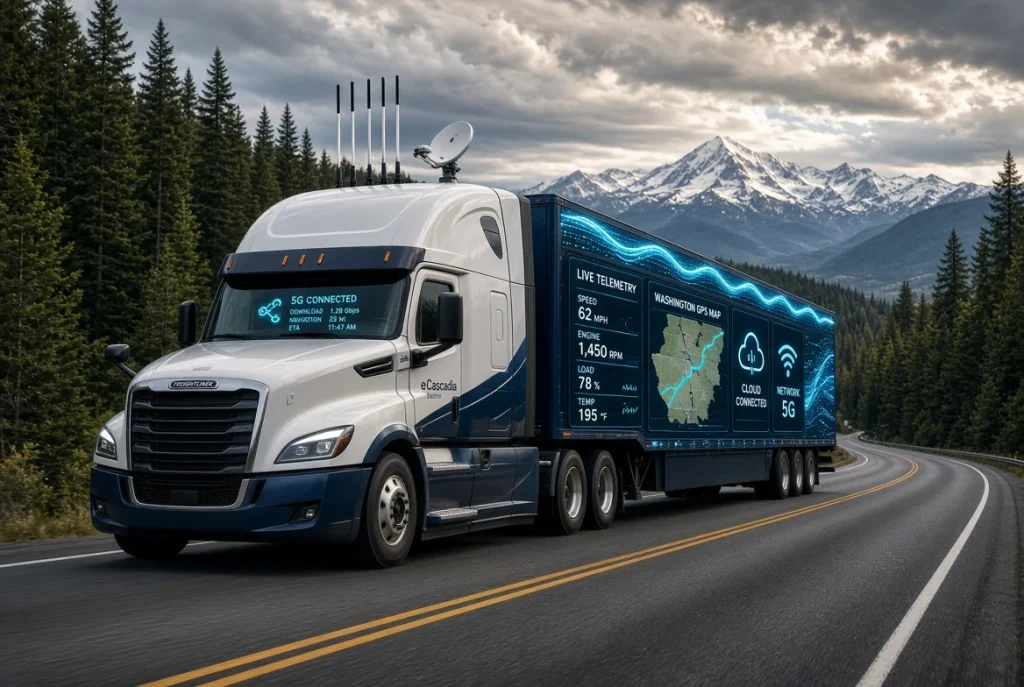

A “connected trucks” is a truck that exchanges data in real time with other vehicles, road infrastructure, and fleet management systems, combining connectivity (V2X), telematics, and, in its most advanced form, partial or full automation.
In Washington, this future is advancing on two simultaneous fronts: at the federal level, the 2026 SELF DRIVE Act, introduced on February 5 by Representative Bob Latta, aims to create the first national regulatory framework for autonomous trucks, allowing limited commercial operations during the testing phase and preempting conflicting state restrictions.
At the state level, the Washington State Department of Transportation (WSDOT) has for years operated the Cooperative Automated Transportation (CAT) program, which is already exploring truck platooning pilots and smart parking along the I-5 corridor.
What “Connected Trucks” Means Beyond Connectivity
A connected truck isn’t the same as an autonomous truck, though the two concepts often get mixed up. Connectivity — through V2X (Vehicle-to-Everything) technology, telematics, and fleet management systems — lets a truck receive and send data in real time: traffic alerts, road conditions, the location of other vehicles, and infrastructure signals. Automation, on the other hand, refers to how much of the driving the vehicle itself handles without human intervention. The future of the “connected truck” combines both dimensions: a vehicle that not only communicates but can also operate with varying levels of assistance or autonomy depending on the route context.
According to WSDOT itself, this ecosystem — which the agency calls Cooperative Automated Transportation (CAT) — includes all vehicle types and all levels of automation and connectivity, and covers not just trucks and cars but also trains, ferries, buses, and even pedestrians and cyclists within one coordinated information system.
The SELF DRIVE Act: The Federal Framework That Could Unlock Commercial Operation
The most important regulatory development in 2026 for the future of connected and autonomous trucks is the SELF DRIVE Act (“Safely Ensuring Lives Future Deployment and Research in Vehicle Evolution Act”), formally introduced on February 5, 2026 by Representatives Bob Latta (R-Ohio) and Debbie Dingell (D-Michigan). According to trade publication FreightWaves, it would be the first federal statute advancing specific rules for autonomous freight vehicles, if enacted.
The bill aims to dismantle the regulatory roadblocks that have kept autonomous trucks in a permanent “testing” phase, by allowing limited commercial operations while a vehicle is still being evaluated under a testing permit. A key change from earlier versions of the bill — introduced by Latta himself in 2017 and 2021, which had intentionally excluded autonomous trucks — is that the 2026 version explicitly includes them.
According to a follow-up FreightWaves report on the bill, the legislation would give the U.S. Secretary of Transportation explicit authority to let manufacturers and fleets engage in “limited commercial operations” — meaning generating revenue — while the vehicle remains under a testing permit, something that wasn’t clearly authorized before.
Why Preempting State Rules Matters for Washington
One of the most relevant elements of the bill for a state like Washington is that it would preempt conflicting state regulations on autonomous vehicles, establishing the legal certainty needed for heavy autonomous trucks to move from closed test tracks into real interstate commerce. The bill also requires certain “covered crashes” to be reported to a federal repository, along with quarterly reports on total miles traveled in revenue service during testing operations — data that would be used to establish the safety record of autonomous trucks compared to human-driven fleets.
According to an analyst FreightWaves consulted about the bill, it remains to be seen whether this legislation goes further than previous attempts, and there’s a chance it could end up folded into the highway bill reauthorization Congress is taking up this year.
What’s Already Underway in Washington: WSDOT’s CAT Program
While the federal debate moves forward, Washington already has its own structure in place for this kind of technology. WSDOT operates the Cooperative Automated Transportation (CAT) program, which, according to the agency itself, envisions a future where automated, connected, electrified, and shared mobility contributes to a safe and efficient transportation system. The program developed a CAT Policy Framework that weighs both local community needs and regional transportation system needs to shape investment priorities.
Within that program, WSDOT is actively exploring pilot projects for interstate truck platooning and smart truck parking, while also working to reduce barriers to expanding field deployments of this technology and to preserve radio spectrum space for public safety uses.
The Precedent That Paved the Way in Washington
The state’s interest in connected and autonomous vehicles isn’t new. Back in 2017, Washington’s then-governor signed Executive Order 17-02 on autonomous vehicle testing and technology, which directed the Governor’s Office to convene and facilitate an interagency work group to address the impact of this technology across all modes of transportation — including freight, aviation, transit, passenger rail, and ferries — along with points of convergence with connected, shared, and electric vehicles. That order laid the institutional groundwork that WSDOT’s CAT program builds on today.
What This All Means for a Trucking Company in Washington
For an owner-operator or a freight company operating in the state, the combination of these developments points to a medium-term scenario where connectivity — real-time alerts about route hazards, synchronized braking between trucks, and infrastructure data — becomes an increasingly standard feature, while real commercial automation still depends on the federal framework being finalized and on physical infrastructure — traffic lights and roadsides equipped to communicate with vehicles — expanding beyond today’s pilot corridors.
Frequently Asked Questions
What is the 2026 SELF DRIVE Act? It’s a federal bill introduced on February 5, 2026 that aims to create the first national regulatory framework specific to autonomous trucks, allowing limited commercial operations during the testing phase and preempting conflicting state regulations.
Does Washington already have its own program for connected and autonomous vehicles? Yes. WSDOT operates the Cooperative Automated Transportation (CAT) program, which explores truck platooning and smart parking pilots and is developing a specific policy framework for this technology.
What’s the difference between a connected truck and an autonomous truck? A connected truck exchanges data in real time with other vehicles, infrastructure, and fleet systems, but can still be driven by a human. An autonomous truck, by contrast, has varying levels of ability to drive itself without human intervention.
How long has Washington been working on autonomous vehicle policy? Since at least 2017, when the governor at the time signed Executive Order 17-02, creating an interagency work group to address the impact of these vehicles across all modes of transportation in the state.
 Business hours: Monday to Friday from 8:00 AM to 5:00 PM. California time