 Hable con un agente al (888) 572-7520
  Enviar mensaje a un agente


The death of a man who became stranded in a remote area of Death Valley National Park a week ago is once again highlighting the risks drivers face when extreme temperatures, long distances and limited access to communication and emergency assistance come together.
Pierre Michel Formosa, a 68-year-old French tourist, died on August 17 after the vehicle he was traveling in with a companion became stuck in mud near Queen of Sheba Mine Road. Temperatures in Death Valley reached 116°F (47°C) that day.
Unable to continue by vehicle, the two began walking across the salt flats toward Badwater Road in search of help. After approximately 1.3 miles, Formosa was unable to continue. His companion kept walking, eventually received assistance from a passing motorist and reported the emergency at the Furnace Creek Visitor Center.
National Park Service rangers, an Inyo County deputy and a California Highway Patrol helicopter took part in the search. Formosa was located later that afternoon and pronounced dead at the scene. The Inyo County coroner will determine the official cause of death.
The incident did not occur on the highway used by commercial trucks, but it raises an important issue for professional drivers: what to do when a vehicle breaks down or becomes stranded in extreme heat, far from populated areas and emergency services.
Do commercial trucks travel through Death Valley?
Yes, but with significant restrictions.
California State Route 190 (CA-190) is the only highway inside Death Valley National Park where commercial trucks are allowed. Commercial vehicles are prohibited on the park’s other roads.
CA-190 can be used by commercial vehicles traveling between destinations outside the park. However, the National Park Service discourages commercial trucks from using the highway because of its steep grades.
One of the most demanding sections is Towne Pass, where the highway gains and loses approximately 5,000 feet in elevation and includes grades of up to 9.3%.
For heavy trucks, those conditions create risks beyond extreme heat. Long downhill grades can place significant stress on braking systems, particularly when drivers rely heavily on their brakes to control speed.
Six tractor-trailers caught fire in 2024
Previous incidents illustrate why authorities have issued specific recommendations for heavy vehicles traveling through the area.
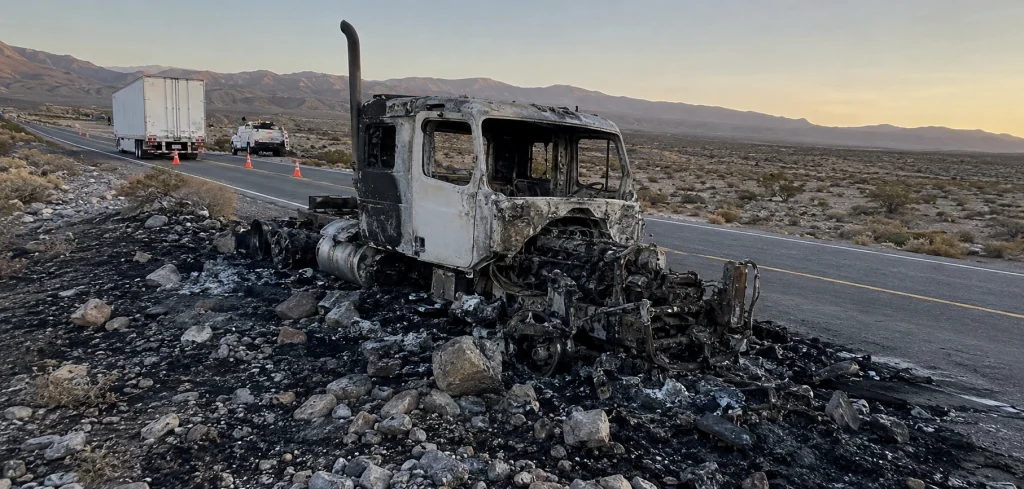
In 2024, six tractor-trailers and one fifth-wheel RV caught fire along CA-190 inside Death Valley National Park. Most of those incidents were linked to overheated brakes while descending steep grades.
The National Park Service has advised drivers of heavy vehicles to use lower gears while descending and, when necessary, stop in a safe location to allow their brakes to cool.
The danger can become even greater when demanding road conditions coincide with extreme temperatures.
A truck driver died on CA-190
The risks of this highway had fatal consequences in May 2025.
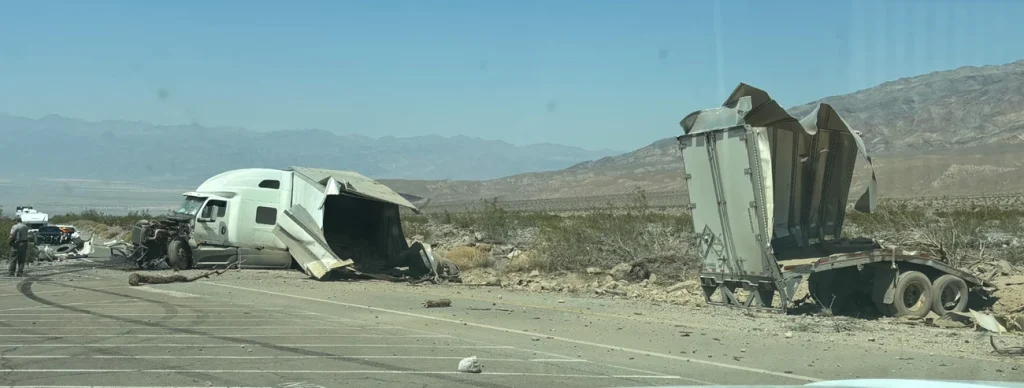
A semi-truck carrying sodium sulfate from Searles Valley crashed at Emigrant Junction following a suspected brake failure. The truck struck a historic building that had once been used as a ranger station, and the driver was killed.
The crash also caused a diesel fuel spill, and wreckage from the truck blocked CA-190 for approximately 22 hours.
Authorities again warned that the long grades on both sides of Towne Pass can cause the brakes of heavy vehicles to overheat.
One month later, another tractor-trailer traveling from Battle Mountain, Nevada, to Long Beach, California, caught fire while descending Towne Pass. The driver managed to disconnect the trailer before the flames spread and escaped without injury, although the tractor was destroyed.
That trip illustrates why some commercial drivers may encounter CA-190 while traveling between Nevada and California, even though park officials discourage heavy trucks from taking the route.
What should drivers do if their vehicle becomes stranded?
The August 17 death highlights one particularly important recommendation for anyone driving through Death Valley: if a vehicle becomes disabled, staying with it is often safer than walking to find help.
A vehicle provides shade and shelter from extreme temperatures and is also much easier for search-and-rescue teams to locate than a person walking across open desert.
Death Valley covers vast areas where cell service is limited or nonexistent, and emergency assistance can sometimes be hours away.
For that reason, the National Park Service advises travelers to check weather and road conditions before departure, plan their route in advance and carry plenty of water and emergency supplies.
Extreme heat safety tips for truckers
For professional drivers, a breakdown that might normally mean a delay or roadside repair can quickly become an emergency in an area such as Death Valley.
Before driving through extreme heat, truckers should pay particular attention to brakes, tires and cooling systems, check fluid levels and make sure they have enough drinking water and emergency supplies onboard.
On highways with long downhill grades such as CA-190, drivers should use an appropriate low gear to control speed and reduce reliance on the brakes. If there are signs of overheating, drivers should stop only in a safe location and allow the braking system to cool.
Checking current road and weather conditions before entering remote areas is also critical, as is considering an alternate route. In Death Valley specifically, although commercial vehicles are allowed on CA-190, the National Park Service discourages commercial trucks from using the highway because of its steep grades.
The death of the stranded driver a week ago occurred under circumstances different from those of a commercial trucking trip. But the case demonstrates how quickly a disabled vehicle can become a serious emergency when extreme heat, isolation and limited communications are involved.
For truckers operating in extreme temperatures, preparation goes beyond vehicle maintenance: knowing what to do if the truck becomes stranded, carrying adequate water and supplies, and avoiding leaving the vehicle to search for help can be critical in an emergency.
It’s essential to travel with insurance that provides 24/7 assistance.
 Business hours: Monday to Friday from 8:00 AM to 5:00 PM. California time