 Hable con un agente al (888) 572-7520
  Enviar mensaje a un agente

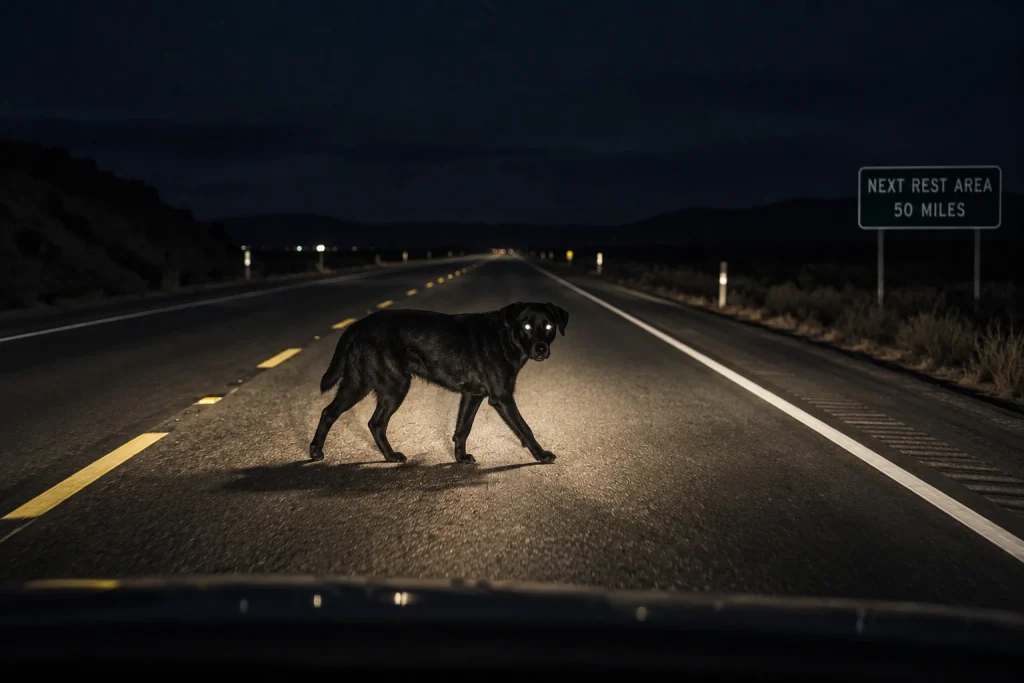

The mysterious Black Dog that suddenly appears in front of a truck. Hitchhikers who vanish without a trace. Headlights that follow a vehicle and disappear without ever passing it. Unexplained lights in the sky.
Driving at night on America’s highways has a folklore all its own. When the cities disappear, traffic thins out and all that lies ahead are miles of asphalt illuminated by headlights, the stories that truckers and travelers have shared for decades begin to emerge.
They are difficult to prove and, for the most part, belong to the oral tradition of America’s highways. But some have become so well known that they are now part of trucking culture.
And one of the most enduring involves a dog said to appear before death.
The “Black Dog”: The Final Warning Before Falling Asleep
The story of the Black Dog has circulated among long-haul truckers for decades.
The versions vary, but the basic story remains remarkably similar: after many hours behind the wheel, usually late at night, a trucker sees an enormous black dog suddenly appear on the highway or running alongside the truck.
The driver brakes. Slows down. Looks again — and the dog is gone.
In trucking folklore, seeing the Black Dog is interpreted as a warning: the driver has reached the limits of fatigue and needs to stop.
Websites devoted to collecting truckers’ stories still document accounts and versions of the “Ghost Dog” legend, which is closely associated with overnight driving and extreme exhaustion. There is no evidence that it is a supernatural phenomenon; what is remarkable is how long the story has endured. (GhostDog Trucker)
Science offers a far less mysterious explanation — but one that matters much more to anyone behind the wheel of a truck.
The Federal Motor Carrier Safety Administration (FMCSA) warns that drivers are naturally less alert at night, particularly after midnight, and that lack of sleep can impair reaction time, attention and decision-making.
The Black Dog may be a legend. The fatigue it represents is very real.
Route 44 and the Red-Haired Hitchhiker
Another famous road legend comes from Massachusetts.
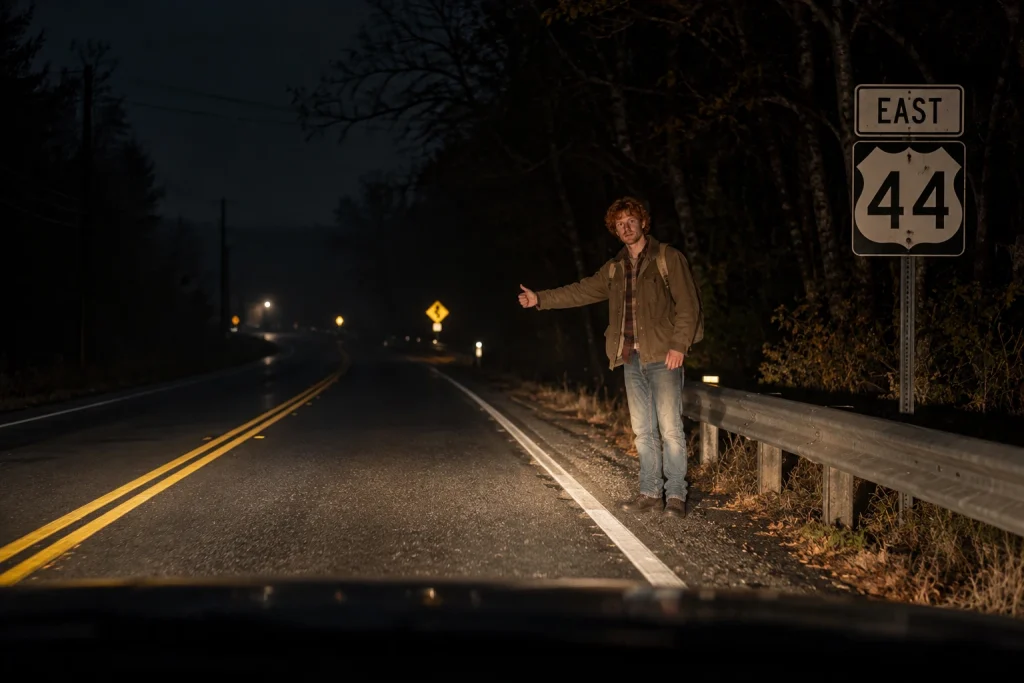
Along a stretch of U.S. Route 44 near Rehoboth, drivers have spent decades telling stories about a mysterious red-haired man who appears walking or hitchhiking along the side of the road.
Some versions say motorists stop for him, only to watch the figure disappear. Others claim the man actually gets into the vehicle before suddenly vanishing.
The story became part of the folklore surrounding an area known as the Bridgewater Triangle, the setting for numerous reports of strange phenomena. Boston.com has documented the legend of the “red-headed hitchhiker” along with other local stories of mysterious roadside apparitions.
Clinton Road: Watch What Appears in Your Mirror
New Jersey has a legendary road of its own.
Clinton Road, in West Milford, runs through a heavily wooded area with little lighting and has accumulated so many strange stories that it frequently appears on lists of America’s supposedly “haunted” roads.
One of the best-known legends involves a ghost vehicle.
A driver sees headlights rapidly approaching from behind. The lights stay right on the car or truck’s bumper for miles. When the driver tries to let the vehicle pass, the lights simply disappear.
What makes the story particularly interesting is that it remains alive among local residents. In 2024, the West Milford Messenger interviewed a woman who said she had twice seen the lights of an alleged ghost vehicle at night. That documents the eyewitness account, of course — not the existence of a supernatural vehicle.
There is also a much simpler explanation for at least part of the legend: Clinton Road has long stretches with few side roads and little lighting. A vehicle traveling behind you can appear to be “following” simply because there are very few places for it to turn off.
But that explanation probably ruins a good truck stop story.
And Then There Are the Lights in the Sky
Truckers are hardly the only people who have looked toward the sky and believed they saw something they could not explain.
America’s fascination with UFOs — now frequently referred to as UAPs, or Unidentified Anomalous Phenomena — exploded after a famous incident in 1947.
On June 24 of that year, private pilot Kenneth Arnold was flying near Mount Rainier in Washington when he reported seeing nine objects moving through the sky.
When Arnold later described their movement, he said they moved like saucers skipping across water. Newspaper coverage transformed that description into a phrase that would become famous around the world: “flying saucers.”
The incident is documented by the National Archives and helped trigger a wave of reports that eventually led the U.S. Air Force to formally investigate the phenomenon.
And the numbers are striking.
Between 1947 and 1969, the U.S. Air Force’s Project Blue Book collected 12,618 reported sightings.
Most eventually received an explanation.
But 701 were classified as “unidentified.”
That does not mean extraterrestrials. The Air Force concluded that it had found no evidence that the unidentified cases involved extraterrestrial vehicles or technology beyond the scientific knowledge of the time. The complete records can now be explored through the National Archives.
When the Brain Starts Filling in What It Can’t See
There is also a reason so many extraordinary stories seem to originate on dark, rural and monotonous highways.
Driving for hours requires sustained attention while the brain receives extremely repetitive visual information: white lines, signs, distant lights, trees, darkness — and then more white lines.
When sleep deprivation is added to that monotony, the issue stops being folklore. It becomes fatigue.
The National Highway Traffic Safety Administration (NHTSA) says drowsy-driving crashes occur most frequently between midnight and 6 a.m. and commonly happen on rural roads and highways.
The agency also warns about microsleeps — brief episodes of sleep that can last only four or five seconds.
At 55 mph, that means traveling more than 100 yards while asleep.
The FMCSA adds a particularly important statistic for truckers: in its Large Truck Crash Causation Study, 13% of commercial motor vehicle drivers involved in the crashes studied were considered fatigued at the time of the crash.
Turning up the radio, opening the window or simply trying to push through does not solve the problem. The FMCSA warns that these tricks can create a false sense of security.

The Stories That Survive at Truck Stops
Maybe that helps explain why the Black Dog has survived for so long.
Before apps, GPS, ELDs and smartphones, stories traveled from trucker to trucker. They moved from one cab to another, from one rest area to the next and across truck stop tables late at night.
Some probably grew with every retelling.
But behind the ghosts, the Black Dog, vanishing hitchhikers and unexplained lights lies a surprisingly practical warning.
If, after too many hours driving down a dark highway, you start seeing things that should not be there, it may not matter whether it is the legendary Black Dog, a shadow or simply exhaustion.
It is time to find a safe place, park the 18-wheeler and get some rest.
 Business hours: Monday to Friday from 8:00 AM to 5:00 PM. California time