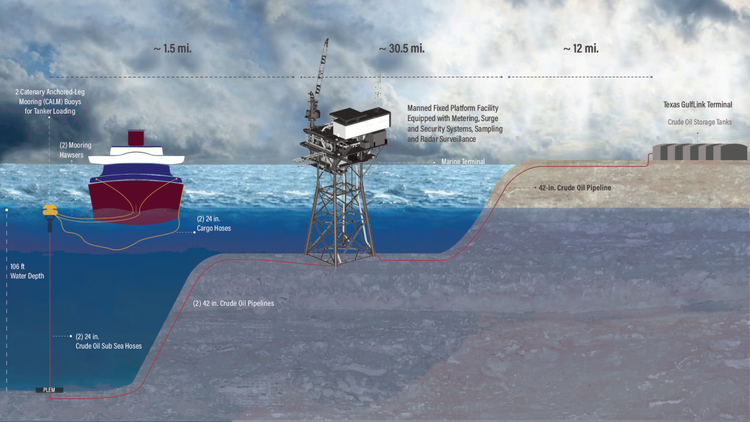
The license issued by the U.S. Department of Transportation (DOT) to the Texas GulfLink project strengthens America’s energy export infrastructure and signals new growth for industrial logistics and heavy-duty trucking.
The U.S. Department of Transportation (DOT) has awarded the first federal license to construct and operate a deepwater oil export port, marking a major milestone in the nation’s energy and maritime strategy. The license was granted to Texas GulfLink, a project designed to expand U.S. crude oil export capacity while modernizing offshore logistics infrastructure.
Announced by Transportation Secretary Sean P. Duffy, the approval represents the first deepwater port license issued under the administration’s initiative to strengthen domestic energy production and streamline export capabilities. The facility will be capable of exporting up to one million barrels of crude oil per day and is engineered to accommodate Very Large Crude Carriers (VLCCs) — massive oil tankers that cannot be serviced at most traditional ports due to draft limitations.
According to DOT officials, the deepwater facility will also reduce vessel congestion in nearshore waters, improve navigational safety, and increase the overall efficiency of U.S. crude exports. Offshore loading allows oil to be transferred directly to large carriers, eliminating the need for complex nearshore transfer operations and significantly cutting logistical delays.
More Than a Maritime Project
While the announcement centers on energy exports, the ripple effects extend well beyond offshore operations. Infrastructure of this scale depends heavily on land-based logistics networks to move equipment, materials, supplies, and operational support.
During the construction phase, the project is expected to drive substantial demand for heavy haul transportation. Oversized steel structures, industrial modules, heavy machinery, and specialized equipment must be transported to staging and support facilities. These movements create opportunities for carriers specializing in over-dimensional loads, industrial logistics, and project cargo operations.
Jobs and Long-Term Logistics Demand
The Texas GulfLink development is projected to create up to 720 jobs tied to construction and operations. But the broader economic impact goes further. Major energy infrastructure projects generate long-term logistical activity that depends on reliable trucking networks.
Once operational, the facility will require continuous deliveries of maintenance materials, replacement parts, safety equipment, technical systems, and operational supplies. These recurring freight flows support regional and long-haul trucking demand and contribute to sustained freight movement tied to energy-sector activity.
Large-scale energy hubs often attract additional industrial development, including storage facilities, service centers, and supporting infrastructure. As those sites come online, freight volumes increase across nearby highways and regional logistics corridors.
A Strategic Node in the Export Chain
By enabling direct loading of VLCCs, the new port improves the reliability and speed of U.S. energy exports. Reducing bottlenecks near shore enhances predictability across the supply chain — a critical factor for trucking operations that depend on precise timing and coordinated delivery schedules.
For the trucking industry, this means deeper integration with high-value industrial and port logistics. Energy export facilities function as complex logistical hubs where maritime operations, storage infrastructure, and constant truck traffic intersect.
Freight associated with these projects extends beyond crude oil. Trucks move specialized components, control systems, safety materials, communications technology, and third-party services that support daily operations.
Infrastructure and Regulatory Coordination
The project underwent a comprehensive review led by the Maritime Administration (MARAD), an agency within DOT, in coordination with the U.S. Coast Guard and multiple federal and state agencies. Officials confirmed that the license was granted only after meeting strict safety, environmental, and security standards.
For logistics providers, this coordinated oversight provides greater regulatory clarity — an important factor for carriers serving critical infrastructure projects. Predictable permitting and operational standards help ensure smoother long-term planning for freight operators working in industrial and energy sectors.
Energy Growth Drives Freight Movement
The deepwater port license highlights how energy expansion directly fuels freight demand on land. Before crude oil reaches global markets, an extensive network of trucks supports every stage of the operation — from construction to daily maintenance.
Projects like Texas GulfLink signal sustained growth in industrial freight activity. For trucking companies, that means new lanes, specialized hauling opportunities, and stronger integration into energy and maritime supply chains.
As offshore export capacity increases, so does the need for reliable surface transportation to keep the system running. In that sense, energy infrastructure doesn’t just power economies — it keeps freight moving.

Why Reefer Is the Most Profitable Segment of 2026
Refrigerated transportation is leading the recovery of the U.S. freight market: higher rates, sustained demand, and key opportunities in Florida and along the Mexico border.

Artemis II and the logistics of space: more like trucking than you think
On Wednesday, April 1, 2026, NASA launched the Artemis II mission, and it made us wonder: what do a truck and a spacecraft have in common?

FMCSA report: HOS violations increase after 2020 rule changes
In a recent report presented to Congress, the Federal Motor Carrier Safety Administration (FMCSA) evaluated the 2020 changes to hours-of-service (HOS) regulations.

How Artificial Intelligence Is Redefining Cargo Theft in the Trucking Industry
The rapid rise of AI-driven fraud schemes—deepfakes, double brokering, and identity theft—is generating multimillion-dollar losses across the freight industry, forcing companies and regulators to rethink security systems.

Wall Street: Transport sector bets on peace and market rebound
Industry leaders predict a significant logistics surge as stabilizing global trade routes and the prospect of peace ignite a much-needed recovery for major transport firms.

Truck Mechanics: The Most In-Demand Job in the United States
The shortage of truck mechanics has become a critical challenge for the transportation industry—but also a high-paying career opportunity.