 Hable con un agente al (888) 572-7520
  Enviar mensaje a un agente



Florida has one of the busiest highway networks in the United States. Population growth, tourism, ports, logistics hubs and the daily movement of freight place enormous pressure on the state’s major highways.
But what are the busiest highways in Florida?
Data from the Florida Department of Transportation (FDOT) provides a way to measure traffic volumes through Annual Average Daily Traffic (AADT). This metric represents the average number of vehicles traveling through a specific roadway segment each day over the course of a year. FDOT collects traffic information throughout the year and publishes annual statistics, with 2025 data currently available.
For truck drivers, knowing which corridors carry the most traffic is particularly important. High AADT can mean heavier congestion, changing speeds, more interaction with passenger vehicles and less predictable travel times, especially when crossing Florida’s major metropolitan areas.
I-95: One of Florida’s Major Traffic Corridors
Interstate 95 (I-95) is impossible to overlook when discussing Florida’s busiest highways. It runs along the state’s Atlantic coast, passing through or connecting Miami, Fort Lauderdale, West Palm Beach, Daytona Beach and Jacksonville before continuing north into Georgia.
Traffic volumes vary considerably depending on the section of highway, with South Florida recording some of the highest numbers.
Recent FDOT documentation for the I-95 corridor in southern Broward County illustrates the scale of the traffic. On certain segments, 2024 AADT ranged from approximately 269,000 to 291,000 vehicles per day. Projections for 2050 put those figures at approximately 303,000 to 333,000 vehicles per day on some sections.
That makes I-95 a particularly demanding corridor for commercial transportation. The challenge is not simply the number of vehicles. Long-distance traffic shares the highway with commuters and other local traffic moving through densely populated metropolitan areas.
I-4: The Main Artery Through Central Florida
Interstate 4 (I-4) is another critical Florida corridor. It connects the Tampa area with Orlando and Daytona Beach, crossing a region that has experienced significant population and economic growth.
For truckers, I-4 is strategically important because it connects distribution centers, industrial areas, tourist destinations and other major highways used to reach different parts of Florida.
Traffic around Orlando can be especially intense. Unlike a highway used primarily for intercity travel, I-4 carries a combination of commercial vehicles, local residents, commuters and millions of visitors traveling throughout Central Florida.
For professional drivers, this means that the time of day they cross Orlando can have a significant impact on total travel time.
I-75: A Critical Freight Artery
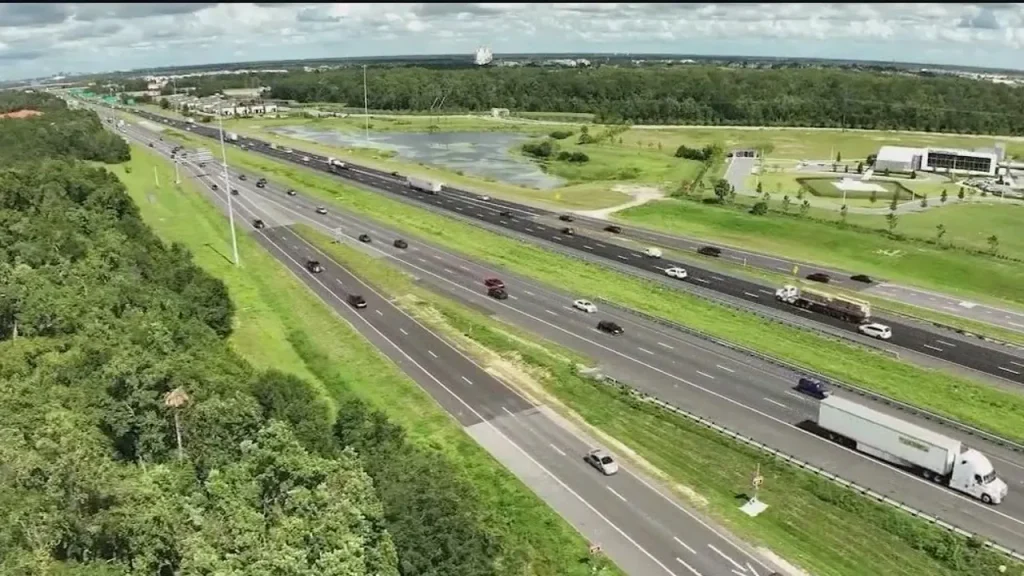
Interstate 75 (I-75) is particularly important to the trucking industry. It enters Florida from Georgia, crosses the northern and central parts of the state and continues toward the Gulf Coast before crossing Alligator Alley into South Florida.
Its length and location make it one of Florida’s primary north-south freight corridors.
Historical FDOT data also shows how traffic volumes increase as the highway approaches major metropolitan areas. A statewide study of interstate corridors reported that I-75 reached approximately 154,500 vehicles per day at its southern end in Miami-Dade, while less heavily traveled sections recorded substantially lower volumes.
The difference highlights an important point: describing a highway as “busy” does not mean every mile carries the same amount of traffic.
For a truck driver, knowing which segment and what time of day can be much more useful than knowing the highway’s overall average.
Florida’s Turnpike: Another Key Corridor
Florida’s Turnpike is also a major part of the state’s highway network, particularly for trips between Central and South Florida.
Its importance to commercial transportation comes from its connections to the South Florida metropolitan area and to numerous corridors used to distribute freight across the state.
For carriers, however, there is another factor to consider: Florida’s Turnpike is a toll road.
That means route planning involves evaluating not only congestion and travel time, but also toll costs compared with alternative routes.
In trucking, the shortest route is not necessarily the most cost-effective. Tolls, fuel consumption, congestion and available driving hours can completely change the equation.
I-275 and the Tampa Bay Highway Network
The Tampa Bay region also handles significant traffic volumes. I-275 plays a central role in metropolitan travel and connects with I-75 and other important highways.
For truckers, the area presents a challenge similar to Miami and Orlando: heavy local traffic mixes with commercial vehicles that need to cross the metropolitan area or reach logistics and industrial facilities.
Large urban areas explain much of the variation in traffic volumes from one highway segment to another. FDOT has noted that interstate traffic increases significantly near metropolitan areas because these highways also serve daily commuter trips between suburbs and urban centers.
How Does Florida Know How Many Vehicles Use Its Highways?
FDOT maintains an extensive traffic monitoring infrastructure across the state.
Its Traffic Data Section operates a network of approximately 300 continuous monitoring sites that transmit information daily. Shorter traffic studies are also conducted at thousands of additional locations.
Depending on the monitoring station, the information collected can include traffic volume, vehicle classification, speed, weight and the percentage of trucks using a roadway.
This allows transportation officials to measure much more than the number of cars passing a specific point.
FDOT also provides geographic datasets for Annual Average Daily Traffic, showing traffic volumes across different segments of Florida’s State Highway System. GIS data related to AADT and Truck AADT can also help identify where heavy commercial vehicle traffic is concentrated.
What Do Florida’s Busiest Highways Mean for Truckers?
For commercial drivers, Florida’s busiest highways include corridors that are often difficult to avoid.
I-95 dominates much of the Atlantic Coast; I-4 cuts across the heart of the state; I-75 provides one of Florida’s most important north-south connections; Florida’s Turnpike facilitates travel between Central and South Florida; and I-275 forms part of the complex Tampa Bay highway network.
The key issue is that traffic volume can change dramatically along the same highway.
A rural segment may offer relatively free-flowing traffic, only for the same highway to enter a metropolitan area carrying more than 200,000 vehicles per day just a few dozen miles later.
For truck drivers and fleet operators, planning a route through Florida therefore involves much more than calculating mileage. Checking current traffic conditions, considering peak travel periods and anticipating potential delays can help reduce unproductive time on the road and improve safety.
On corridors where thousands of commercial vehicles share the road every day with enormous volumes of passenger traffic, being prepared for the unexpected is also essential. Having the right commercial truck insurance coverage and access to 24/7 assistance can make a major difference when an accident, breakdown or other problem disrupts a trip.
 Business hours: Monday to Friday from 8:00 AM to 5:00 PM. California time