 Hable con un agente al (888) 572-7520
  Enviar mensaje a un agente

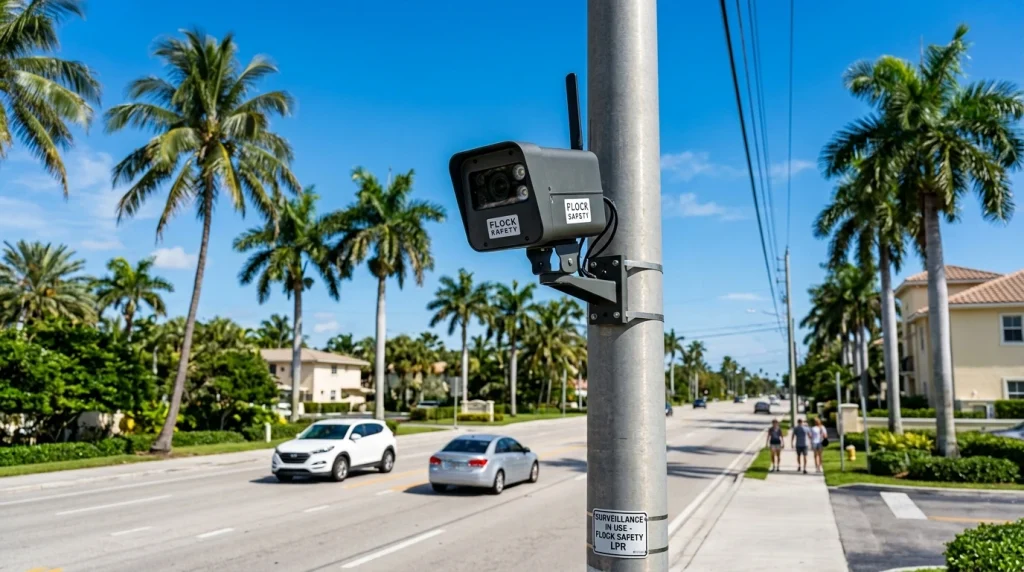

For years, Flock cameras have quietly appeared along highways, at city entrances and near intersections across the United States. They may look like small traffic cameras mounted on poles, but their purpose is different: they can identify vehicles, capture license plates and store information that can later be used in law enforcement investigations.
Now, the Florida Department of Transportation (FDOT) has revoked approvals for automated license plate readers installed along state roadways and directed local law enforcement agencies to remove them.
Devices that remain in place after the 30-day deadline may be removed by the state itself.
The department will also stop accepting new applications to install this type of equipment along those roads.
The decision applies to Automated License Plate Readers (ALPRs), a technology offered by several companies, although much of the controversy has centered on Flock Safety, one of the country’s leading providers.
What Are Flock Cameras?
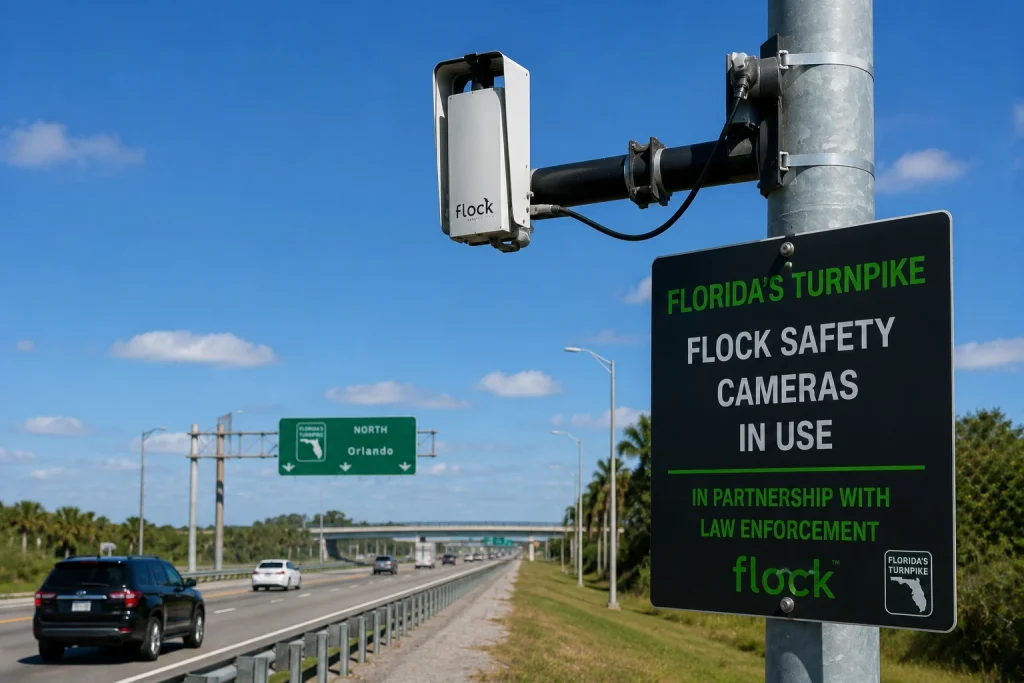
These are not traditional cameras designed simply to monitor traffic, nor do they necessarily work like cameras used to issue speeding tickets.
Flock devices are automated license plate readers. When a vehicle passes one, the system can capture its license plate and other vehicle characteristics, turning that information into searchable data that authorized agencies can access later.
The cameras use recognition technology and machine learning to identify vehicle information. A police department, for example, can search for a license plate associated with a stolen car or an investigation and determine whether that vehicle passed any camera within the network.
That capability helps explain why law enforcement agencies adopted the technology so quickly.
ALPR systems can help locate stolen vehicles, find missing people or generate leads in serious criminal investigations. Supporters argue that the technology can complete in seconds searches that once required hours of police work.
But that same capability has raised a much more complicated question: what happens to the information collected from millions of drivers who are not suspected of any crime?
The Issue Is No Longer Just Reading a License Plate
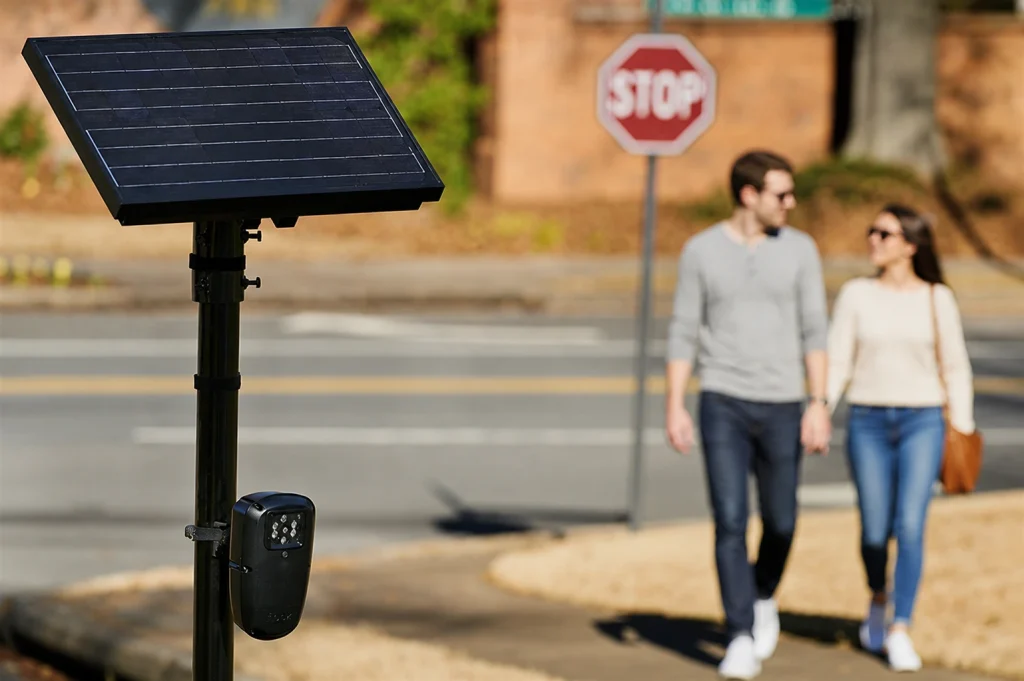
A license plate is visible to anyone on a public road. The controversy surrounding ALPRs involves something different: the ability to automatically record thousands or millions of vehicle movements, store those records and turn them into a searchable database.
A single camera can record that a vehicle passed a particular location.
A network of cameras can do something much more powerful: create multiple records of that same vehicle appearing in different places at different times.
For an ordinary driver, that can mean information about where the vehicle has traveled. For a trucker covering hundreds of miles every day, the potential number of records can be considerably greater.
The concern grows when that data can be accessed across jurisdictions.
A recent investigation by WIRED showed just how extensive those networks can become: the Alpharetta Police Department in Georgia was sharing information from its Flock system with more than 2,000 organizations while also being able to receive data from numerous other agencies.
The issue has also reached Florida.
According to Axios, the Hollywood Police Department shared data from its automated license plate readers with 365 law enforcement agencies across the United States, including agencies located thousands of miles from Florida.
That reach helps explain why technology initially presented as a local law enforcement tool has evolved into a national debate over surveillance.
Where Did the Controversy Begin?
The backlash did not emerge overnight.
Over the past several years, cases have surfaced involving cross-jurisdictional data sharing, questionable access and the use of these systems for purposes different from those that originally justified their installation.
In June 2026, for example, an audit by the San Francisco Police Department found that federal and out-of-state agencies had improperly accessed the city’s license plate reader data hundreds of times.
Other cases have been far more personal.
In Florida, a recent internal investigation found that a Brevard County officer had used the Flock system while off duty and without a valid law enforcement reason to search for an ex-partner’s vehicle. The officer ultimately resigned.
Another recent case in Georgia involved an officer accused of repeatedly using Flock to track the vehicles of an ex-partner and another officer.
These incidents have fueled a central concern: a tool created to investigate crime can also become, when safeguards fail, an extremely powerful way to track someone’s movements.
Florida Steps In
In a memorandum issued August 31, FDOT cited the rapid growth of these devices along roadways as well as concerns involving potential misuse, data privacy and surveillance practices.
Gov. Ron DeSantis has also questioned the expansion of these cameras and called for greater limits on their use.
The shift is significant because Florida had previously allowed structures specifically designed for license plate readers within its roadway system. In fact, official FDOT documentation included several Flock Safety mounting systems among equipment whose structural designs had been reviewed and approved for use in Florida.
Is Florida Banning All Flock Cameras?
No. FDOT’s order applies to readers installed within the state transportation department’s roadway jurisdiction and on public roads covered by its approvals. It does not automatically mean that every Flock camera in Florida will disappear.
Cities, counties, police departments, private communities and other entities may have devices installed outside those areas under different rules and contracts.
Drivers may therefore continue to encounter license plate readers in different parts of the state.
What has changed is that Florida is using its authority over state roadway infrastructure to limit an expansion officials increasingly view as problematic.
What Does Flock Safety Say About the Data?
The company says its customers own and control the information collected by their cameras and decide who can access it. Flock also says it does not sell the data and that agencies can restrict or revoke access granted to other organizations.
The company also says ICE does not have direct access to Flock cameras or their data, and that any sharing with a federal agency depends on the decisions and authorization of the local agencies that control that information.
However, investigations into how different police departments share data are precisely one of the reasons the broader debate remains unresolved.
Why Should Truckers Care?
Because few workers spend as many hours driving under roadside cameras as professional drivers.
A trucker can travel through multiple cities, counties and states in a single day. Tractors and trailers are constantly moving through highways, intersections, industrial entrances, warehouses and major metropolitan areas.
The debate over ALPRs does not mean that every camera is individually tracking every truck driver. Nor does capturing a license plate automatically mean the information is being misused.
The issue is broader: the technology makes it technically possible to build increasingly extensive records showing where and when a vehicle was detected.
And in an industry built around the constant movement of commercial vehicles, questions about who can access those records, how long they are retained and what they can be used for take on particular importance.
Florida has now become one of the clearest examples of that debate.
Cameras that for years were promoted primarily as tools for finding vehicles and fighting crime are now at the center of a much larger discussion across the United States: how much surveillance is acceptable on a public road, and who should control the information vehicles leave behind every time they pass a camera?
 Business hours: Monday to Friday from 8:00 AM to 5:00 PM. California time