 Hable con un agente al (888) 572-7520
  Enviar mensaje a un agente

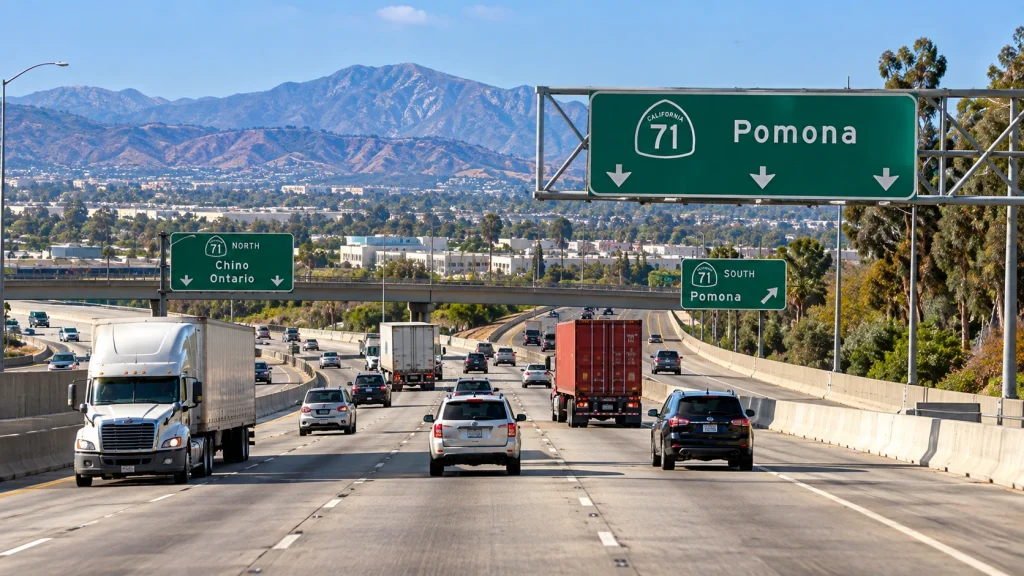

Two major freight corridors in Florida and Los Angeles County will receive federal funding to expand capacity and reduce congestion. The projects are part of a $426 million investment announced by the U.S. Department of Transportation (USDOT) for infrastructure projects across 12 states.
For truck drivers and motor carriers, both investments have a clear objective: increase capacity along heavily traveled corridors and reduce bottlenecks that affect travel times and freight movement.
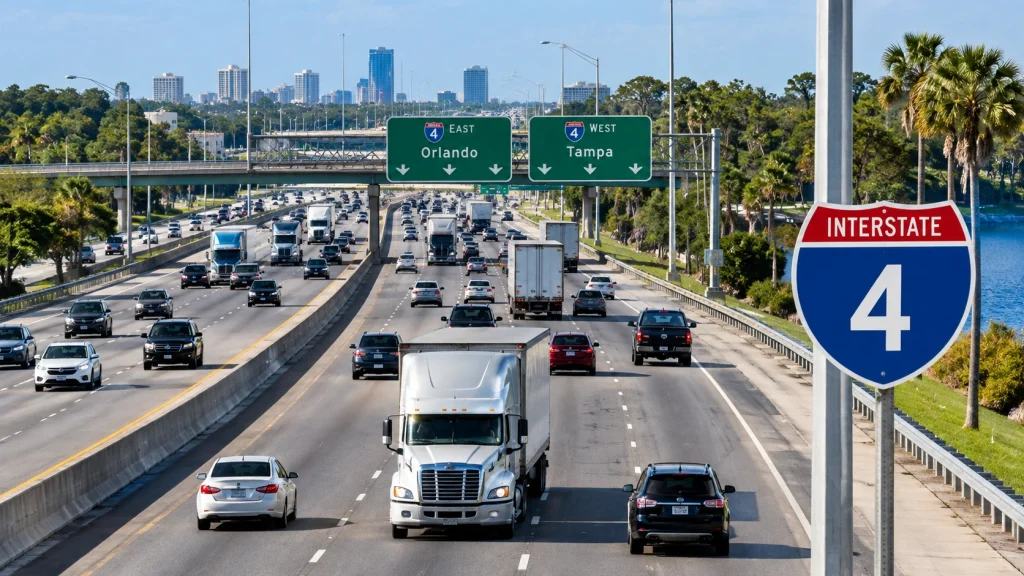
Florida: $85 million to widen 20 miles of I-4
The Florida Department of Transportation (FDOT) will receive $85 million to widen approximately 20 miles of Interstate 4 (I-4) between State Road 434 and State Road 472 in Seminole and Volusia counties.
The project will add one new general-purpose lane in each direction, increasing capacity along one of Central Florida’s busiest transportation corridors.
For truck drivers, the investment is particularly significant because I-4 is one of Florida’s primary east-west transportation routes, connecting the Tampa area with Orlando and providing access to the I-95 corridor along the Atlantic Coast.
USDOT specifically noted that the expansion will increase freight capacity and reduce congestion along this section of the interstate.
The project area is located north of metropolitan Orlando and continues a broader series of improvements along I-4 aimed at accommodating Central Florida’s growing traffic demand.
For fleets and drivers that regularly use this corridor, the most important long-term benefit will be additional highway capacity in an area where local traffic, tourism, population growth and commercial transportation combine to create significant traffic volumes.
Los Angeles: SR-71 to expand from four to eight lanes
In California, the Los Angeles County Metropolitan Transportation Authority (Metro) will receive $25 million for the State Route 71 Gap Closure Project in Pomona.
The project will convert the existing four-lane expressway into an eight-lane freeway, with median barriers and auxiliary lanes. It will also include safety improvements along a corridor where the collision rate is 30% higher than the statewide average, according to USDOT.
SR-71 also plays a strategic role in freight transportation because it provides connections to some of Southern California’s most important highways.
Documents from the California Transportation Commission identify SR-71 as an interregional corridor connecting I-10, SR-60 and SR-91, with the improvements intended to increase the reliability and efficiency of the freight network.
The project also includes auxiliary lanes between Mission Boulevard and Valley Boulevard, reconstruction of two bridges over railroad facilities, sound walls and a new accessible pedestrian crossing.
The federal government identifies this location as a critical freight bottleneck within the National Highway System, meaning the expansion is designed not only to improve local traffic conditions in Pomona but also to support the regional movement of goods.
More investment in U.S. freight corridors
The Florida and Los Angeles projects are part of a much broader infrastructure package. The $426 million will be distributed among projects in 12 states through the Nationally Significant Multimodal Freight & Highway Projects (INFRA) program, which funds highway and freight infrastructure considered important to national and regional transportation networks and supply chains.
Among the other investments announced is Savannah, Georgia, which will receive $11.3 million to build a new four-lane divided connector from I-516 to a realigned White Bluff Road. The project is part of a corridor that is important for port-related logistics and hurricane evacuation.
In Wichita, Kansas, the federal government will provide $53.5 million to reconstruct and widen approximately 2.5 miles of K-96 from four to six lanes. USDOT identifies the section as Kansas’ top freight bottleneck and estimates the highway will eventually serve approximately 5,000 trucks per day.
Louisiana will also receive $28 million to replace a signalized intersection in the Lafayette area with a new grade-separated interchange, including ramps, elevated bridges and improvements along Kaliste Saloom Road and US-90. The federal government ranks the location among the top 100 freight bottlenecks in the United States.
U.S. Transportation Secretary Sean P. Duffy said the investments are intended to modernize the nation’s freight infrastructure and strengthen supply chains. The projects are part of broader efforts to improve the country’s major commercial transportation corridors.
For truckers and motor carriers, the Florida and California projects are especially significant because of their locations along heavily traveled commercial corridors. However, the $426 million represents federal funding for infrastructure projects and does not mean the additional lanes will become available immediately.
Drivers will still need to monitor construction zones, closures and traffic restrictions as the projects move forward.
Before traveling through these areas, truck drivers can check official updates from the Florida Department of Transportation and Caltrans for current road conditions, construction activity and restrictions.
 Business hours: Monday to Friday from 8:00 AM to 5:00 PM. California time