 Hable con un agente al (888) 572-7520
  Enviar mensaje a un agente

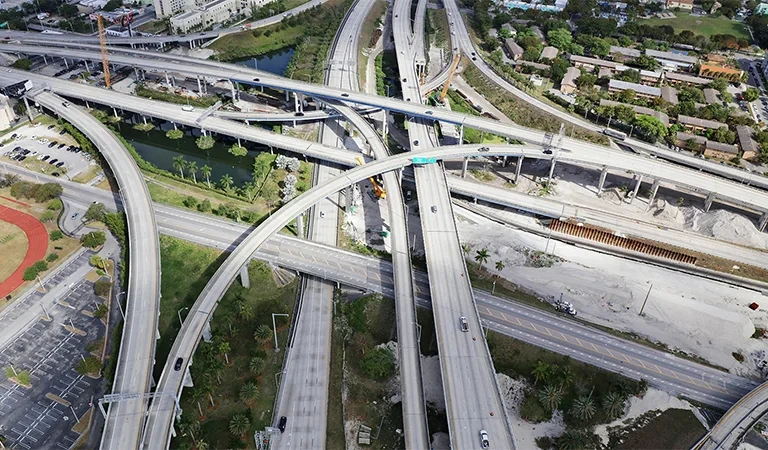

Florida has one of the largest and most diverse transportation systems in the United States. Roads, bridges, seaports, airports, and railroads form an extensive network that must accommodate the needs of residents as well as the State’s enormous tourism and commercial activity.
The latest figures published by the Florida Department of Transportation (FDOT) help illustrate the scale of that infrastructure and, in particular, the important role played by road transportation.
Florida had 23.4 million residents in 2025 and welcomed 143.3 million visitors that same year. The State also had a GDP of $1.7 trillion in 2024.
Moving people and goods across a State of this size requires an enormous transportation network.
How Many Miles of Roads Does Florida Have?
Florida’s public road network extends for more than 122,000 miles.
According to FDOT, 12,273 miles of public roads are maintained by the State, while another 110,029 miles are maintained locally.
Florida also has extensive bridge infrastructure. The State-maintained system includes 7,285 highway bridges, while another 5,763 bridges are maintained locally.
FDOT also reports that 83% of State Highway System pavement was in good condition in 2025, while 95% of State Highway System bridges were rated in good condition.
These numbers are especially important for the trucking industry, since major commercial routes depend on reliable infrastructure to keep freight moving efficiently.

How Much Traffic Do Florida Roads Handle?
Approximately 682 million vehicle miles are traveled on Florida’s public roads every day.
Of that total, 371 million daily vehicle miles are traveled on the State Highway System, representing 54% of all daily vehicle miles traveled.
Florida also has approximately 22 million registered vehicles, according to FDOT’s 2026 figures.
This level of traffic helps explain the importance of corridors such as I-4, I-75, I-95, and Florida’s Turnpike, which connect major metropolitan areas, logistics hubs, and key points where goods enter and leave the State.
How Much Freight Do Trucks Move?
Trucking plays a central role in Florida’s transportation system.
The latest figure available from FDOT shows 899 million tons of freight moved by combination trucks, based on 2022 data.
The scale becomes even clearer when compared with other modes of transportation. Florida’s 16 public seaports handled 113 million tons of freight in 2025, while aviation accounted for approximately 4 million tons in 2024.
These transportation modes do not necessarily compete with one another. Much of Florida’s logistics activity depends on how they connect. Freight arriving at a seaport, airport, or rail terminal frequently needs a truck to complete another stage of its journey.
That makes highways and trucks some of the most important links in Florida’s logistics chain.
How Is Florida Connected by Land, Sea, and Air?
Florida’s transportation system extends far beyond its highways.
The State has 16 public seaports, 21 primary commercial-service airports, and 2,777 miles of rail mainline. It also has 30 urban transit systems and 18 rural transit systems.
Together, these systems connect major cities and distribution centers with ports, airports, and other regions of the United States.
For truck drivers, these connections are particularly important. A significant part of freight transportation does not begin or end on a highway. Trucking also involves trips to warehouses, distribution centers, ports, rail terminals, and other logistics facilities.
Why Is Florida Divided Into Seven Transportation Districts?
To manage a network of this size, FDOT divides Florida into seven districts.
Each district has very different characteristics. According to FDOT’s district data, District 5 has the most public road miles, with 24,443, followed by District 2 with 22,313 and District 1 with 21,828.
District 2 covers 18 counties, while District 6 includes only two. The districts also differ in their number of bridges, airports, seaports, transit systems, and rail infrastructure.
Florida’s Turnpike also plays a distinct role in the State’s transportation network and had 799 bridges in 2025.
How Congested Are Florida’s Roads?
Florida’s enormous traffic volume also creates challenges.
In 2024, 5.4% of State Highway System centerline miles were heavily congested during peak hours.
For commercial drivers, congestion has real consequences. It can increase travel times and fuel consumption while making it more difficult to plan deliveries and manage hours of service.
With more than 23 million residents, millions of visitors, and an enormous volume of freight moving throughout the State, keeping Florida’s transportation network flowing is an ongoing challenge.
Florida by the Numbers: A Transportation Network Where Trucking Is Key
FDOT’s figures show the scale of transportation in Florida: more than 122,000 miles of public roads, 22 million registered vehicles, 16 public seaports, 21 primary commercial-service airports, and nearly 900 million tons of freight moved by combination trucks, based on the latest available year for each indicator.
For those working in the trucking industry, understanding this network helps explain why Florida’s highways play such an important role in the State’s economy and the movement of goods.
Before every trip, checking current road conditions, preparing for potential delays, and keeping your truck properly insured remain essential steps for traveling safely across Florida.
 Business hours: Monday to Friday from 8:00 AM to 5:00 PM. California time