 Hable con un agente al (888) 572-7520
  Enviar mensaje a un agente



The trucking industry is facing one of its biggest regulatory and technological shifts in years. The U.S. Department of Transportation has officially launched “Motus,” a new digital platform designed to combat fraud within the federal carrier registration system — an issue that has increasingly concerned regulators, logistics companies, brokers, insurers, and fleets across the country.
The initiative was introduced by Transportation Secretary Sean P. Duffy alongside the Federal Motor Carrier Safety Administration (FMCSA). The system specifically targets shell companies, fraudulent registrations, and repeat offenders that continue operating under new business identities.
According to federal authorities, thousands of suspicious registration numbers are currently linked to fraudulent operators in the trucking industry. The problem goes far beyond paperwork violations. It is also tied to highway safety risks, sanction evasion, and the difficulty of tracking carriers with negative safety histories.
An outdated system that enabled fraud
For decades, the federal trucking registration system operated through a fragmented technological structure that many industry groups considered outdated and vulnerable.
Federal officials acknowledged that the previous system allowed companies to obtain registrations with minimal verification requirements, often using little more than an email address, a company name, and a physical address.
In addition, trucking registration data was spread across multiple disconnected applications, creating major blind spots and making it difficult to detect suspicious patterns or repeated violations.
This fragmentation enabled the rise of so-called “chameleon carriers” — companies that shut down after accumulating violations, safety issues, or poor records, only to reopen under a different name or a new federal registration number.
For many within the industry, these practices became one of the most serious structural problems in modern trucking.
How Motus will work
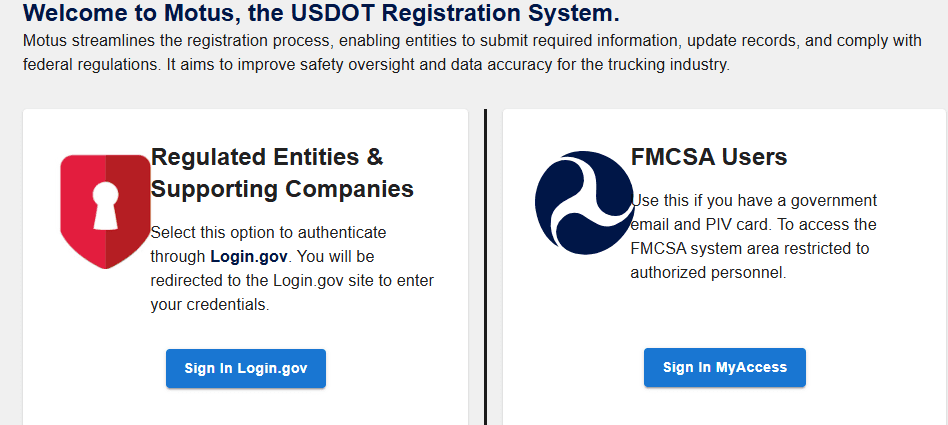
The new Motus platform is designed to eliminate those gaps.
The system will centralize registration, validation, and monitoring processes into a single federal digital environment. Among its main features are biometric facial recognition, government-issued ID verification, advanced data analytics, and automated business validation tools.
According to FMCSA, the goal is to prevent fraudulent operators from hiding their identities or recycling business structures to avoid enforcement actions.
The system also promises a more streamlined experience for legitimate carriers. Federal officials stated that Motus will reduce administrative delays, simplify renewals, and allow operators to complete registration processes through a unified mobile-friendly platform.
To access the system, operators will need a login.gov account, the federal government’s official authentication platform.
Increased oversight for carriers and brokers
The implementation of Motus could significantly impact multiple segments of the logistics industry.
The changes will not only affect carriers and commercial drivers but also brokers, freight forwarders, dispatch services, and other transportation-related businesses.
In recent years, the growth of registration fraud has coincided with rising cargo theft cases, identity fraud, and logistics operations linked to difficult-to-trace companies.
Several industry associations have repeatedly pushed for a modernization of the federal registration system, especially as digital fraud schemes became increasingly sophisticated.
The introduction of biometric verification represents a major departure from the previous low-barrier registration process.
Safety concerns and political pressure
The launch also carries a strong public safety and political message.
During the official announcement, Secretary Sean Duffy argued that the old system allowed dangerous operators to continue working on American highways.
“Dangerous drivers and shell companies have been taking advantage of this weak and outdated federal system for years,” Duffy stated during the launch event.
Federal officials believe that a portion of serious trucking-related crashes involve companies with irregular records or hidden safety histories tied to repeated corporate identity changes.
For that reason, Motus is not only intended to modernize federal administration but also to strengthen oversight of high-risk operators.
The digital future of trucking
Beyond its immediate impact, Motus reflects a broader transformation taking place across the logistics industry: the rapid digitalization of oversight and compliance systems.
Biometric technology, advanced data intelligence, and centralized digital platforms are becoming increasingly common tools within modern commercial transportation.
For many companies, this could mean stricter documentation requirements and tighter compliance standards. At the same time, it could also create a more transparent market with fewer opportunities for fraudulent operators.
FMCSA stated that the platform was built to evolve alongside future regulatory and technological needs, allowing additional monitoring and enforcement tools to be integrated over time.
For now, the federal message is clear: trucking registration will no longer be easy to manipulate, and fraud in the trucking industry has become a national enforcement priority.
 Business hours: Monday to Friday from 8:00 AM to 5:00 PM. California time