 Hable con un agente al (888) 572-7520
  Enviar mensaje a un agente

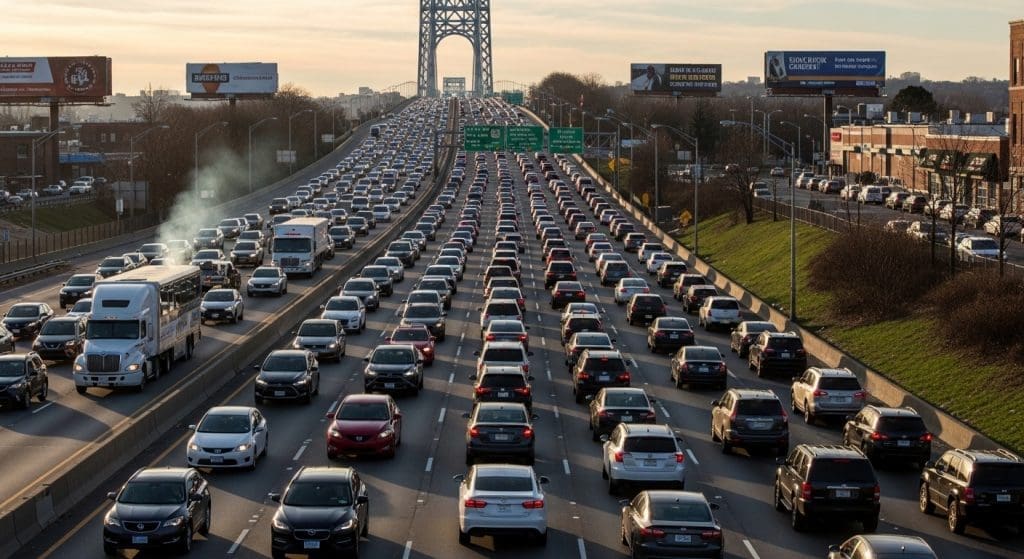

The U.S. government has launched a new strategy to address one of the most costly structural challenges facing its economy: traffic congestion. Under the name Freedom to Drive, the Department of Transportation (USDOT) introduced a program focused on eliminating the most critical bottlenecks across the national highway network, placing freight movement back at the center of infrastructure policy.
The initiative, led by Transportation Secretary Sean P. Duffy in coordination with the Federal Highway Administration (FHWA), establishes a clear framework: each state must identify between two and five of its worst congestion points and submit concrete action plans to address them. The goal is to maximize the capacity of existing roads, accelerate congestion relief projects, and promote public-private partnerships to finance large-scale infrastructure improvements.
The hidden cost of congestion for trucking
For the trucking industry, the timing of this initiative is critical. Congestion is not just an urban mobility issue—it is a structural factor that directly impacts operating costs, logistics efficiency, and overall competitiveness.
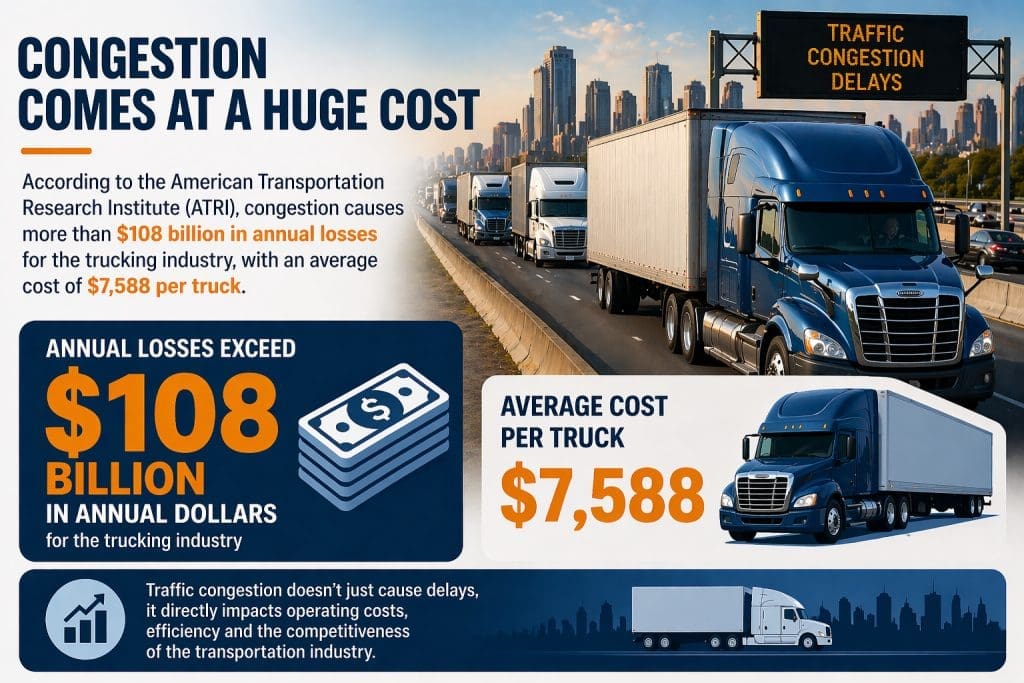
According to the American Transportation Research Institute (ATRI), traffic bottlenecks generate more than $108 billion in annual losses for the trucking industry, with an average cost of $7,588 per truck.
Operationally, the impact is even more striking. The total delays across major freight corridors are equivalent to having more than 436,000 drivers completely idle for an entire working year—an indicator of systemic inefficiency across the supply chain.
More than traffic: a national economic issue
USDOT also highlighted the broader impact of congestion: in 2024, the average urban commuter lost 63 hours sitting in traffic, resulting in a $269 billion hit to national productivity.
More importantly, the agency explicitly acknowledged that delays in freight and commercial activity are a direct drag on the economy. This represents a significant shift in policy perspective, as congestion strategies have historically focused on passenger vehicles while overlooking freight mobility needs.
Where the worst bottlenecks are located
The problem is well mapped. The ATRI Top 100 Truck Bottleneck Report 2025 identifies key hotspots in areas such as Fort Lee (New Jersey), Atlanta, Chicago, Los Angeles, and Houston.
In these corridors, peak-hour truck speeds drop to critical levels, with a national average of just 34.2 mph in the most congested locations.
Even more concerning is the trend: the number of locations with speeds below 45 mph continues to rise, indicating that congestion is spreading rather than concentrating.
Chicago: proof that investment works
Not all indicators are negative. The Jane Byrne Interchange in Chicago provides a clear example that targeted infrastructure investment can deliver measurable results.
After ranking as the worst truck bottleneck in the country for years, sustained federal investment helped improve peak-hour speeds by nearly 25% and significantly reduced its ranking impact. This case reinforces a core idea behind the program: addressing key nodes can generate system-wide improvements.
What changes for trucking companies
For fleets and logistics operators, Freedom to Drive has direct operational implications. One of the most important is the potential improvement in travel time predictability—a key factor for complying with Hours of Service (HOS) regulations.
Unpredictable congestion remains one of the biggest challenges for route planning and on-time delivery performance. Any structural improvement in critical corridors could translate into greater operational efficiency and reduced regulatory risk.
Infrastructure, investment, and new funding models
The program also signals a shift in how infrastructure may be financed. With the cost of modernizing the U.S. road network approaching $1 trillion, the government is encouraging stronger private sector participation.
This could lead to new funding models, including concessions, privately financed freight corridors, and dynamic tolling systems on key logistics routes.
A shift in priorities: freight back at the center
Beyond its technical components, Freedom to Drive represents a broader policy shift. In a context defined by e-commerce growth, supply chain pressure, and the need for greater efficiency, freight mobility is once again a central priority.
The message is clear: improving the flow of goods is not just a transportation issue—it is essential for economic competitiveness.
The challenge ahead: from planning to execution
The real test will be implementation. The speed at which states respond, the quality of proposed solutions, and the ability to coordinate large-scale investments will determine the program’s success.
If effectively executed, Freedom to Drive could mark a turning point in how the United States addresses one of its most persistent challenges: traffic congestion as a structural barrier to economic growth.
 Business hours: Monday to Friday from 8:00 AM to 5:00 PM. California time