 Hable con un agente al (888) 572-7520
  Enviar mensaje a un agente



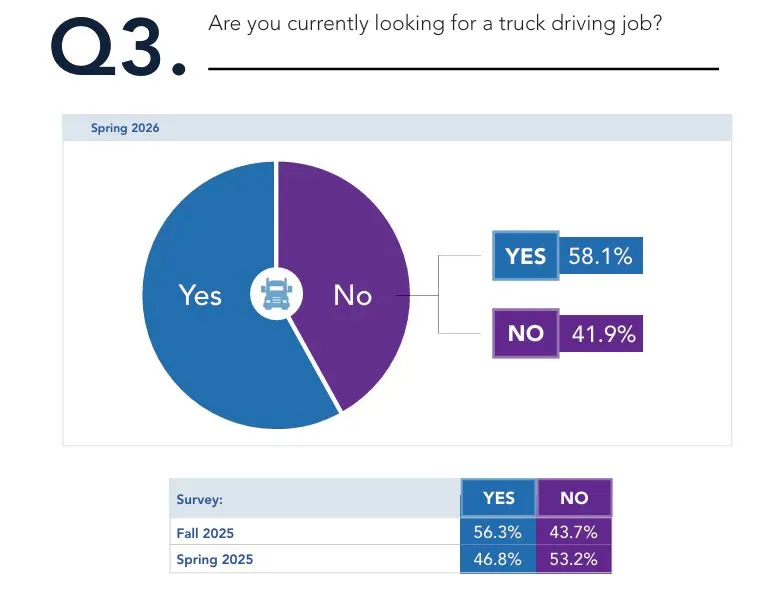
The gradual improvement in freight volumes and transportation rates is beginning to generate a familiar effect in the trucking industry: increased driver turnover. This is according to the Spring 2026 Truck Driver Survey conducted by Conversion Interactive Agency and People. Data. Analytics. (PDA), which found that a record 58.1% of drivers are currently seeking a new job, compared with 46.8% during the same period in 2025.
The results reflect a significant shift in the transportation labor market. After several years of uncertainty and reduced activity, the recovery in freight demand is creating new employment opportunities for drivers, who now have more options to switch companies in search of better working conditions.
Priscilla Peters, Vice President of Marketing at Conversion, explained in a recent article published by Transport Topics that driver turnover has historically increased when freight markets and carrier rates improve. Although the overall pool of drivers has shrunk, the availability of new job openings is encouraging greater workforce mobility within the industry.
Scott Dismuke, Vice President of Operations at PDA, noted that carriers cannot assume their drivers will remain in their current positions as market conditions continue to improve. According to Dismuke, drivers are becoming increasingly mobile and evaluate multiple factors before deciding where to work.
Truck Driver Turnover: Drivers Seek a Balance Between Quality of Life and Financial Stability
The survey reveals that home time and higher, more predictable pay remain the primary reasons truck drivers look for new employment. Drivers are seeking a balance between quality of life and financial stability, while factors such as benefits, equipment quality, and working conditions also influence their decisions.
In addition, more than one in four drivers reported feeling undervalued in their current job, highlighting ongoing communication and organizational culture issues across many fleets. Respect, attention to drivers’ needs, and effective communication continue to be key factors in employee retention.
Pressure on trucking companies is increasing at a time when the available driver workforce has been reduced by several factors, including stricter regulatory requirements. The U.S. Department of Transportation has begun strengthening oversight of commercial driver’s licenses for non-domiciled drivers and enforcing English language proficiency requirements. Many industry analysts view these measures as an additional factor contributing to the shrinking labor supply.
Industry experts point out that many drivers are currently staying in their jobs while monitoring market developments, but a significant group is prepared to change employers once conditions improve more clearly and sustainably. According to the firm, driver retention has increased since late 2023, although that trend could reverse as the industry’s recovery continues.
Moreover, unlike previous cycles, drivers are now better informed about market conditions and capacity reductions, enabling them to make employment decisions with a greater understanding of the broader environment.

Beyond Financial Incentives
Given this scenario, industry specialists agree that companies will need to go beyond traditional financial incentives. Optimizing routes to ensure sufficient mileage, providing more home time, improving the driver experience, and strengthening internal communication will be critical factors in retaining talent in a market that is once again showing signs of growth.
The growing intention among drivers to change jobs confirms that, as freight volumes recover, competition for labor is also returning. This challenge could intensify during the second half of 2026 if freight transportation conditions continue to improve.
 Business hours: Monday to Friday from 8:00 AM to 5:00 PM. California time