 Hable con un agente al (888) 572-7520
  Enviar mensaje a un agente



When people think about a maximum-security prison such as the legendary Alcatraz, the first images that come to mind are usually towering walls, razor-wire fences, guard towers and strict inmate controls. Yet behind those visible security measures lies another critical operation: the logistics system that keeps these facilities running every day.
Federal and state correctional institutions receive food, medical supplies, fuel, cleaning products, construction materials, replacement parts, tools and countless other necessities. None of it arrives by chance. Every delivery is planned, scheduled and monitored under security procedures that often resemble those used at military installations.
Truck transportation plays a central role in this system. Without a reliable flow of freight, many correctional facilities would struggle to operate.
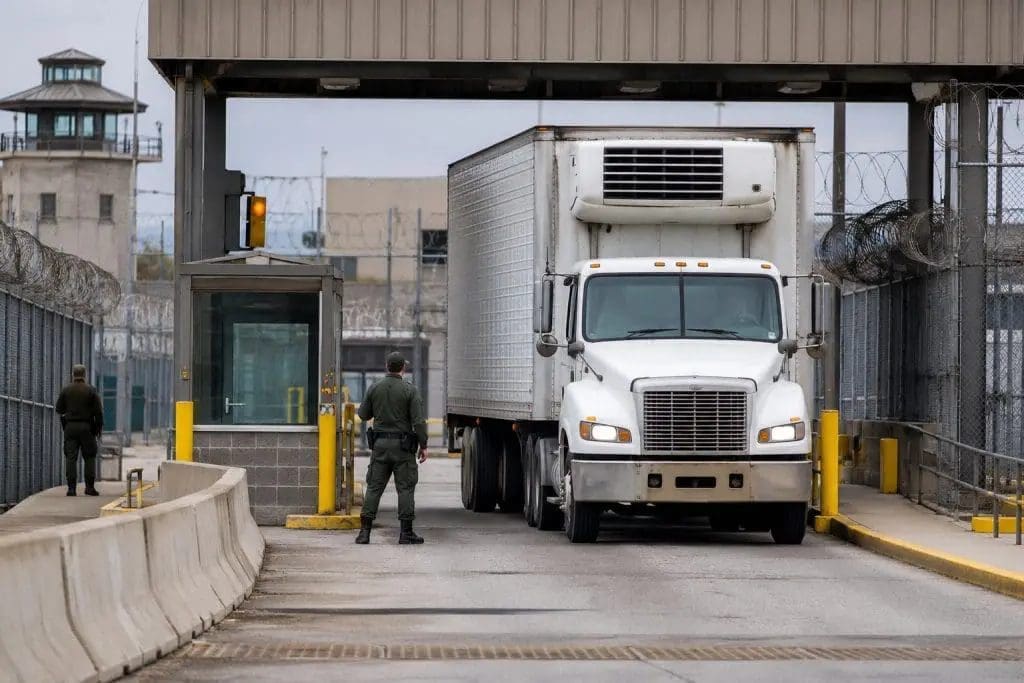
Small Cities That Require Constant Deliveries
Modern prisons consume enormous quantities of resources.
Some federal correctional complexes house more than a thousand inmates, along with correctional officers, medical personnel, administrative staff, maintenance crews and approved contractors.
Kitchen facilities prepare thousands of meals every day. Medical centers require a continuous supply of medications and equipment. Workshops need tools and materials. Heating systems, generators and maintenance operations consume fuel and replacement parts.
As a result, supply trucks regularly enter correctional facilities to support operations that cannot afford interruptions.
Unlike a traditional warehouse or distribution center, however, security always comes first.
The First Layer: The Secure Perimeter
Long before a truck reaches a prison gate, its arrival has typically been authorized and documented.
Modern facilities may use multiple layers of protection, including:
• Reinforced or Electrified Security Fences
• Armed Guard Towers
• Thermal Imaging Cameras
• Motion Detection Systems
• Automatic License Plate Recognition Systems
• Continuous Video Surveillance
When a truck arrives, it does not immediately enter operational areas.
Instead, it is directed to a secure inspection zone where correctional personnel verify:
• Driver Identification
• Commercial Driver Credentials
• Vehicle Registration
• Carrier Information
• Cargo Documentation
• Authorized Delivery Schedule
Any discrepancy can result in immediate denial of entry.
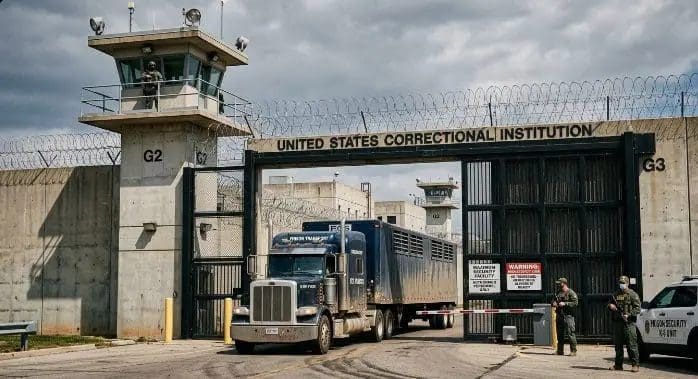
Drivers Must Often Pass Security Screening
One of the lesser-known aspects of prison logistics is that many drivers must be approved before being allowed to enter a facility.
Depending on the institution, authorities may require:
• Criminal Background Checks
• Fingerprinting
• Biometric Registration
• Identification Photographs
• Permanent or Temporary Security Credentials
Many federal facilities maintain approved-driver lists that are updated regularly.
These measures reduce the presence of unfamiliar individuals inside institutions that may house some of the country’s most dangerous offenders.
For transportation companies, obtaining authorization can take days or even weeks and often involves security procedures comparable to those used at sensitive government facilities.
Scanners, K-9 Units and Full Cargo Inspections
Cargo inspections represent one of the most critical stages of the delivery process.
Correctional officers use multiple tools to ensure prohibited items never enter the facility.
Common inspection methods include:
• Industrial Cargo Scanners
• Metal Detectors
• Inspection Cameras
• Drug and Explosive Detection Dogs
• Random Physical Inspections
The goal is to prevent the introduction of:
• Weapons
• Illegal Drugs
• Cell Phones
• Tools
• Electronic Devices
• Materials That Could Aid an Escape
In some facilities, inspections involve opening pallets and containers for detailed examination.
Why Outbound Trucks Became a Security Concern
For decades, most attention focused on vehicles entering correctional facilities.
Eventually, authorities realized that trucks leaving a prison could present an equally serious security risk.
Several incidents demonstrated that even well-protected facilities could remain vulnerable if outbound vehicles were not thoroughly inspected.
That realization fundamentally changed prison security procedures throughout the United States.
The Garbage Truck Escape That Changed Security Protocols
One of the most famous examples occurred in 1987 at the Maryland House of Correction.
Several inmates successfully hid inside a garbage truck leaving the facility.
The prisoners spent weeks studying collection schedules, observing inspection routines and identifying weaknesses in the process.
By concealing themselves among compacted waste, they temporarily escaped from custody.
Although they were eventually recaptured, the incident triggered a major review of prison transportation procedures nationwide.
Following the escape, many institutions adopted:
• Exit Inspections
• Under-Vehicle Mirror Checks
• Specialized K-9 Teams
• Double Inmate Counts
• Comprehensive Vehicle Searches Before Departure
Laundry, Maintenance and Waste Operations: High-Risk Areas
Experience has shown that material-handling operations often represent some of the most vulnerable areas within correctional facilities.
For that reason, trucks associated with:
• Industrial Laundry Services
• Maintenance Operations
• Waste Removal
• Construction Projects
• Internal Supply Distribution
are frequently subject to enhanced inspections.
Over the years, authorities have documented multiple escape attempts involving laundry carts, industrial containers and service vehicles.
One notable case involved an inmate attempting to hide inside a large industrial laundry container bound for an outside facility.
These incidents prompted stricter controls across all service-related operations.
Clinton Correctional Facility and the Risks of Service Areas
Another high-profile case occurred in 2015 at Clinton Correctional Facility in New York.
Inmates Richard Matt and David Sweat escaped using concealed tools, insider assistance and maintenance infrastructure.
Although they did not leave the prison in a truck, the case highlighted how maintenance and service areas can become significant security vulnerabilities.
The escape led to one of the largest manhunts in recent U.S. history.
Why Escaping in a Truck Is Far More Difficult Today
Decades of lessons learned have transformed correctional security.
Today, many facilities:
• Weigh Trucks on Entry and Exit
• Use Thermal Imaging Systems
• Employ Motion Detection Technology
• Conduct Biometric Verification
• Inspect Garbage Compactors
• Disassemble Entire Pallets
• Search Trailer Roofs and Compartments
• Utilize Full-Trailer Cargo Scanning Systems
The objective is simple: identify any anomaly that could indicate hidden individuals or prohibited materials.
For truck drivers, delivering to these facilities often means complying with security procedures that exceed those found at many industrial sites, airports or government complexes.
Alcatraz and the Lessons That Still Matter
Although Alcatraz closed in 1963, it remains one of the most influential examples in correctional security history.
The prison housed notorious criminals such as Al Capone, Mickey Cohen and James “Whitey” Bulger and became famous for its reputation as an escape-proof institution.
Everything required to operate the island prison arrived by boat, including food, fuel, medical supplies, construction materials and even mail.
The famous 1962 escape involving Frank Morris and brothers John and Clarence Anglin reinforced a lesson that remains relevant today: any area connected to maintenance, logistics or services can become a potential escape opportunity.
Trump’s Proposal to Reopen Alcatraz
More than six decades after its closure, Alcatraz returned to public discussion when President Donald Trump suggested the possibility of reopening the historic prison to house high-risk criminals or terrorists.
Experts note that the same challenge that contributed to its closure remains significant today: cost.
Operating Alcatraz was roughly twice as expensive as running other federal prisons because every supply had to be transported across San Francisco Bay.
In addition, the facility required extensive maintenance and infrastructure investment.
For the transportation industry, Alcatraz remains unique because it is one of the few American prisons where trucks never entered the facility. Every shipment arrived by water.
Famous Escapes and the Movies They Inspired
Prison escapes and correctional security failures have inspired numerous films, television series and documentaries.
Perhaps the most famous is the 1962 Alcatraz escape by Frank Morris and the Anglin brothers, which inspired the 1979 film Escape from Alcatraz starring Clint Eastwood.
Another well-known case was the escape of Richard Matt and David Sweat, later dramatized in the acclaimed miniseries Escape at Dannemora.
The relationship between logistics, maintenance operations and prison security has also influenced fictional productions that portray service areas as potential vulnerabilities.
Some of the most recognized titles include:
• Escape from Alcatraz
• The Shawshank Redemption
• Prison Break
• Escape at Dannemora
While many of these productions contain fictional elements, they reflect a reality correctional logistics professionals have understood for decades: transportation, maintenance and supply operations can create opportunities for escape if security procedures are not rigorously enforced.
More Than Just a Delivery
A truck arriving at a correctional facility may appear to be performing a routine delivery, but behind every shipment lies a sophisticated coordination effort involving transportation companies, correctional personnel and advanced security systems.
From the lessons learned at Alcatraz to the technology deployed at modern federal institutions, prison logistics remains one of the most controlled and closely monitored transportation operations in the United States.
For truck drivers involved in these deliveries, every trip represents far more than moving freight. It means entering one of the most secure environments in the country and complying with procedures designed to ensure that essential supplies never become a security threat.
 Business hours: Monday to Friday from 8:00 AM to 5:00 PM. California time