 Hable con un agente al (888) 572-7520
  Enviar mensaje a un agente



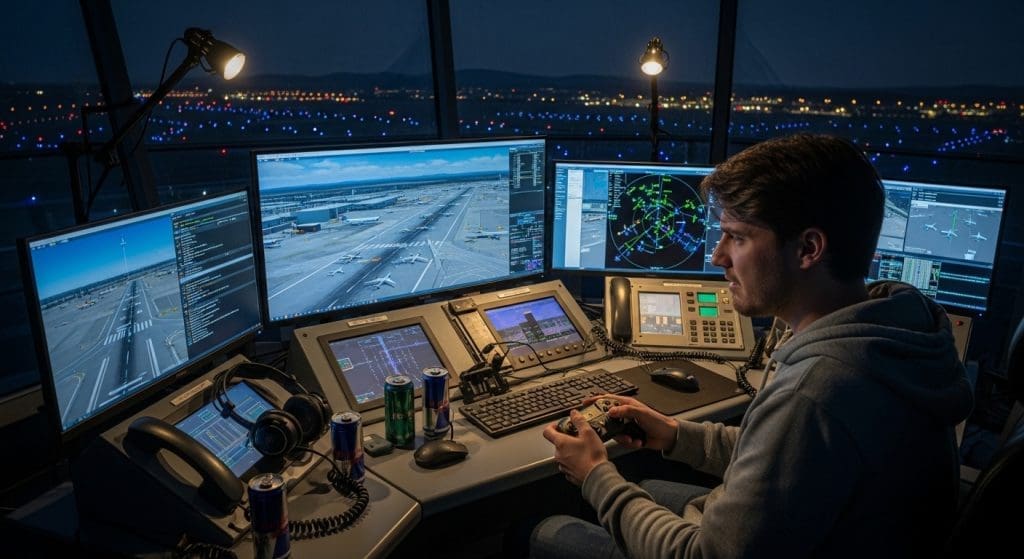
The recent Federal Aviation Administration (FAA) recruitment campaign that attracted more than 8,000 gamers in just 13 hours is not just a curious labor market story. Behind that number lies a clear warning signal for the logistics industry: the U.S. air traffic system is facing a structural staffing crisis that is beginning to impact cargo transportation—and, consequently, the trucking sector.
The numbers are striking. In less than half a day, the Department of Transportation’s campaign received 8,004 applications, averaging 10 candidates per minute. The goal is straightforward: address a long-standing shortage of controllers that has forced the system to operate with extended shifts, mandatory overtime, and high levels of fatigue.
An air problem with ground-level consequences
Air traffic control is not an isolated function. It is a critical component of the logistics chain, particularly in a country like the United States, where air cargo plays a key role in urgent shipments, high-value goods, and just-in-time operations.
When the system works properly, timing is tightly synchronized: flights arrive, cargo is unloaded, and trucks distribute goods. But when air traffic control falters, that synchronization breaks down.
The shortage of controllers has already forced extraordinary measures, including reduced services at certain terminals and operational adjustments. This translates directly into:
- Delays in cargo flights
- Congestion at key airports
- Changes in unloading windows
- Increased uncertainty in logistics planning
More pressure on trucking
When air transport loses efficiency, the impact inevitably shifts to ground transportation. In practice, this creates two major effects for the trucking industry:
1. Freight shifting to highways
Cargo that would typically move by air—especially time-sensitive shipments—begins to move by road instead, increasing demand on fleets and drivers.
2. Operational disruption at logistics hubs
Trucks operating in and around airports rely on precise schedules. When flights are delayed, carriers face:
- Extended wait times
- Higher fuel consumption
- Reduced route efficiency
- Increased risk of missed delivery windows
In major freight corridors such as Chicago, Memphis, and Louisville—key air cargo hubs—these disruptions can quickly escalate and affect regional operations.
A system operating at capacity
The issue is not new, but it has intensified. According to official data, air traffic operations in the U.S. grew by 10% between 2015 and 2024, reaching more than 30 million flights annually. However, staffing levels have not kept pace.
The result is a system operating at its limits, where any staffing gap can trigger a chain reaction.
Compounding the issue, training new controllers remains challenging. Only a fraction of candidates successfully complete the rigorous technical and psychological requirements needed for certification. This prolongs the staffing shortage and slows system recovery.
The gamer recruitment strategy: a short-term solution
In this context, targeting gamers is a strategic decision. Authorities are seeking individuals with strong multitasking abilities, quick reaction times, and the capacity to manage multiple variables simultaneously.
These skills are essential for air traffic control, but they also reflect a broader trend across modern logistics: the increasing need for operators who can manage complex, real-time systems.
However, while the recruitment campaign has been successful in terms of volume, the real challenge lies in training. Not all applicants will become certified controllers, meaning the short-term impact may be limited.
What this means for U.S. logistics
For the transportation industry, several key takeaways emerge:
- The logistics system is deeply interconnected: disruptions in the air affect the road
- Trucking remains the structural backbone of the supply chain
- Pressure on drivers and fleets is likely to increase during disruptions
- Logistics planning will need to become more flexible and resilient
In a context of rising demand, expanding e-commerce, and increasingly tight supply chains, the stability of the air traffic system is critical to avoiding bottlenecks.
The influx of thousands of gamers into the air traffic controller recruitment process is only the visible side of a deeper issue. The shortage of controllers is not just an aviation problem—it is a logistics challenge with nationwide implications.
When the air system slows down, trucking once again plays its traditional role: absorbing the pressure, maintaining the flow of goods, and sustaining the supply chain.
In an increasingly demanding environment, U.S. logistics faces a clear challenge: adapting to a system where any disruption—even in the skies—ultimately hits the road.
 Business hours: Monday to Friday from 8:00 AM to 5:00 PM. California time