 Llame al (888) 572-7520 para hablar con un agente
 Enviar mensaje a un agente
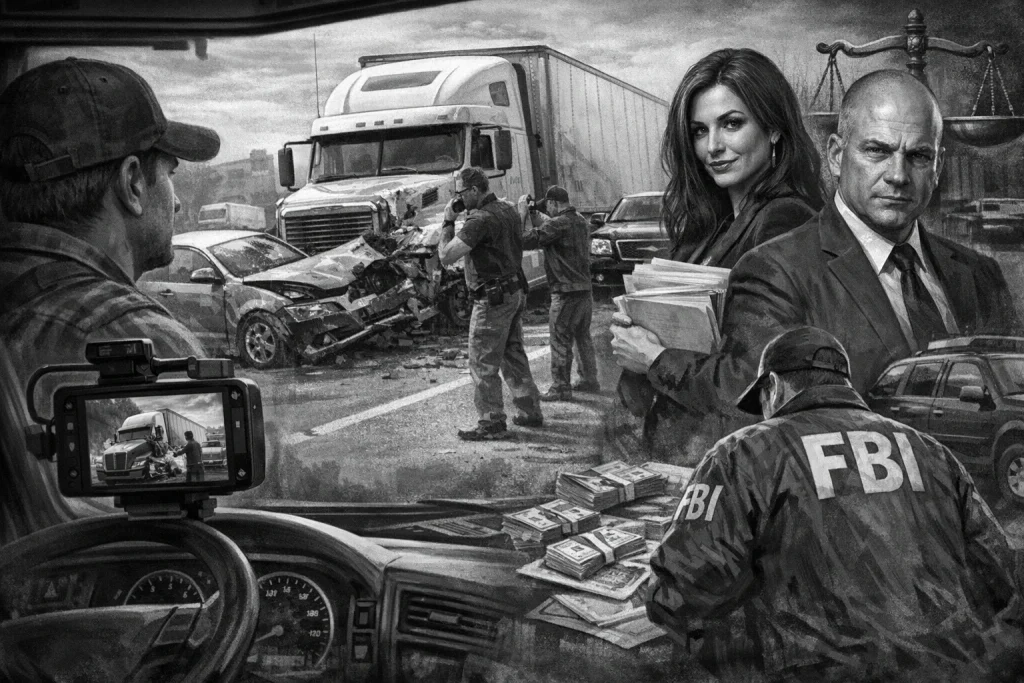

It was a conviction that will go down in history. The trucking industry in the United States is breathing a sigh of relief today after a landmark conviction in the fight against organized fraud. Two lawyers from New Orleans were found guilty by a federal jury after their active participation in a criminal network dedicated to deliberately causing accidents involving cargo trucks was confirmed. This network not only sought quick financial gains but also endangered the lives of professional drivers and the financial stability of fleets on the highways of the southern United States.
According to information officially provided by the U.S. Attorney’s Office for the Eastern District of Louisiana, those convicted managed a corruption scheme that operated for more than a decade. The investigation revealed that Vanessa Motta and Jason F. Giles, along with their respective law firms, coordinated illicit activities from late 2011 until December 2024. Their primary targets were 18-wheelers, specifically chosen because of the robust insurance policies that federal regulations require of freight carriers.
This conviction is the result of an operation that uncovered an almost cinematic scheme to defraud the system. Lawyers used drivers known as “slammers”, whose task was to intentionally crash into trucks in the middle of traffic. Once the incident occurred, the legal machinery kicked in to file fraudulent claims for millions of dollars. The deception didn’t end on the road, as the fake passengers were pressured into undergoing unnecessary spinal surgeries to inflate medical costs and demand much larger settlements from insurance companies.
Key figures known as “spotters” and recruiters also participated in the organization, responsible for monitoring the area and finding people willing to lie to the authorities. Jonathan Tapp, the FBI’s special agent in charge in New Orleans, stated unequivocally that these individuals sought to amass personal fortunes through systematic deception. According to the official, these types of practices end up hurting the wallets of every truck owner and independent operator in the state, due to the inevitable increase in commercial insurance premiums.
Million-dollar fraud to hit the trucking industry
From the highest levels of the industry, reactions to the conviction were swift given the magnitude of the case. Henry Hanscom, representative of the American Trucking Associations, celebrated the verdict but warned that this case reflects a deeper problem in the civil justice system. For trucking companies, these networks are not isolated cases, but rather a symptom of a system where the abuse of lawsuits has become a lucrative business. Hanscom emphasized that when profit takes precedence over fairness, the real costs are silently passed on to those who keep the country’s economy moving on wheels.
Renee Amar, leader of the Louisiana Motor Transport Association, described the conviction as the long-awaited accountability the sector had hoped for. Amar recalled that, for years, these criminal setups not only increased operating costs but also destroyed the reputations of professional drivers whose records were tarnished by accidents that were never their fault. While the sentence is a significant step forward, the association maintains that the system must evolve to more effectively protect honest business owners from these kinds of legal predators.

In terms of professional consequences, both Motta and Giles have already been suspended by the Louisiana State Bar, although the administrative process in other states, such as Texas, is ongoing. Chief Federal Judge Wendy B. Vitter has scheduled sentencing hearings for July, where the final penalties for the individuals and their law firms will be determined. This case adds to a list of more than 50 people who have been prosecuted in the last seven years thanks to the joint work of the FBI and the Louisiana State Police.
For the trucker who travels the Interstates every day, this conviction represents a vital precedent for legal certainty. The fight against highway fraud is a battle of endurance that requires constant vigilance and courageous reporting by fleets. While authorities promise to continue pursuing these criminal organizations, the trucking industry celebrates that, for once, the law has sided with truth and honest work.
How to Respond to a Suspected Staged Crash
1. Immediate Safety and Observation Phase
Staying calm is your most powerful tool. Scammers count on the driver being confused or intimidated.
Secure the scene: Activate your hazard lights and do not move the truck unless there is an imminent danger.
Count occupants: Immediately identify how many people are in the other vehicle. A common tactic is to add extra passengers after the impact (known as “jump-ins”) to inflate the claim.
Observe behavior: Note if the other vehicle braked suddenly without a justifiable reason (the “Swoop and Squat” technique) or if the driver appears to be following instructions from a third party over the phone.
2. Critical Visual Documentation
In these cases, a picture is worth a thousand false testimonies in court.
Photos of the surroundings: Capture traffic signs, skid marks (or the lack thereof), and the exact position of the vehicles.
Photos of the damage: Take close-up shots of the points of contact. Con artists sometimes use pre-existing damage to inflate the claim.
Photograph the people: Try to photograph all the occupants of the other vehicle, ideally while they are outside the car, to prevent them from later claiming disabling injuries that they didn’t show at the scene.
3. Information and Authorities Management
The police report is the foundational document for any subsequent legal defense.
911 Call: Clearly state that you suspect an irregular maneuver.
Do not admit fault: Avoid phrases like “I’m sorry” or “I didn’t see you.” Stick to the facts: “The vehicle stopped abruptly for no apparent reason.”
Identify independent witnesses: Look for drivers who witnessed the maneuver and are not connected to those involved. Quickly obtain their contact information.
Verify licenses: Ensure that the person claiming to be driving was actually behind the wheel. Driver swapping is common in these schemes.
4. Internal reporting and evidence preservation
Once safe, speed in handling data is vital for your insurance company.
Dashcam backup: This is your primary piece of evidence. Save the original video immediately and secure a copy in the cloud. Video showing staged braking is the fastest route to a fraud conviction.
Spotter information: If you noticed a second vehicle that appeared to be watching or boxing in your truck before the collision, report its description and license plate. These are accomplices who helped coordinate the impact.
5. Post-incident follow-up
Claims monitoring: Inform your insurer that you suspect a staged accident. This activates their Special Investigation Units (SIUs).
Beware of “clinics”: Be alert if you receive reports of extreme medical treatments for injuries that appeared nonexistent at the scene.
This protocol not only complies with current legislation but also follows best practices recommended by the American Trucking Associations (ATA) and the National Insurance Crime Bureau (NICB).
 Business hours: Monday to Friday from 8:00 AM to 5:00 PM. California time