 Llame al (888) 572-7520 para hablar con un agente
 Enviar mensaje a un agente
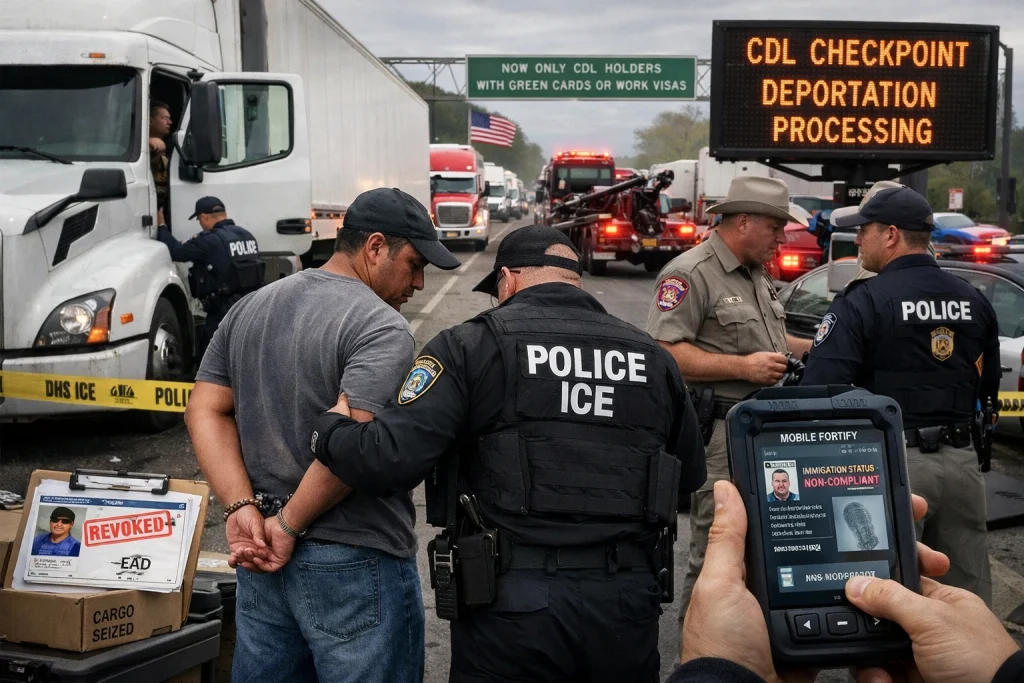

For thousands of immigrant truck drivers, the game board is changing drastically in 2026. A new legal strategy, coordinated between state governments and the Department of Transportation (DOT), has launched a surveillance network aimed at controlling “big rig” drivers who are not U.S. citizens.
This “iron wave” not only targets those without documents but also scrutinizes workers with legal employment permits, who have been the engine of national logistics. Specifically, the current administration has implemented regulations that turn a simple roadside inspection into a potential deportation process.
The most radical change came with the recent DOT “Final Rule,” which restricts access to Commercial Driver’s Licenses (CDL). Historically, thousands of immigrants used their Employment Authorization Document (EAD) to obtain these licenses. However, under the new guidelines, the EAD is no longer sufficient.
From now on, only those with permanent residency or specific work visas (such as H-2A or H-2B) will be eligible for a CDL. It is estimated that this measure could sideline more than 40,000 drivers nationwide who relied on temporary permits or protected status.
Additionally, states like Florida and Texas have led the charge with local laws. In Florida, law SB 86, which takes full effect in July of this year, requires officers to immediately detain any commercial vehicle driver identified as an “unauthorized migrant.” The impact is twofold: the driver is arrested, and the truck, along with its valuable cargo, is seized, generating guaranteed multimillion-dollar losses for trucking companies.
Operation Midway Blitz
This strategy is not new, but it is more sophisticated. During Donald Trump’s first administration, the foundations of these immigrant controls were laid with cooperation programs like 287(g), which allows local police to act as immigration agents.
We remember emblematic operations like “Operation Midway Blitz,” conducted on the border between Indiana and Illinois. At that time, raids at truck stops resulted in the arrest of hundreds of immigrant drivers. Official data from the period showed that:
More than 140 truckers were arrested in a single regional operation.
Dozens of licenses obtained in “sanctuary states” were detected, which the federal government deemed fraudulent.
The pressure resulted in a driver shortage that raised food transportation costs by 12% in affected areas.
Today, history is repeating itself with the addition of technology. The use of the “Mobile Fortify” app allows agents to perform biometric scans right on the roadside, verifying immigration status in seconds, which has eliminated the margin for error—and defense—for many workers.

What results have these controls had so far?
Advocates of these measures, like Transportation Secretary Sean Duffy, argue it’s a matter of “national security” and road safety. They claim that drivers without a verifiable driving history from their home countries pose a risk.
On the other hand, the practical results impact as follows:
- Supply disruptions: In California and Texas ports, wait times to move cargo have increased due to the lack of certified drivers.
- Criminalization of workers: Immigrant drivers who have paid taxes for years and driven thousands of miles without accidents are now in hiding, afraid to pass a weigh station or checkpoint.
- Language barriers: The new requirement for CDL exams strictly in English has sidelined veteran drivers who understand traffic signs but don’t master the required technical language.
Survival Tips
Faced with this landscape, immigrant advocacy organizations and legal experts suggest considering these key points:
- Audit your documentation: Check if your license was issued based on an EAD. If so, consult a lawyer to see if you’re eligible for a transition to an H-2B visa or if your state offers extensions under litigation.
- Know your rights in the cab: While police can stop you for a traffic violation or safety inspection, you have the right to remain silent about your birthplace or immigration status unless there’s a court order.
- Avoid high-risk states: If your status is uncertain, steer clear of routes through Florida, Indiana, or Texas, where cooperation with ICE is more aggressive.
- Emergency plan: Keep a specialized lawyer’s contact handy and ensure your family knows what to do if the truck is seized.
The road has always been a symbol of freedom in the United States, but for some Latinos, it has become a “minefield” today.
“Sanctuary” States vs. High-Risk States
The implementation of the DOT Final Rule (March 16, 2026) has created a divide in the country. This regulation prohibits states from issuing or renewing Commercial Driver’s Licenses (CDL) to immigrants who only have a Work Permit (EAD), limiting them exclusively to citizens, permanent residents, and holders of H-2A, H-2B, or E-2 visas.
Some states have tried to resist federal pressure, though they are under extreme scrutiny.
- California: Although the DMV was forced to cancel thousands of licenses, a recent court order in the Doe v. DMV case allows affected drivers to reapply for their license, keeping the process in legal limbo that offers a window of time. However, California has already begun requiring exams to be strictly in English.
- Illinois and New York: They maintain policies that have historically supported immigrants but are under threat of losing federal transportation funds if they don’t revoke CDLs from those without the specific visas mentioned above. They remain more “friendly” states for administrative processes, but roadside surveillance has increased.
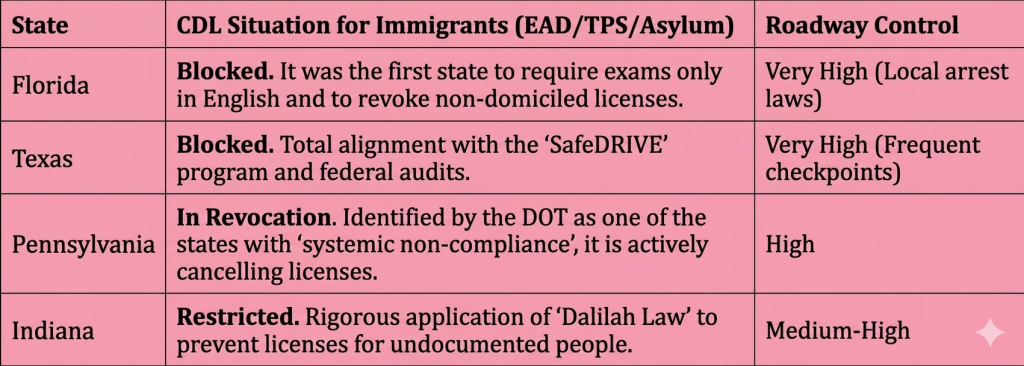
The Strictest States
These states have aligned their systems with the federal government’s SAVE database to verify immigrant status in real time before any processing.
The safest states
Although the license is federal, the intensity of enforcement varies. Northeastern states like Vermont, Rhode Island, and Connecticut have less history of “hunt-style” operations at weigh stations compared to the Sun Belt.
Critical point: If the license was issued in a state the federal government considers “non-compliant” (such as Colorado or Washington), you could be detained in other states simply because the license no longer appears as valid in the national system, even if the physical card has not expired.
Strategic recommendations:
- Status change: If the driver is under TPS or Asylum, they must urgently consult whether their employer can sponsor them for an H-2B visa. It is one of the few paths that the new law recognizes as valid to keep the CDL.
- English certification: Drivers must prepare for knowledge and skills exams only in English. The era of translators or Spanish-language CDL tests is coming to an end in almost the entire country.
- Alert app: It is recommended to use immigrant driver networks and traffic apps to monitor FMCSA (Federal Motor Carrier Safety Administration) operations in real time.
 Business hours: Monday to Friday from 8:00 AM to 5:00 PM. California time