 Hable con un agente al (888) 572-7520
  Enviar mensaje a un agente

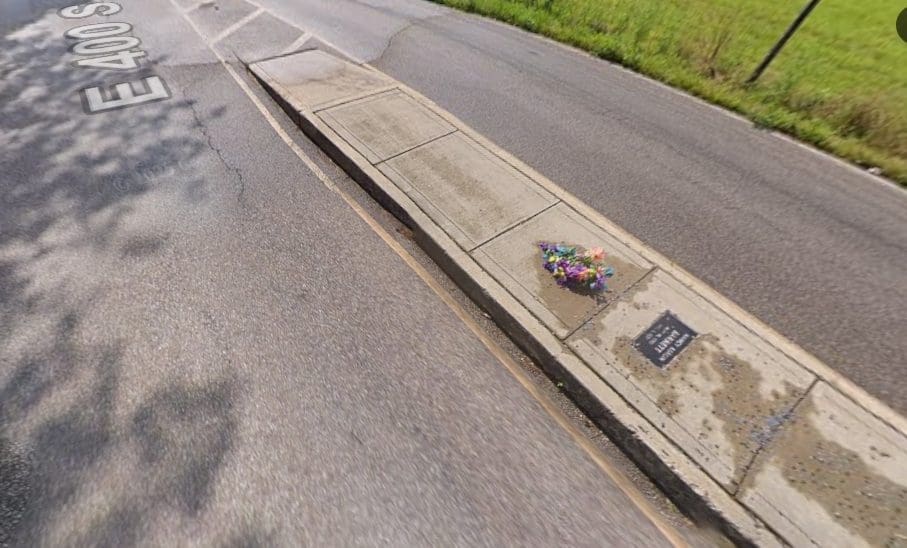

Indiana is known as the Crossroads of America because of its extensive highway network and its importance to freight transportation across the United States. But one rural road defies conventional highway design: it splits in two to make room for a grave.
The unusual site is located in Johnson County, near the small community of Amity, along County Road 400 South. There, drivers encounter a burial site surrounded by pavement, complete with a headstone, a small protected area, and traffic lanes that separate to allow vehicles to pass on either side.
This is not a historical reconstruction or a tourist attraction created for visitors. The grave is real and belongs to Nancy Kerlin Barnett, a woman who died in 1831 and whose final resting place ultimately determined the layout of a public road.
The explanation involves family history, the expansion of Indiana’s rural road network, and the determination of a grandson who, according to local accounts, confronted workers with a shotgun to prevent his grandmother’s remains from being moved.
A Grave That Was There Long Before the Road
Nancy Kerlin Barnett died in 1831 at the age of 38. She was married to William Barnett and had eleven children. Her family buried her on a small hill near Sugar Creek, in a rural area surrounded by fields and vegetation.
Over time, other people were buried nearby, and the site became a small family cemetery.
For decades, the grave remained undisturbed in the agricultural landscape. However, as the county expanded its road network and improved connections between rural communities, its future became uncertain.
When local authorities decided to improve a road through the old cemetery, they encountered a problem: several burial sites stood directly in the planned route.
The usual solution was to relocate the remains to another cemetery and clear the land for construction. Most of the graves were moved, but the Barnett family refused to allow Nancy’s remains to be disturbed.
The Grandson Who Defended the Grave With a Shotgun
The best-known version of the story centers on Daniel Barnett, Nancy’s grandson, who was determined to stop workers from removing his grandmother’s remains.
According to local tradition, Daniel arrived with a shotgun and stood guard beside the grave to prevent its relocation.
His resistance forced officials to consider another solution. Rather than move the grave, they agreed to leave it in place and build the road around it.
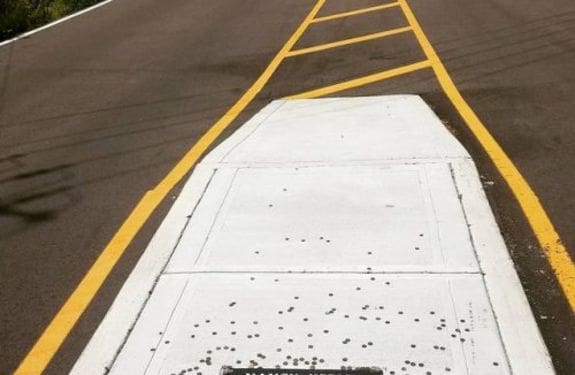
The result was one of Indiana’s most unusual roadway configurations: a public road divided by a 19th-century burial site.
The decision allowed traffic to continue without disturbing Nancy’s final resting place. It also created a feature that continues to surprise drivers traveling through Johnson County.
In 1912, a concrete barrier was placed around the grave to protect it from passing vehicles. Decades later, in 1982, Nancy’s descendants installed a memorial marker explaining the family’s history and the unusual road design.
The Surprising Discovery in 2016: Seven People Were Buried There
The story took an unexpected turn in 2016, when Johnson County officials decided to improve safety along County Road 400 South.
For years, the raised burial mound had been a roadway hazard. Visible impact marks showed that some drivers had failed to navigate around it safely.
The improvement project aimed to widen the roadway, lower the monument, and make travel safer, particularly for the vehicles and agricultural equipment that regularly use rural roads.
But there was one important condition: Nancy’s burial site had to be preserved.
To complete the work, county officials brought in archaeologists from the University of Indianapolis, led by professor Christopher Schmidt.
Researchers began excavating the site expecting to find Nancy Kerlin Barnett’s remains. Instead, they made a remarkable discovery: seven people had been buried there.
In addition to remains believed to belong to Nancy, archaeologists discovered another adult woman, a man, and four children, ranging in age from newborn to approximately ten years old.
The discovery revealed that the small roadside monument was much more than a single grave. It was part of an old family cemetery that had survived for nearly two centuries in the middle of a road.
How Engineers Preserved the Cemetery While Improving Traffic Safety
The 2016 project addressed a safety problem that had affected the road for decades.
The remains were temporarily removed for archaeological examination and later reburied at the same location in seven wooden coffins made by family descendants.
In August of that year, approximately 60 relatives attended a reburial ceremony.
The original raised mound was replaced with a much lower concrete structure, nearly level with the roadway. A new headstone was also installed, while the original historical marker was moved to the Johnson County Museum of History.
The road remained divided around the cemetery, but its redesigned layout made the area safer for passing vehicles.
In 2017, the project received recognition from Indiana’s Division of Historic Preservation and Archaeology for the cooperation among archaeologists, local authorities, and family members.
What Truck Drivers Should Know About This Road
For professional drivers, the story has an additional point of interest: the cemetery sits along a rural road also used by work vehicles and agricultural equipment.
Because a structure occupies the center of the roadway, drivers must adjust their normal path to navigate around it. Larger vehicles require particular attention to available clearance and road positioning when encountering obstacles of this kind.
In fact, repeated collisions with the original burial mound were among the reasons county officials undertook the 2016 safety improvements.
This is not an interstate highway or a major freight corridor. County Road 400 South is a local road near Franklin and Interstate 65, one of Indiana’s major transportation routes.
For truckers traveling through the region, the site also serves as a reminder of the differences between major highways designed for commercial transportation and rural roads, where unexpected curves, narrow passages, and unusual obstacles can create additional challenges.
From Family History to One of Indiana’s Most Famous Roadside Attractions
Over the years, the Barnett cemetery has become a point of interest for travelers, history enthusiasts, and people fascinated by America’s unusual roadside landmarks.
Its popularity has even earned it a place in Indiana tourism publications, where it has been featured among the state’s strangest attractions, sometimes alongside tales of ghost sightings and paranormal activity.
However, there is no verified evidence supporting the ghost stories. The truly remarkable part is that a family’s determination in the 19th century continues to influence the design of a road in the 21st century.
Today, nearly 200 years after Nancy Kerlin Barnett’s death, traffic still passes around the place where she was buried in 1831, alongside six other individuals.
Indiana, one of the nation’s most important states for freight transportation, is home to a roadside curiosity rarely seen anywhere else: a road that had to be designed around a family’s history.
And although modern engineering has made the location safer, one thing has never changed: vehicles still travel on either side of the Barnett family cemetery.
 Business hours: Monday to Friday from 8:00 AM to 5:00 PM. California time