 Hable con un agente al (888) 572-7520
 Enviar mensaje a un agente


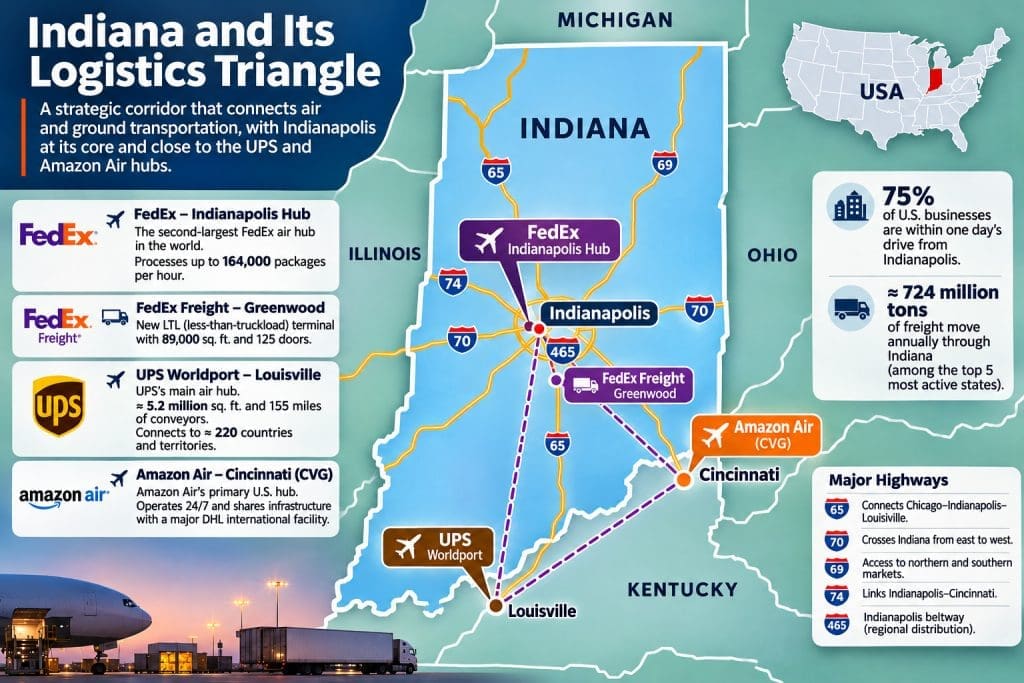

While millions of Americans sleep, a massive logistics operation comes to life in Indiana, at the heart of the USA. Cargo planes land throughout the night, thousands of packages move through automated sorting systems, and truck fleets prepare to distribute freight to markets across the country. Much of this activity is concentrated within a triangle formed by Indianapolis, Louisville, and Cincinnati, three cities that have become strategic centers of American transportation.
Indiana holds a privileged position within this system. Its capital is home to FedEx’s second-largest air hub worldwide, while UPS Worldport in Kentucky and Amazon Air’s primary U.S. hub at Cincinnati/Northern Kentucky International Airport are both within a relatively short drive.
Although these companies operate independent networks and compete in the delivery market, their geographic proximity has helped establish one of North America’s most important logistics corridors.
Indianapolis: 164,000 Packages per Hour
Indianapolis International Airport plays a critical role in FedEx’s global network.
According to FedEx’s 2025 Annual Report, its sorting facility covers approximately 3 million square feet and can process up to 164,000 packages per hour.
Only the company’s main hub in Memphis, Tennessee, surpasses the Indianapolis facility in size.
But package volume tells only part of the story. Its strategic value becomes even more apparent when air cargo operations connect with the ground transportation network.
During overnight operations, incoming shipments are unloaded, sorted by destination, and transferred to other aircraft or ground vehicles. Some continue their journey aboard long-haul trucks, while others move to regional distribution centers.
This system combines the speed of air transportation over long distances with the flexibility of trucking for regional routes and final deliveries.
Louisville and Cincinnati Complete the Triangle
Approximately two hours by road from Indianapolis lies Louisville, Kentucky, home to Worldport, UPS’s primary air hub.
The facility covers approximately 5.2 million square feet and features 155 miles of conveyor belts for package sorting. According to Louisville Muhammad Ali International Airport, its operations connect the city to approximately 220 countries and territories.
The third point of the triangle is Cincinnati/Northern Kentucky International Airport (CVG), physically located in Kentucky, where Amazon Air established its primary U.S. air hub.
CVG also houses a major DHL international hub, further increasing the concentration of cargo infrastructure in the region.
According to official airport information, its facilities support around-the-clock operations and include extensive infrastructure dedicated to freight transportation.
The proximity of these three airports provides access to industrial markets, distribution centers, and interstate corridors connecting the Midwest with the rest of the country.
Why Indiana Matters So Much to Truck Drivers
Indiana’s competitive advantage extends beyond its airports. Its extensive interstate highway network is equally important.
Indianapolis sits at the intersection of several major transportation corridors:
- I-65: Connects the Chicago area with Indianapolis and Louisville.
- I-70: Crosses Indiana from east to west, connecting markets such as Columbus, Indianapolis, and St. Louis.
- I-69: Provides access to major markets in northern and southern Indiana.
- I-74: Connects Indianapolis with Cincinnati and other Midwestern cities.
- I-465: Serves as Indianapolis’s beltway, supporting regional freight distribution.
This location allows companies to organize ground transportation routes to numerous consumer markets without relying exclusively on air freight.
According to the Indianapolis Airport Authority, 75% of U.S. businesses are within a one-day drive of the airport.
This connectivity helps explain why so many transportation, warehousing, and distribution companies have established operations in Indiana.
For trucking companies, this concentration of activity creates opportunities for contracts, regional routes, and specialized services, particularly in consolidated freight transportation, package distribution, and logistics center supply operations.
FedEx Expands Its Ground Network in Indiana
One of the clearest examples of the connection between air and ground transportation was the opening of a new FedEx Freight terminal in Greenwood, south of Indianapolis, in 2025.
The facility covers approximately 89,000 square feet and features 125 loading and unloading doors.
Its opening increased FedEx Freight’s available dock doors in the Indianapolis market from 252 to 377.
The new terminal was designed to meet growing demand for less-than-truckload (LTL) shipping, which allows freight from multiple customers to be transported on the same truck.
It also includes maintenance and fueling infrastructure, essential for reducing vehicle downtime.
The terminal expands operational capacity serving the Louisville, Kentucky, and Muncie, Indiana, markets.
This investment illustrates how the growth of major air cargo hubs is accompanied by an increasing need for ground transportation infrastructure.
The Business of Overnight Deliveries
The efficiency of this logistics corridor depends on precise coordination between flight schedules, freight sorting, and truck departures.
A delay in unloading an aircraft can affect the preparation of multiple ground routes. Similarly, a highway disruption can prevent shipments from reaching distribution centers on schedule.
This operating model is especially important for e-commerce, industrial replacement parts, medical products, and other goods requiring short delivery times.
It also explains why ground transportation remains indispensable, even in an industry that operates large fleets of cargo aircraft.
Planes accelerate transportation between major hubs, but trucks connect those facilities with warehouses, factories, businesses, and consumers.
Together, these transportation systems support a significant share of time-sensitive deliveries across the United States.
More Freight Movement Means Greater Demands on Trucking Fleets
The concentration of logistics activity also presents challenges for transportation companies. Operators serving airports and distribution centers must meet strict loading and unloading schedules, navigate heavily traveled commercial routes, and coordinate operations with facilities that remain active overnight.
Major risks include accidents during terminal maneuvers, cargo damage, freight theft, and disruptions caused by adverse weather conditions.
Pressure to meet delivery windows also requires careful planning around drivers’ hours of service and federally mandated rest periods.
For trucking companies, operating in high-volume logistics corridors demands particular attention to preventive maintenance, parking security, vehicle monitoring, and cargo protection.
From a commercial insurance perspective, companies must also evaluate whether their coverage matches their operations, vehicle types, and the characteristics of the freight they transport.
Commercial auto liability, physical damage, and motor truck cargo insurance serve different purposes, making it essential to review policy terms according to each fleet’s specific risks.
Indiana: Much More Than a Transit State
The Indiana Department of Transportation reports that approximately 724 million tons of freight move through the state annually, placing Indiana among the five most active states for commercial freight transportation.
The agency also projects that freight movement could increase by 60% by 2040, highlighting the importance of continued investment in infrastructure and logistics capacity.
The expansion of e-commerce, manufacturing demand, and distribution services continues to reinforce Indiana’s strategic position.
Its strength lies not simply in having major airports or interstate highways, but in its ability to connect different modes of transportation within the same region.
Across the triangle formed by Indianapolis, Louisville, and Cincinnati, aircraft allow freight to travel enormous distances overnight. But trucks transform that speed into actual deliveries.
For the trucking industry, Indiana is far more than a state to drive through. It is one of the places where the final journey of millions of American deliveries begins.
 Business hours: Monday to Friday from 8:00 AM to 5:00 PM. California time