 Hable con un agente al (888) 572-7520
  Enviar mensaje a un agente



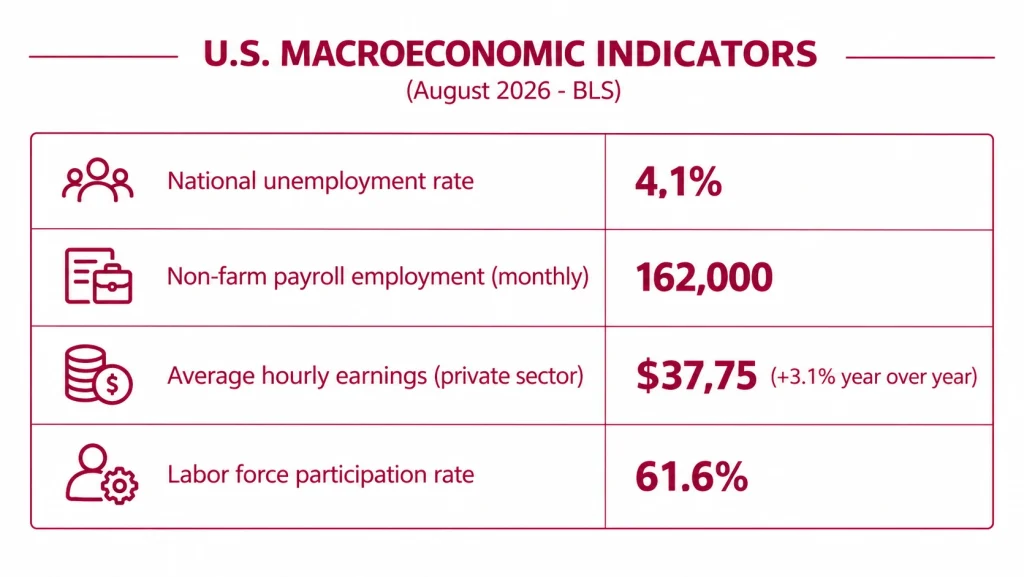
The U.S. labor market in 2026 is showing signs of moderation compared to the high hiring rates of the post-pandemic period. According to the U.S. Department of Labor’s Bureau of Labor Statistics (BLS) report for August 2026, the national unemployment rate stood at 4.1%, remaining largely unchanged over the past year, with a total of 7.0 million people unemployed.
In the non-farm payroll sector, the U.S. economy added 162,000 net jobs in August 2026. BLS revisions adjusted the summer figures, reporting 31,000 jobs added in June and 21,000 in July. During the cumulative 12-month period ending in July 2026, the average monthly job creation was 31,000.

Wages in the private sector showed continued year-over-year growth. In August 2026, the average hourly wage for all employees on private payrolls reached $37.75, representing a 3.1% increase compared to the same month in 2025. For production and direct supervisory workers, the average hourly wage reached $32.53. Meanwhile, the average workweek in the general private sector was 34.4 hours.
In terms of labor supply, the labor force participation rate was 61.6% in August 2026, representing a decrease of 0.5 percentage points compared to January of the same year. The employment-to-population ratio was 59.1%. BLS data also reflect that the proportion of economically disadvantaged part-time workers decreased to 4.4 million. Long-term unemployment —people without employment for 27 weeks or more— accounts for 27.0% of the total unemployed, standing at 1.9 million individuals.
At the sectoral level, job creation during 2026 was uneven. The sectors with the most dynamic job creation included food and beverage services (+59,000 in August 2026), education and local government (+42,000), manufacturing (+16,000), and healthcare (+13,000). In contrast, the information sector registered a reduction of 23,000 jobs in the last month reported.
Regarding human capital trends, the job turnover indicators reported by the Job Openings and Turnover Survey (JOLTS) show a volume of vacancies of approximately 7.35 million. The voluntary resignation rate (quittal rate) stands at 2.0%, indicating lower mobility among contracted workers compared to the 3.0% to 4.0% range observed between 2021 and 2022.
Employment, Fleet Supply, and Operational Dynamics
The trucking industry operates within a framework where capacity demand and driver availability have reached a phase of operational stabilization. According to the Bureau of Transportation Statistics (BTS) and the BLS, the unadjusted unemployment rate in the overall transportation and warehousing sector was 4.7% in August 2026. This figure represents a decrease from the 5.9% recorded in August 2025, and is 0.4 percentage points above the overall unadjusted U.S. unemployment rate (4.3%).
In the specific trucking sector, the volume of salaried employment reached 1,470,300 workers in August 2026. This represents a monthly increase of 0.3% compared to July, but maintains a slight year-over-year decrease of 0.7% compared to August 2025 levels. Employment within the warehousing and storage sector totaled 1,837,400 employees, with monthly decreases of 0.1% and year-over-year decreases of 1.7%.
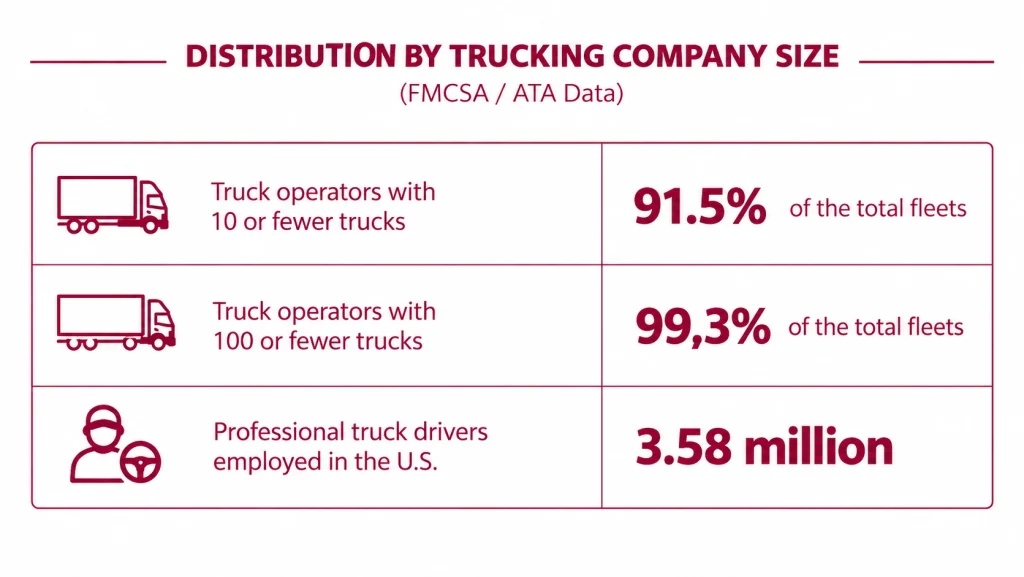
The industry structure continues to be characterized by a high degree of fleet fragmentation. Figures from the U.S. Department of Transportation (USDOT) and the Federal Motor Carrier Safety Administration (FMCSA) show the presence of approximately 580,000 active motor carriers with operating authority registrations. Of this universe of companies:
- 91.5% operate fleets of 10 or fewer trucks.
- 99.3% operate fleets of 100 or fewer trucks.
At a macro-operational scale, estimates from the American Trucking Association (ATA) indicate that the trucking ecosystem employs more than 8.4 million people in various roles related to the sector. Specifically, in the category of professional heavy-duty truck drivers, the workforce is estimated at around 3.58 million registered drivers.
Trucking maintains a crucial position in the flow of trade. The ATA reports that trucks move more than 70% of the total domestic freight tonnage in the United States. In the area of surface international trade, trucked freight accounts for 67% of the trade value with Canada and reaches 85% of the trade value transferred with Mexico. Regarding freight volume, the ATA Truck Tonnage Index has registered monthly fluctuations during the recent period, including a -1.0% adjustment in July 2026 after variations of +0.1% in June and -2.0% in May.
Economic data for the sector in 2026 indicate a scenario in which the trucking fleet operates with an adjustment in equipment allocation and revenue, conditioned by fixed operating costs and the evolution of short- and long-haul freight rates. The relationship between available transport capacity and industrial cargo volume continues to determine operating margins and the retention of driving personnel on the country’s roads.
 Business hours: Monday to Friday from 8:00 AM to 5:00 PM. California time