 Llame al (888) 572-7520 para hablar con un agente
 Enviar mensaje a un agente

The trucking industry is often perceived as a predominantly male space. Although over time it has become increasingly common to find women in the sector, in 1918 the reality was very different. At that time, a woman truck driver was a disruptive figure—someone who dared to challenge established stereotypes, a woman who would leave a lasting mark. This is the story of Luella Bates, considered the first woman truck driver, a woman who proved that the transportation industry has no gender.

Luella Bates: a pioneer of the trucking industry
Luella Bates was not only a truck driver; she was a pioneer in the industry. Originally from Wisconsin, Bates developed her career as a driver, mechanic, and truck inspector, becoming one of the most notable figures in early trucking.
She began her career as a truck driver in 1918, after many women found themselves needing to take over the jobs of their husbands, who had been called to fight in World War I. Bates was one of the 150 women hired by Four Wheel Drive Auto Co. (FWD) in Clintonville, Wisconsin. After receiving training, some of them worked as test drivers for the trucks manufactured by the company.
During the time Bates and her fellow drivers worked with FWD, they traveled thousands of miles, driving trucks in various weather and road conditions throughout Wisconsin. These women not only honed their driving skills but also gained mechanical knowledge.
When the war ended, many of them traded the truck cab for home life; but Luella Bates decided that her place was behind the wheel of a truck. Bates gained so much enthusiasm and experience that she became a recognizable figure for FWD.
In 1920, the company sent Bates on tours outside Wisconsin, where she worked as a tester, demonstrator, mechanic, and ambassador for the company’s trucks. This tour was part of the “Safety First” advertising campaign led by FWD and Francis Hugo. During the tour, Bates visited 25 cities and became the first woman to obtain a driver’s license in the state of New York. Bates carried out all her roles with passion and unmatched competence, making it clear that trucks were not only for men.
“I like this business and hope to stay in it,” Bates told the Times newspaper based in Shreveport, Louisiana.
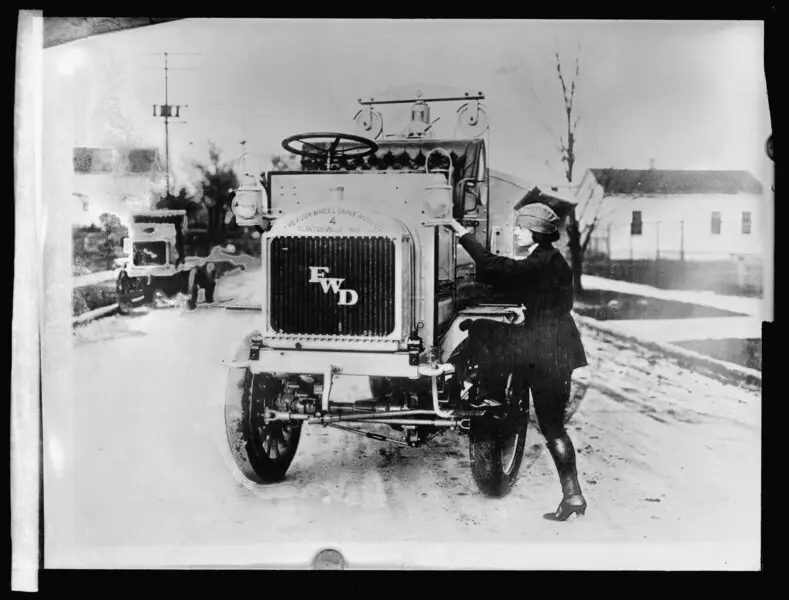
The legacy of Luella Bates
The story of Luella Bates continues to have a profound impact even today. Women remain a minority in the trucking industry; factors such as family responsibilities, demanding schedules, and safety concerns represent obstacles that make it difficult for them to build careers as truck drivers. Nevertheless, Bates remains a source of inspiration for many of them. She not only opened the door but also laid fundamental foundations within the industry.
“From now on, be careful what you say about truck drivers in general. Not all of them are big, burly people with a wide vocabulary of profanity,” Bates stated in a 1920 article in Popular Science Monthly.
 Business hours: Monday to Friday from 8:00 AM to 5:00 PM. California time