 Hable con un agente al (888) 572-7520
  Enviar mensaje a un agente



The U.S. trucking landscape is undergoing its most radical transformation in the last three decades. For years, the golden rule for any owner-operator or mid-sized fleet was simple: position trucks near the major West Coast ports to move goods arriving from Asia into the interior of the country.
Today, that traditional model is losing ground. The combination of geopolitical tensions, disruptions in global supply chains, and federal tax incentive policies has triggered the economic phenomenon of nearshoring. Companies are relocating their production facilities from Asia to Mexico to be closer to the American consumer.
For the independent carrier, this isn’t just a theory about global trade. It represents a direct shift in the location of available cargo, the length of routes, and the cost per mile of freight.
From the West Coast to the southern border
Official data confirms that this trend is not temporary. According to the Bureau of Transportation Statistics (BTS) of the U.S. Department of Transportation (DOT), Mexico has firmly established itself as the United States’ leading trading partner in the exchange of goods.
This concentration of cross-border trade means that freight demand no longer depends solely on ocean-bound containers arriving in Los Angeles or Long Beach. The main flow has shifted to land border crossings in the Southwest.
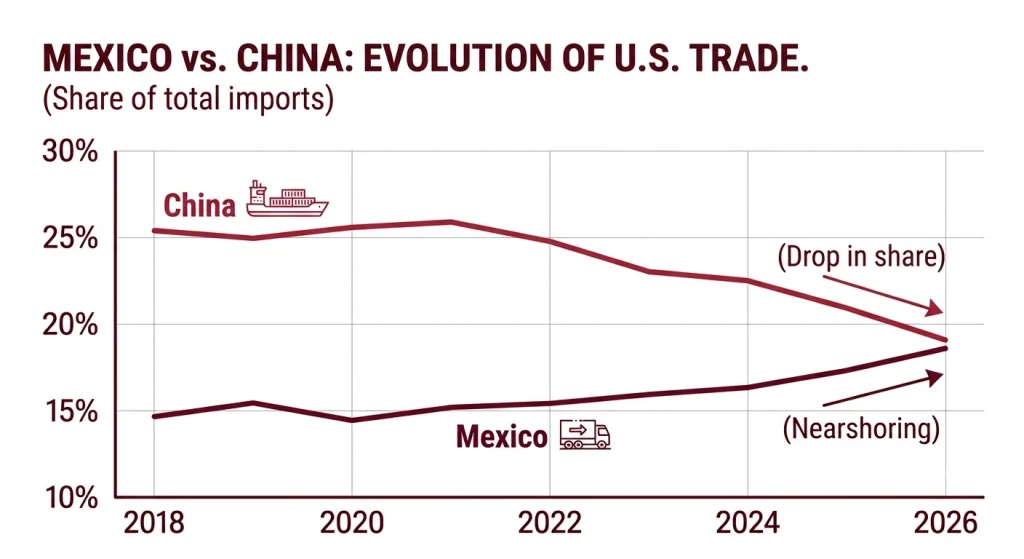
The U.S. Department of Commerce highlights that the import of advanced manufactured goods—such as auto parts, electronic components, heavy machinery, and medical equipment—leads this regional trade. Unlike mass-market consumer goods that used to be stored for months in warehouses, industrial inputs brought in under the nearshoring model operate under just-in-time delivery systems.
Reports from the American Trucking Associations (ATA) indicate that more than 80% of the total value of bilingual trade between Mexico and the U.S. is transported exclusively by truck. This makes the highway the bottleneck or the main artery of continental trade.
For carriers, this translates into a concrete opportunity: cross-border freight commands competitive rates due to the strict punctuality required by assembly plants in the Rust Belt and the Midwest.
New Logistics Corridors
The relocation of production to Mexico has redefined the nation’s most lucrative lanes. Historically, the Interstate 10 or 80 corridor dominated east-west traffic. Currently, the north-south vertical routes connecting to the southern border are experiencing unprecedented traffic densities.
Key entry points have changed the dynamics of border cities:
Laredo and McAllen (Texas): The Laredo land port has become the country’s highest-volume logistics hub. It connects directly to Interstate 35 (I-35), the main corridor that carries goods to Dallas, Kansas City, and Chicago.
Nogales (Arizona): It connects via I-15 and I-10, facilitating the transport of goods to the West Coast and the Pacific Northwest states.
Otay Mesa (California): Vital for the movement of electronic components and medical supplies to Californian distribution centers.

According to analysis by the Federal Reserve Bank of Dallas, investment in storage and logistics infrastructure in the bordering areas of Texas has increased at accelerated rates. However, this massive volume of cargo presents a technical challenge for the carrier: customs delays and the cost of detention time.
To get the most out of nearshoring, the owner-operator does not need to cross the border into Mexico. The vast majority of loads operate under the “transshipment” or drayage system: a Mexican truck crosses the trailer through the border commercial zone, leaves it at a maneuvering yard in the US, and it is there where the US carrier hooks the box for the long stretch (line-haul).
To protect the operating margin on these routes, the economic strategy requires attention to three main factors:
Negotiation of detention time: Border areas suffer from congestion during peak hours. Make sure your contracts with brokers include clear detention charge clauses starting from the second hour of waiting at the transshipment yard.
Identifying Backhaul: Moving freight south (boundary direction) used to pay low rates. Nearshoring is balancing the scales: the flow of machinery, raw materials and components that the US sends to Mexico for processing has increased the rate per mile on one-way trips south.
Preventive maintenance focused on braking and tires: Nearshoring corridors involve dragging weights close to the legal limit of 80,000 pounds due to the density of metal and machinery components. This increases the wear and tear of key inputs.
Adjustments for the future of transportation
The impact of nearshoring transcends short-term rate situations; represents a restructuring of the economic geography of North America. Data from the Council of Supply Chain Management Professionals (CSCMP) confirms that companies prioritize operational resilience and proximity over the ultra-low labor costs that Asia offered.
For the United States carrier, adapting to this reality does not require changing trucks, but rather adjusting the vision of the business. Monitoring freight volumes in border cities, diversifying relationships with brokers specialized in cross-border cargo, and positioning teams in north-south corridors are the necessary steps to stay on the most profitable route.
Fuel and insurance will continue to put pressure on fixed costs, but the freight is there, moving forward by leaps and bounds just south of our border. With nearshoring, the opportunity to leverage those miles and ensure the viability of your business is on the table.
 Business hours: Monday to Friday from 8:00 AM to 5:00 PM. California time