 Hable con un agente al (888) 572-7520
 Enviar mensaje a un agente


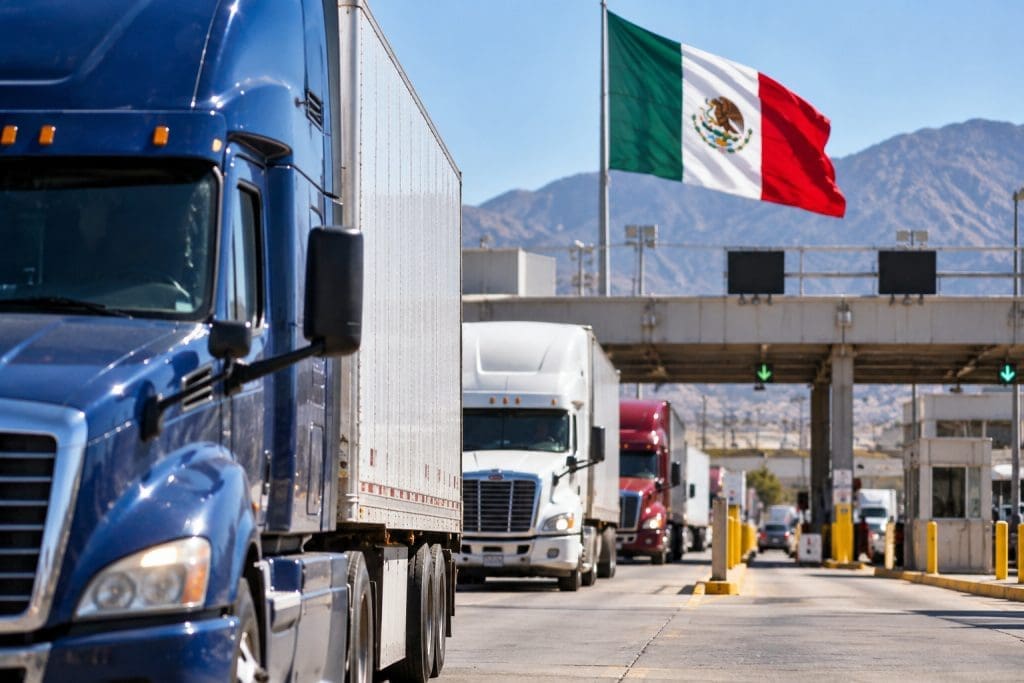

Freight transportation between the United States and Mexico is facing increased regulatory scrutiny, raising concerns among logistics companies on both sides of the border.
The U.S. government is stepping up enforcement of rules governing truck drivers from Mexico, particularly those involving business visas, domestic freight transportation, and commercial driver qualifications.
The issue took center stage at the 2026 National Convention of Mexico’s National Chamber of Freight Transportation (CANACAR), held in Cancún, where trucking industry representatives, customs officials, and international organizations discussed the potential consequences of stricter enforcement.
U.S. and Mexico-based trucking companies agree on the need to prevent unauthorized freight operations. However, industry representatives warn that enforcement must be consistent and should not create additional obstacles for carriers that comply with existing regulations.
The issue goes beyond immigration enforcement. It also affects driver availability, delivery schedules, and transportation costs along one of North America’s most important trade corridors.
What Mexican Truck Drivers Can Legally Do in the United States
One of the main issues under discussion is cabotage, which refers to transporting freight between two locations within the same country.
U.S. regulations allow certain Mexican truck drivers to enter the country to deliver goods originating in Mexico or pick up freight destined for export.
However, drivers operating under a B-1 visa for international transportation cannot freely accept domestic freight assignments between U.S. cities.
For example, a Mexican truck driver may transport goods from Monterrey to Dallas and, provided all applicable requirements are met, pick up another load destined for Mexico.
That same authorization does not allow the driver to haul a purely domestic load from Dallas to Houston.
U.S. Customs and Border Protection (CBP) explained these restrictions in an official cabotage enforcement notice issued April 29, 2026.
The notice also outlines restrictions involving certain empty trailer movements, adding domestic freight to international shipments, and deliveries that no longer qualify as international transportation.
CBP Clarifies There Is No 100-Mile or 24-Hour Limit
One of the most significant developments for Mexican truck drivers came October 5, when CBP issued official guidance clarifying authorized B-1 visa transportation activities.
The agency confirmed that there is no general rule requiring drivers to remain within 100 miles of the border. Nor is there an automatic 24-hour limit for completing an international delivery.
This means a Mexican truck driver may travel the distance necessary to deliver freight, pick up export-bound shipments, and return to Mexico, provided the operation complies with applicable immigration and transportation regulations.
CBP also clarified that an international shipment may be delivered to multiple locations within the United States without automatically constituting a cabotage violation.
This distinction is important because it separates legitimate international freight movements from unauthorized domestic trucking services.
However, the agency warned that certain interruptions may affect a shipment’s status.
For example, if a driver parks a truck in the United States, returns to Mexico overnight, and later comes back to retrieve the vehicle, compliance questions may arise if the shipment has lost its continuity as an international transportation operation.
Trucking companies must therefore carefully review the documentation and circumstances surrounding each trip.

B-1 Visas Face Increased Scrutiny
Another major concern involves B-1 visas, which Mexican truck drivers use for authorized international commercial transportation activities.
These visas do not provide unrestricted authorization to work as truck drivers within the United States.
During the Cancún convention, Justen Thomas, a representative of the U.S. Consulate General, encouraged drivers to prepare thoroughly for visa application and renewal interviews.
English proficiency may be among the factors considered during evaluations, although immigration decisions depend on multiple eligibility requirements.
Concerns about visa cancellations are not new.
In June, FreightWaves reported that CANACAR estimated approximately 20,000 visa revocations involving Mexican truck drivers between April 2025 and April 2026.
The figure came from the Mexican trucking organization and reflects the scale of the difficulties reported by the industry. It should not be interpreted as an official U.S. government count of confirmed violations.
The situation has also triggered protests.
In September, truck drivers demonstrated in Mexicali, calling for greater clarity in the enforcement of immigration regulations, according to another FreightWaves report.
English Proficiency Requirements Could Put Drivers Out of Service
Enforcement efforts also extend to English-language requirements for commercial motor vehicle operators.
The Federal Motor Carrier Safety Administration (FMCSA) requires commercial drivers to be able to answer questions from law enforcement officers and understand highway traffic signs in English.
Although the requirement has existed for years, enforcement became stricter under the Trump administration.
In May 2025, Transportation Secretary Sean P. Duffy announced that drivers who failed to meet the requirements could be placed out of service during roadside inspections.
The FMCSA subsequently updated its instructions for inspectors.
The agency’s revised April 2026 enforcement policy explains how inspectors should evaluate English-language proficiency and apply the appropriate enforcement measures.
For international trucking companies, the consequences can be immediate.
A driver who fails an inspection may be prohibited from continuing the trip until the situation is resolved in accordance with applicable regulations.
Mexican trucking companies have already begun adapting.
In Ciudad Juárez, some carriers introduced English-language training programs for their drivers, as documented by Reuters.
U.S. Trucking Companies Support Enforcement but Call for Clear Rules
During the meetings in Cancún, Derek Leathers, president and CEO of Werner Enterprises, expressed support for measures aimed at preventing foreign carriers from conducting unauthorized domestic trucking operations.
His position is that companies should compete under the same rules and that visas intended for international transportation should not be used to perform domestic freight services.
Meanwhile, Bob Costello, chief economist at the American Trucking Associations (ATA), emphasized the importance of fair and proportionate enforcement.
Costello noted that cross-border trade had recovered during 2026 following a slight decline in 2025 and stressed the need to keep freight moving.
Augusto Ramos Melo, president of CANACAR, also acknowledged that combating illegal cabotage is necessary but warned that increased inspections could lead to delays and operational difficulties.
Their positions were outlined in an October 15 report published by the International Road Transport Union (IRU).
The common ground among U.S. and Mexican industry representatives is that stricter enforcement should not penalize carriers that comply with the requirements for transporting freight between the two countries.
New Border Security and Documentation Procedures
The changes extend beyond driver inspections. Liliana Flores, CBP port director at the Del Rio, Texas, port of entry, presented several initiatives during the convention aimed at improving commercial information sharing and strengthening cargo security.
Among them is the Customs Trade Partnership Against Terrorism (CTPAT), a voluntary partnership between U.S. authorities and private companies designed to improve international supply chain security.
Participants also discussed developments involving the Electronic Export Manifest, a system intended to facilitate the electronic submission of information about goods leaving the United States.
According to FreightWaves, the testing phase of a pilot initiative was scheduled to continue through October 23, 2026.
Digital procedures may help reduce paperwork and improve cargo identification. However, companies will need to adjust their processes and ensure that submitted information accurately reflects their transportation operations.
Why Freight Delays and Transportation Costs Could Increase
The consequences of stricter enforcement may extend well beyond border crossings.
When a trucking company loses drivers authorized to handle international shipments, it has fewer qualified operators available to meet customer commitments.
This can lead to rescheduled deliveries, tighter truck capacity, and higher transportation costs.
Signs of pressure are already appearing in freight market indicators.
An October 13 FreightWaves analysis described rising load rejection rates among carriers operating in major cross-border corridors, including El Paso, Otay Mesa, and Laredo.
The report linked tightening truck capacity to restrictions affecting drivers, although operating expenses and other market conditions also influence freight rates.
Another report published October 12 warned that driver availability constraints could continue into 2027.
For companies that depend on frequent shipments between Mexico and the United States, the consequences may include longer waiting times, difficulties coordinating warehouses and distribution centers, and higher freight rates.
However, U.S. authorities have not announced a blanket ban on Mexican truck drivers entering the country.
International trucking operations remain permitted when drivers and carriers meet the applicable requirements.
What Mexican Truck Drivers Need to Know Before Crossing the Border
For Mexican truck drivers who regularly operate international routes, the current enforcement environment makes it especially important to verify the validity of their documents, visa conditions, professional qualifications, and the nature of the freight being transported.
Carriers must also be able to demonstrate that each shipment is part of a legitimate international transportation operation rather than an unauthorized domestic haul.
Shipping documents, delivery instructions, pickup locations, and final destinations are particularly important during inspections.
CBP’s recent clarifications provide more detailed guidance on permitted activities, but they do not eliminate the obligation to comply with immigration and transportation regulations.
The challenge for U.S. authorities will be to enforce restrictions on illegal operations without creating unnecessary delays in trade with Mexico.
For truck drivers and logistics companies, the priority remains clear rules, predictable procedures, and enough transportation capacity to keep freight moving.
At Saint George, we offer specialized binational commercial truck insurance solutions for Mexican carriers operating between Mexico and the United States. Click here.
 Business hours: Monday to Friday from 8:00 AM to 5:00 PM. California time