 Hable con un agente al (888) 572-7520
 Enviar mensaje a un agente


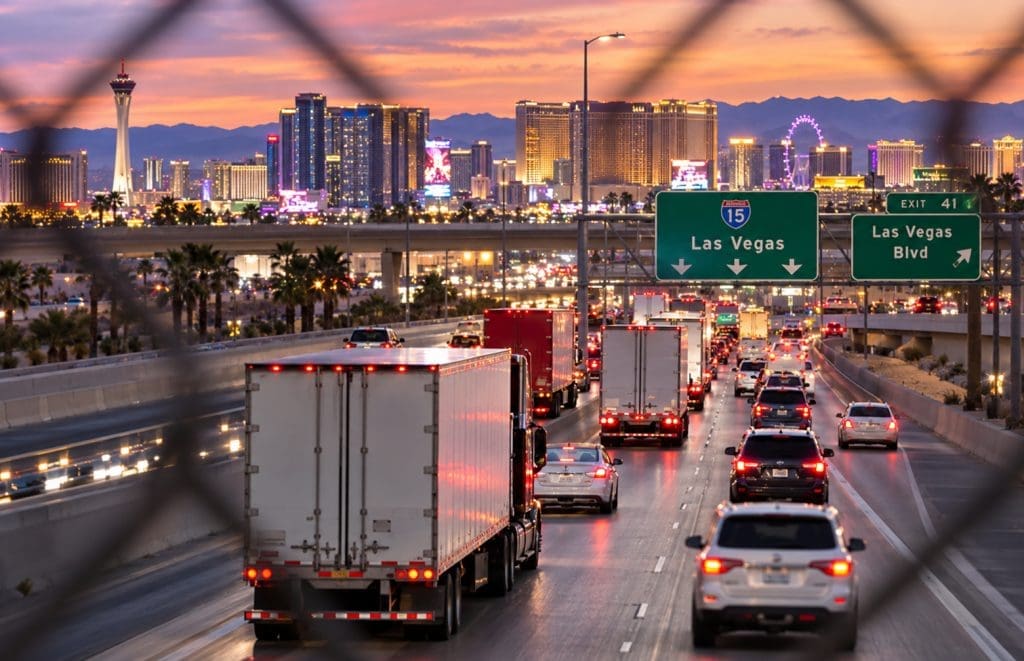

Nevada is preparing for steady growth in freight transportation over the coming decades. The Nevada Department of Transportation (NDOT) has outlined a strategy in its 2026 Nevada Freight Plan to improve highways, ease congestion, expand truck parking, and strengthen freight connections with California, Arizona, and Utah.
The plan identifies I-15 and I-80, along with US-95, US-93, and US-50, as essential freight corridors. These highways connect West Coast ports with distribution centers, industrial facilities, and markets across the country.
According to projections in the report, freight moving into, out of, and within Nevada could exceed 850 million tons by 2050. Trucking is expected to remain a major driver of that growth.
I-15 and I-80 Are Nevada’s Most Important Trucking Routes
I-15 handles a significant share of commercial truck traffic in southern Nevada. Running through the Las Vegas area, it connects distribution centers in Southern California with markets in Utah and other western states.
The report estimates that more than 35,000 trucks travel through the Las Vegas Valley each day, making I-15 a major priority for freight infrastructure planning.
In northern Nevada, I-80 plays a similarly important role. It connects Reno and Sparks with California, Salt Lake City, and markets throughout the Midwest. The corridor carries industrial products, machinery, electronics, and freight moving through the region’s logistics hubs.
US-95 and the developing I-11 corridor are becoming increasingly important for north-south freight connections, while US-93 and US-50 provide essential access to mining, agricultural, and industrial operations in rural Nevada.
The expansion of e-commerce and distribution centers is putting additional pressure on these highways, particularly near warehouses and industrial parks.
Nevada Plans to Expand Truck Parking
One of the biggest challenges identified by NDOT is the shortage of safe truck parking, particularly along rural highways.
According to the plan, Nevada has approximately 6,318 free truck parking spaces across 171 public and private locations. However, long stretches of highway, especially in central and eastern Nevada, still lack adequate places for drivers to stop and rest.
Since 2022, NDOT has added 136 public truck parking spaces, while approximately 230 additional spaces are planned or programmed for private construction over the following three years.
Recent and planned improvements include expanded parking along I-80 at Golconda Summit and along I-15 near Apex and the Garnet interchange. Additional improvements are also being considered along US-6.
Limited parking availability can force drivers to look for alternatives in industrial areas, near highway ramps, or in unauthorized locations, creating safety concerns and making it harder to comply with federal hours-of-service regulations.
Real-Time Technology Could Help Truckers Find Parking
Nevada is also developing a Truck Parking Availability System (TPAS) to help commercial drivers locate available parking spaces.
The system is designed to use sensors and cameras to monitor parking availability and share updates through electronic highway signs, Nevada’s 511 traveler information service, and trucking applications.
The plan describes a pilot program covering 11 locations along I-15 and I-80, with broader implementation planned for 2028 and 2029.
The goal is to help truckers identify available parking before reaching a facility, spend less time searching for a place to stop, and schedule required rest breaks before reaching their driving-hour limits.
New Truck Climbing Lanes and Interchange Improvements
The report also identifies highway improvements aimed at reducing truck delays on steep grades and near major industrial facilities.
Recent and planned projects include additional truck climbing lanes along I-80 near Emigrant Pass, Pequop Summit, and Golconda Summit, as well as along I-15 near Apex, Garnet, and Byron.
These improvements are intended to reduce speed differences between heavily loaded trucks and other vehicles, particularly on steep uphill sections.
The plan also includes interchange improvements at I-80 and USA Parkway and at I-515/I-11 and Charleston Avenue, along with new truck weight-enforcement sensors on northbound I-15 near Apex.
These projects are in different stages of planning and implementation. They should not be interpreted as announcements of immediate highway closures or construction beginning simultaneously.
Nevada Identifies Critical Freight Corridors
In September 2023, the Federal Highway Administration (FHWA) approved Nevada’s updated designations for Critical Urban Freight Corridors (CUFCs) and Critical Rural Freight Corridors (CRFCs).
NDOT developed the list through a data-driven needs assessment, working with metropolitan planning organizations and its Freight Advisory Committee.
These designations help identify transportation links that are especially important for safety, travel-time reliability, and economic activity. They also help guide federal freight infrastructure investments.
Projects identified through this process must go through the One Nevada Transportation Process for evaluation and prioritization before moving toward implementation.
Winter Storms and Extreme Weather Remain Major Concerns
Nevada’s freight strategy also addresses disruptions caused by winter storms, wildfires, flooding, and rockslides.
NDOT has identified more than 60 freight-related highway segments vulnerable to these types of events.
Along I-80, heavy snowfall and highway closures can leave truckers waiting for extended periods. Nevada is therefore working with California, Utah, Wyoming, and Nebraska to improve weather information, traffic management, and emergency response coordination.
Along I-15, regional cooperation with California, Arizona, and Utah focuses on improving alternate routes and maintaining freight movement when crashes, construction, or other disruptions affect the corridor.
For truckers traveling through Nevada, the plan points to gradual improvements in highway infrastructure, additional parking options, better technology for planning rest stops, and upgrades to the state’s busiest freight routes.
The 2026 Nevada Freight Plan is a long-term transportation planning document, not a schedule of current highway closures or restrictions. Drivers can check real-time road conditions, traffic alerts, and travel information through the official Nevada 511
 Business hours: Monday to Friday from 8:00 AM to 5:00 PM. California time