 Hable con un agente al (888) 572-7520
  Enviar mensaje a un agente

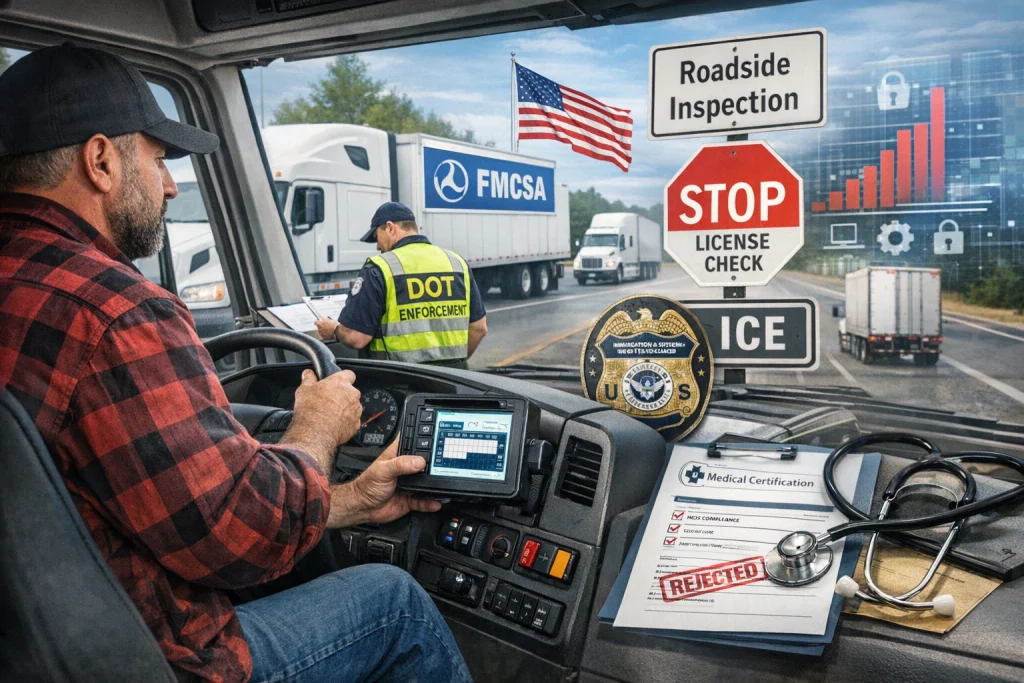

The impact of recent government regulations is transforming the daily lives of thousands of transportation workers and business owners in the United States, who now face a much stricter and more digitized compliance environment. In this regard, the Federal Motor Carrier Safety Administration (FMCSA) has made it clear that its current priority is modernizing the oversight system, which translates into constant, real-time monitoring of driver hours and qualifications.
This change is not merely bureaucratic: it represents a restructuring of how the authority to operate on U.S. highways is granted and maintained. One of the most significant measures has been the elimination of licenses for non-resident foreign drivers who do not meet the new interagency safety standards, a direct response to concerns about serious accidents recorded last year.
The Department of Transportation (DOT) is implementing rules to close legal loopholes that allowed certain states to issue commercial driver’s licenses without thoroughly verifying driving history or proper immigration status through systems like SAVE.
For independent carriers or small fleet owners, this directly means that the hiring and record-keeping process no longer allows for manual errors or delays in documenting Driver Qualification Files (DQFs).
The context for these decisions is the increasing use of technology as a control tool for transportation, where Electronic Data Recording Devices (ELDs) play a central role. The FMCSA has intensified the vetting of its list of certified devices, removing popular models like the HERO ELD and others for failing to meet minimum technical standards for security and data encryption.
Truck drivers using revoked devices face immediate decommissioning if they do not transition to approved equipment within the agency’s deadlines. Furthermore, the requirement to carry physical ELD manuals in the cab has been eliminated, favoring a purely digital management system that streamlines roadside inspections.
These regulations have also extended to the health sector, as paper medical certificates have been invalid for state verification since January 10, 2026. Now, the entire process is integrated into the National Registry, and companies must verify their drivers’ fitness exclusively through each state’s Motor Vehicle Registry (MVR).
This transition aims to eliminate fraud in medical certifications and ensure that only physically fit drivers operate heavy-duty vehicles, while the Alcohol and Drug Clearinghouse continues to increase penalties for those who fail to undergo mandatory annual checkups.
Operational Challenges and the Future of the Road
The freight transport industry is also influenced by evolving equipment standards, where proactive safety is the new norm. The government has made progress in implementing Automatic Emergency Braking (AEB) and Electronic Stability Control (ESC) systems for heavy trucks, with the goal of drastically reducing rear-end collisions.

Although these technologies aim to save lives and reduce long-term accident costs, for truck owners they represent a larger initial investment or the need to replace equipment previously considered outdated.
On the other hand, the FMCSA has launched pilot programs to explore greater flexibility in hours of service, recognizing that the current rigidity can sometimes be counterproductive to the safety of fatigued drivers.
This balance between technological control and operational flexibility is at the heart of current discussions in Washington. But it’s not the only issue commanding attention: emissions regulations are also on the horizon, with Phase 3 of the EPA’s greenhouse gas standards pressuring manufacturers to produce cleaner vehicles by 2027.
For truckers, staying well-informed is not only necessary to avoid fines, but also to ensure the survival of their business in a market that severely penalizes non-compliance with technical and administrative regulations in the age of digital transparency.
Latest Updates
- Elimination of Licenses for Unqualified Foreigners: States are prohibited from issuing CDLs to foreign drivers who do not have H-2A, H-2B, or E-2 status and who have not passed the SAVE system screening.
- End of Paper Medical Certificates: As of January 10, 2026, medical certification must be verified electronically through the State Registry (MVR).
- Revocation of ELD Devices: Devices such as the HERO ELD have been removed from the official list; drivers have until June 2026 to replace them.
- Registry Modernization (USDOT): Individual MC numbers are being eliminated to consolidate operating authority under USDOT number suffixes in a single online system.
- English Language Proficiency: Enforcement is being strengthened to ensure drivers can communicate and understand traffic signs in English to avoid being deactivated.
- New Automatic Emergency Braking (AEB) Criteria: Final proposal to require AEB systems in commercial vehicles over 10,000 pounds.
- Change to ELD Manual: Drivers are no longer required to carry a printed copy of the ELD user manual inside the vehicle.
- Clearinghouse Inquiries: Increased fines for carriers who fail to check their drivers’ drug and alcohol status in the Clearinghouse database.
 Business hours: Monday to Friday from 8:00 AM to 5:00 PM. California time