USDOT has placed direct responsibility on California Governor Gavin Newsom’s for allowing a 21-year-old asylum seeker to upgrade his commercial driving privileges despite newly enacted federal restrictions.ays later, the driver caused a highway crash that killed three people and left two others hospitalized
The U.S. Department of Transportation (USDOT) has placed direct responsibility on California Governor Gavin Newsom’s administration for allowing a 21-year-old asylum seeker to upgrade his commercial driving privileges despite newly enacted federal restrictions. Days later, the driver caused a highway crash that killed three people and left two others hospitalized — an incident federal officials described as “entirely preventable.”
The case has ignited a nationwide debate over highway safety, the issuance of commercial driver’s licenses (CDLs) to non-citizens, and mounting tensions between federal safety regulations and California’s immigration-aligned licensing policies.
Federal Report Accuses California of Violating Emergency CDL Regulations
A newly released USDOT report, led by Transportation Secretary Sean P. Duffy, alleges that the State of California “knowingly failed” to comply with updated Federal Motor Carrier Safety Administration (FMCSA) standards governing non-domiciled commercial licenses.
According to the report, a post-incident federal audit found that approximately one in four CDL licenses issued to non-domiciled drivers in California were improperly granted, without meeting mandatory federal verification requirements.
The FMCSA had issued an emergency directive on September 26, 2025, requiring states to:
Suspend issuance or modification of non-domiciled CDLs until verification systems aligned with federal standards.
Deny CDL eligibility to asylum applicants pending verified immigration clearance.
Use the federal SAVE database to confirm lawful status.
Identify, revoke, and reissue improperly issued licenses under updated federal criteria.
California was formally notified of these obligations and instructed to halt further updates or renewals until full compliance was assured. However, according to the investigation, the California Department of Motor Vehicles (DMV) continued processing privilege upgrades for foreign nationals without applying the mandatory federal restrictions.
A Timeline of Errors Leading to a Deadly Outcome
One of the reviewed cases was that of Jashanpreet Singh, a 20-year-old asylum applicant who received a restricted non-domiciled CDL on June 27, 2025.
On October 15, 2025 — the day Singh turned 21 — the California DMV removed his “K restriction,” which had limited his CDL use to in-state operations. Under FMCSA’s emergency rule, this upgrade qualified as a “significant privilege enhancement” and should have triggered a full federal eligibility assessment, which would have resulted in license denial due to Singh’s pending asylum status.
Instead, the DMV processed the modification without review under the new federal standards.
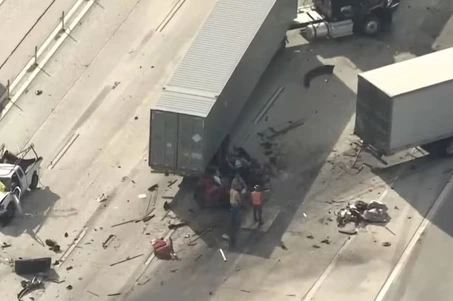
Six days later, on October 21, 2025, Singh was driving a semi-truck under the influence of narcotics when he crashed into vehicles stopped on a California highway. Three people were killed, and two others were transported to the hospital in critical condition.
USDOT concluded that the collision was “entirely preventable had the State of California complied with federal law.”
Federal Officials Blame Newsom Administration Directly
Transportation Secretary Sean P. Duffy publicly condemned the state’s handling of CDL enforcement under Governor Newsom, stating:
“This would never have happened if Gavin Newsom had followed the new rules. California violated federal law, and now three people are dead and two are hospitalized. These families deserve justice. There will be consequences.”
The report further states that California “failed to act with urgency” despite being explicitly warned about systemic noncompliance.
California Faces Federal Sanctions and Legal Exposure
Under current federal enforcement mechanisms, California now has 30 days to:
Conduct a full internal audit of its non-domiciled CDL issuance system.
Flag and review all active licenses issued under pre-rule criteria.
Revoke improperly upgraded or issued licenses.
Implement mandatory SAVE-based immigration verification for all renewals and modifications.
Failure to comply may result in:
Loss of delegated federal licensing authority.
Regulatory sanctions and funding penalties.
Lawsuits related to gross negligence and regulatory failure.
Federal oversight or preemption of CDL issuance within the state.
A National Flashpoint on Immigration, Safety, and State vs. Federal Authority
The incident has already become a catalyst in a widening national debate over:
Whether asylum seekers and non-citizens should hold commercial driving privileges.
The role of states in regulating commercial transportation under federal safety mandates.
The legal liability of state governments for authorizing high-risk operators.
Public safety versus inclusionary licensing policies.
The October 21 tragedy has placed California at the center of scrutiny from lawmakers, transportation associations, and victims’ rights groups, raising critical questions about accountability, compliance, and the intersecting roles of federal law, immigration policy, and highway safety.

Lunar New Year 2026: Ancient Traditions, Renewed Energy, and Massive Celebrations
Lunar New Year 2026 begins on February 17 under the sign of the Fire Horse and is marked by spiritual rituals, family reunions, and large-scale celebrations in both China and the United States, especially in California.

Freedom 250 Grand Prix: How Logistics and Transportation Will Power the Race in Washington
The first-ever IndyCar street race in Washington, D.C., scheduled for August 21–23, will headline the United States’ 250th anniversary celebrations — and it will trigger a massive transportation, freight, and urban logistics operation behind the scenes.

Groundhog Day: What It Means for Trucking When “Phil Sees His Shadow”
The forecast from America’s most famous groundhog is calling for more winter — and that’s an important signal for the trucking industry and cold-season route planning

Love on the open road: the best dating apps for truckers
If you’re looking for someone to go the long haul with, here are the best dating apps for truck drivers. They say love is everywhere…

The most congested cities in the U.S. and the world in 2025
The annual TomTom Traffic Index produces a ranking of the most congested cities in the world. The annual TomTom Traffic Index presents an analysis of

Steady Growth Signals Strong Momentum in the U.S. Trucking Industry
Trucking growth in the United States is gaining strength in 2026, driven by higher freight demand, expanding logistics activity, and new opportunities for carriers and fleet operators.