 Hable con un agente al (888) 572-7520
  Enviar mensaje a un agente



To pick up a container faster at the Port of Tacoma, a truck needs to meet three requirements before arriving at the terminal: the driver must have a registered TWIC (port security credential), the truck must have an active RFID tag and a 2007-or-newer engine under the Northwest Seaport Alliance’s (NWSA) Clean Truck Program, and the driver must book an appointment in eModal as early as possible — never waiting until the “last free day” (the final day before storage charges kick in) to reserve one.
Once those three requirements are met, the single biggest factor in cutting gate wait times is simply not leaving the booking for the last minute, since appointments fill up fast in the days leading up to the free-time deadline.
Why Fast Container Pickup Matters So Much
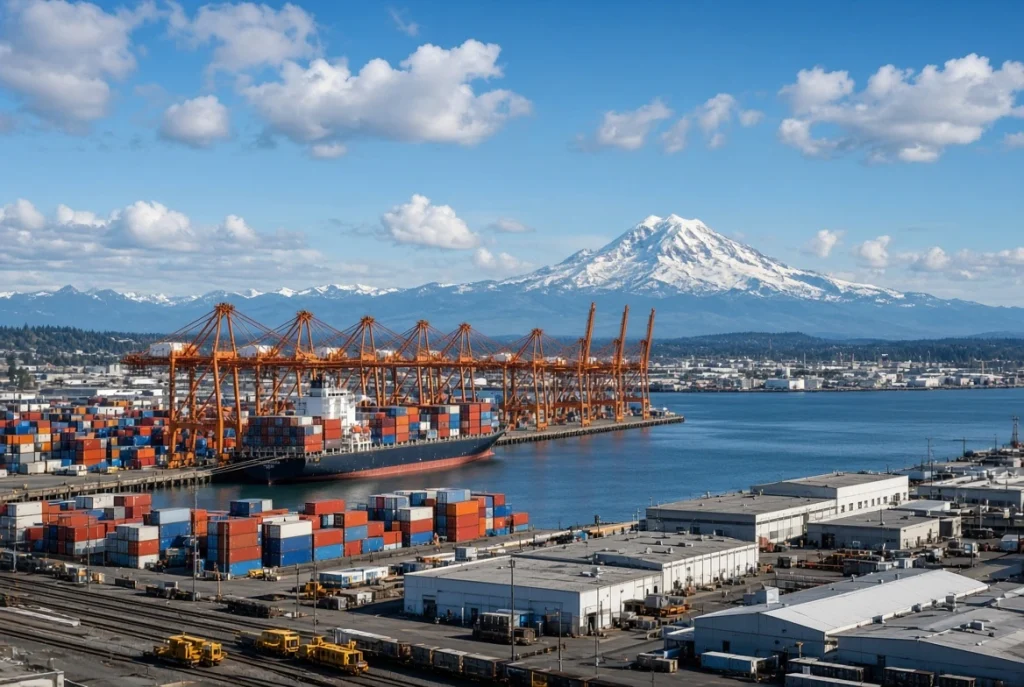
The Port of Tacoma is, according to recent data, the sixth-busiest container port in North America and one of the 25 busiest in the world. It has operated jointly with the Port of Seattle under the Northwest Seaport Alliance (NWSA) since 2015, and that volume of cargo means any delay in picking up a container carries a direct cost: demurrage charges billed by the ocean carrier or the terminal, and detention charges that apply if the container or chassis isn’t returned on time.
For an owner-operator or a trucking company, understanding the pickup process isn’t just an operational detail — it’s a direct question of profitability on every single load.
Step 1: Confirm the Truck and Driver Meet Access Requirements
TWIC: The Mandatory Credential for Terminal Access
Since 2009, a TWIC (Transportation Worker Identification Credential) has been mandatory for anyone requiring regular, unescorted access to restricted areas of the Port of Tacoma, including truck drivers. It’s a biometric security credential issued by the Transportation Security Administration (TSA) after a background check. A driver without a valid TWIC can only enter accompanied by someone who holds one and is authorized as an escort — an extra step that adds unnecessary time and cost to every trip.
RFID and Engine Age: The Clean Truck Program
As of January 1, 2026, every truck serving container terminals — both international and domestic — under the NWSA must carry an active, registered RFID tag, along with a 2007-or-newer engine or a certified equivalent emission control system. This requirement is part of the alliance’s Clean Truck Program. A truck without a valid RFID tag can be denied authorization to operate at the Seattle-Tacoma gateway altogether.
Step 2: Book the eModal Appointment Early
The NWSA manages access to its terminals, including those in Tacoma, through the eModal appointment system. Before booking an import appointment, it’s essential to first check container availability on the relevant terminal’s website: eModal allows appointments to be created even for containers still under customs or freight hold, which can lead to a rejection or delay at the gate if the container hasn’t been fully released.
The official recommendation from terminals operating under the NWSA — such as Washington United Terminals (WUT), on the Blair Waterway — is not to wait until the last free day, or the day before it, to book an appointment. Slots fill up quickly around those dates, which can leave a truck unable to pick up its container on time and add to yard congestion.
Step 3: Know Tacoma’s Terminal Map
The Port of Tacoma isn’t a single terminal — it operates several independent docks, each with its own appointment system and specific rules. The most relevant container terminals in Tacoma include:
- Husky Terminal
- Washington United Terminals (WUT), on the Blair Waterway
- Pierce County Terminal (PCT)
- Matson’s terminal
Each one publishes its own gate schedules and appointment rules, available in one place on the NWSA’s gate schedule page, updated Monday through Friday.
Step 4: Avoid the Most Common Mistakes That Cause Delays
Based on official information published by terminal operators within the NWSA, these are the mistakes that most frequently get a truck turned away or delayed at the gate:
- Booking an appointment on a container that isn’t fully released: if a red-flagged error appears in eModal (as opposed to an orange warning, which still allows you to proceed), the appointment simply cannot go through.
- Showing up without an appointment at terminals that require one: drivers without a booking are typically directed to leave the terminal, with only limited exceptions.
- Not verifying release status before heading to the port: arriving with incomplete paperwork or unconfirmed customs release is one of the most common causes of gate rejection.
- Not having the right chassis lined up: coordinating the chassis source (owned, pool, or carrier-provided) before the appointment avoids additional delays once inside the terminal.
What a Drayage Broker Needs Before Scheduling a Pickup
Drayage companies operating in the Seattle-Tacoma corridor typically require, at minimum, the following information before coordinating a container pickup: terminal name, container number, delivery order status, release status, availability, last free day, assigned appointment, cargo size and weight, and chassis source. Having that information organized in advance significantly speeds up coordination with the carrier and reduces the margin for error at the gate.
Frequently Asked Questions
What is the “last free day” at the Port of Tacoma? It’s the final day a container can be picked up without the ocean carrier or terminal charging additional storage fees (demurrage). Booking the pickup appointment close to that date increases the risk of finding no available slots in eModal.
Is a TWIC required for every trucker entering the Port of Tacoma? Yes. Anyone who needs regular, unescorted access to restricted areas of the port must hold a valid TWIC, including truck drivers.
What happens if my truck doesn’t have an active RFID tag? As of January 1, 2026, an active RFID tag and a 2007-or-newer engine (or a certified equivalent) are mandatory to operate at the Northwest Seaport Alliance’s container terminals. Without meeting that requirement, a truck can be barred from serving the gateway.
Do all Port of Tacoma terminals use the same appointment system? Access coordination is largely centralized through eModal, but each terminal (Husky, WUT, PCT, Matson) has its own gate schedules and specific appointment rules, so it’s worth checking each one’s individual requirements before scheduling a pickup.
 Business hours: Monday to Friday from 8:00 AM to 5:00 PM. California time