 Hable con un agente al (888) 572-7520
  Enviar mensaje a un agente

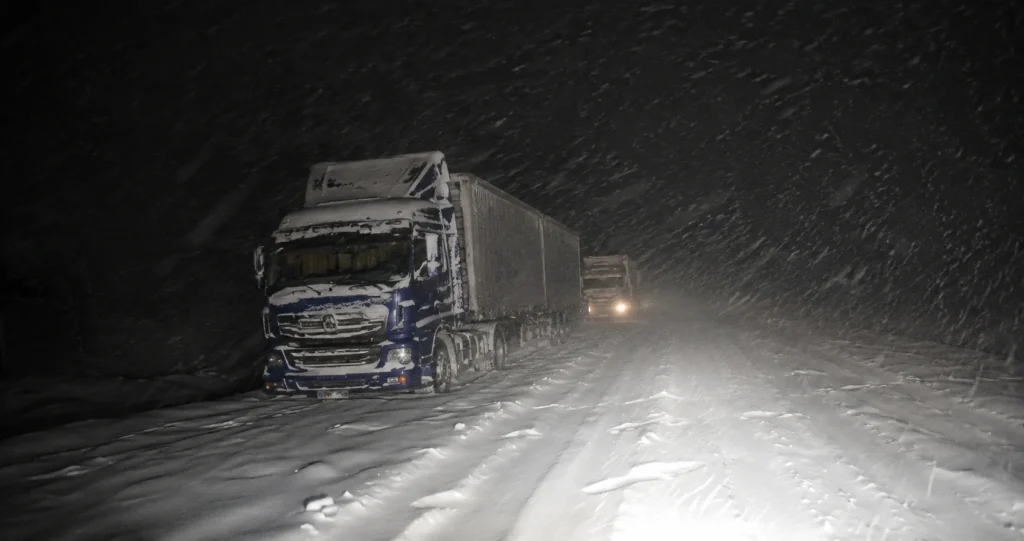

Snowbound truckers have been trapped for days inside their cabs, surrounded by deep snow and freezing temperatures, as they wait for one of South America’s most important mountain highways to reopen. That is the reality facing hundreds of drivers stranded in Argentina’s high Andes along one of the world’s most demanding international routes.
The setting is the Cristo Redentor International Pass, located between Argentina’s Mendoza Province and Chile. It is South America’s main land corridor connecting the Atlantic and Pacific oceans, linking production from Brazil, Argentina, Paraguay, and Uruguay with Chilean ports on the Pacific coast.
Every year, thousands of trucks carrying food, vehicles, machinery, industrial goods, fuel, and countless other products travel this route. During the Southern Hemisphere winter, however, the Andes can bring this vital logistics corridor to a complete standstill.
Over the past several days, more than 600 trucks have been stranded on the Argentine side of the mountains after a powerful snowstorm forced authorities to close the Cristo Redentor Pass. While snowplows work to clear the highway and officials monitor weather conditions, drivers have only one option: wait. Some remain parked in freezing mountain conditions, while others are stopped farther down the highway.
And waiting here means living in one of South America’s harshest environments.
The Road to Aconcagua
Argentina’s National Route 7 passes through spectacular scenery. Just off the highway stands Aconcagua, at 6,961 meters (22,838 feet), the highest mountain in the Americas and the tallest peak outside Asia.
For tourists, it is an unforgettable landscape. For truck drivers, it is another day on a route that demands experience, patience, and complete respect for the mountains.
This is no road for beginners. Steep grades, tight curves, ice, poor visibility, and rapidly changing weather make this corridor suitable only for highly experienced drivers capable of handling heavy trucks under extreme conditions.
Winter storms can dump enormous amounts of snow within hours. Near Las Cuevas, accumulations have reached nearly four meters (13 feet), creating towering snow walls that completely block traffic and require days of work with heavy equipment before the road can reopen.
After the Snow Comes Los Caracoles
Even after the border crossing reopens, drivers still face one of the journey’s greatest challenges.
On the Chilean side lies Los Caracoles, a series of more than 20 tight hairpin turns descending through the Andes.
Transportation professionals widely consider this section one of the world’s most dangerous mountain roads. Steep slopes, extremely tight curves, snow, ice, and dense fog force drivers to travel at very low speeds while maintaining complete concentration.
A commercial driver’s license alone is not enough. Crossing safely requires real mountain-driving experience, a deep understanding of truck handling on long downhill grades, and careful brake management to prevent overheating or loss of control.
Many truckers say surviving the storm is only the first part of the challenge. The second begins when they must navigate Los Caracoles with dozens of tons of cargo.
The Cab Becomes Home
While waiting for the border crossing to reopen, the truck cab becomes far more than a workplace—it turns into a bedroom, dining room, and shelter.
Drivers cook meals, rest, talk with fellow truckers, and closely follow official updates announcing whether weather conditions might allow traffic to resume.
During these long waits, solidarity also becomes essential.
Local residents, trucking organizations, and Argentina’s National Gendarmerie have been distributing water, food, and assistance to drivers who have now been stranded for nearly a week.
The operation is designed to ensure that no driver runs out of supplies while the mountain pass remains closed.
“There’s Nothing to Do but Wait”
Among the stranded drivers is Mauro Da Silva Bueno, from Rio Grande do Sul, Brazil, who is transporting powdered milk to Chile.
“We’ve been stopped in Uspallata for six days waiting for the crossing to reopen. We have supplies, the union is providing assistance, and the Gendarmerie is helping us too,” he said while waiting for news about the pass.
Da Silva shares the wait with truckers from Argentina, Brazil, Chile, Paraguay, and Uruguay.
For all of them, patience is simply part of the job.
“The Mountain Always Has the Final Say”
Carlos Rojas, a Chilean truck driver who regularly hauls industrial cargo between Santiago and Mendoza, summed up the experience with a phrase repeated every winter.
“The mountain always has the final say. You may be in a hurry to deliver your load, but when this much snow falls, all you can do is wait. The important thing is that everyone helps each other until the road opens again.”
His words reflect a reality familiar to everyone who regularly crosses the Andes: during winter, nature sets the schedule.
More Than Just a Highway
The Cristo Redentor International Pass is far more than a road connecting Argentina and Chile.
It is one of South America’s most important trade corridors and a vital gateway linking the Atlantic and Pacific economies.
When it remains closed for several days, thousands of tons of freight come to a halt, disrupting regional supply chains and international commerce.
But behind every parked truck is also a human story.
Drivers spend days away from their families, sleeping inside their cabs while waiting for the snow to give way to work once again.
In the vast Argentine Andes, beneath the shadow of Aconcagua and surrounded by snowbanks reaching up to four meters high, patience becomes the most valuable tool for the men and women who keep an entire continent’s commerce moving.
Travel with confidence. Choose the best insurance with us.
 Business hours: Monday to Friday from 8:00 AM to 5:00 PM. California time