 Hable con un agente al (888) 572-7520
  Enviar mensaje a un agente



With temperatures once again climbing above 100°F (37.8°C) in Texas this summer, working around a truck can quickly become a serious health risk. The issue is gaining even more attention as the United States considers a federal regulation that could change employers’ responsibilities when workers are exposed to extreme heat.
The Occupational Safety and Health Administration (OSHA) is pursuing a federal heat injury and illness prevention standard that would apply to both indoor and outdoor workplaces under its jurisdiction.
The proposal establishes two key thresholds: an initial heat trigger at a heat index of 80°F (26.7°C) and a high heat trigger at 90°F (32.2°C).
Once the 90°F threshold is reached, the proposal becomes more specific: covered employers would be required to provide paid rest breaks of at least 15 minutes every two hours, along with additional monitoring and heat-safety measures.
For Texas, where there is currently no general statewide requirement for this type of heat break and where cities have limited authority to impose certain local labor regulations, the change could be significant.
It could also directly affect important parts of the trucking and logistics industries.
Texas Is Back Above 100°F
The debate comes as Texas faces another summer of extreme temperatures.
The National Weather Service (NWS) recorded Dallas-Fort Worth’s first 100°F day of the year on July 7. That is particularly relevant for transportation because July and August are the months when temperatures in the region routinely remain in the 90s and frequently reach or exceed 100°F.
The extreme conditions are continuing in August.
In the Dallas-Fort Worth area, the NWS is forecasting highs ranging from the upper 90s to approximately 105°F, with heat index values between 100°F and 109°F. In Austin and San Antonio, temperatures are reaching approximately 104°F, while the heat index can range from 104°F to 108°F.
In Houston, humidity makes the situation even more challenging. High temperatures are around 94–98°F, but the heat index can reach 103–110°F.
In other words, conditions across many Texas operations are currently well above both thresholds OSHA proposes for triggering future heat protections.
What Does OSHA Want to Change?
The federal proposal goes far beyond simply recommending that workers “drink more water.”
Once the heat index reaches 80°F, covered employers would have to implement specific preventive measures. These would include providing drinking water, cool rest areas, procedures for acclimatizing new or returning employees, effective communication and rest breaks when necessary to prevent overheating.
Once the second threshold—a 90°F heat index—is reached, additional requirements would apply.
For many workers, the most significant would be a minimum paid rest break of 15 minutes every two hours. Employers would also be required to monitor workers for symptoms of heat-related illness and issue warnings about existing heat risks.
But there is one crucial distinction: these requirements are not yet in effect as a final federal standard.
OSHA published the proposed rule in August 2024. Public hearings were held between June 16 and July 2, 2025, and the deadline for certain post-hearing submissions ended on October 30, 2025. As of August 2026, OSHA continues to officially classify it as a proposed rule.
Why Is Texas Different?
Texas currently does not have a general statewide standard requiring employers to provide these types of heat-related breaks.
In addition, HB 2127, passed in 2023, restricted the ability of municipal and local governments to establish certain labor regulations of their own.
The measure had a particular impact on ordinances in Austin and Dallas, where certain construction workers had mandatory breaks related to heat exposure.
That means there is currently no rule that can simply be summarized as: “If it reaches 100°F in Texas, your employer must give you a 15-minute break every two hours.”
OSHA’s proposal would change that framework for workers and activities covered by the federal standard: the trigger would be federal and tied to heat exposure rather than a municipal ordinance.
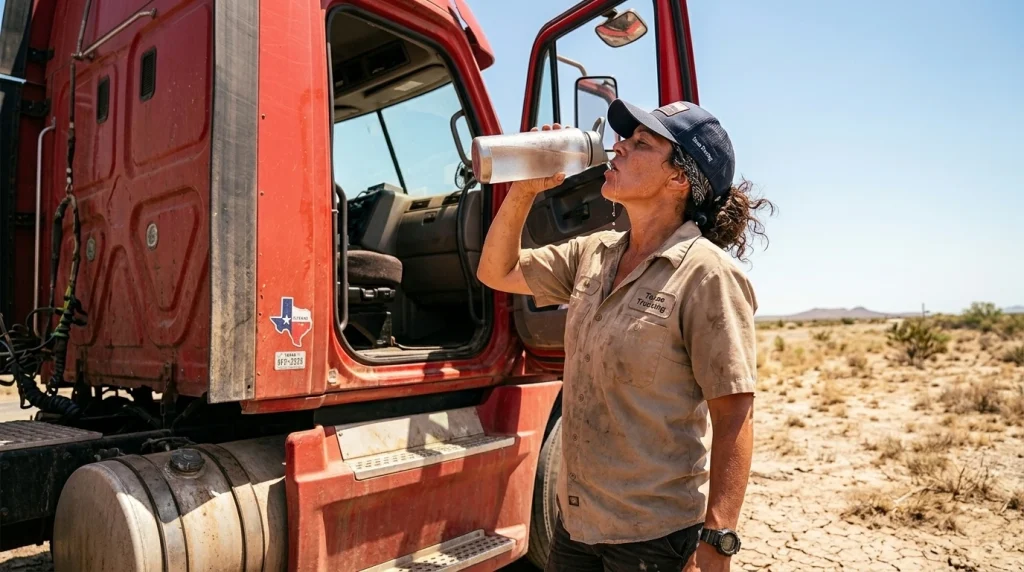
If You’re Unloading a Trailer in 100°F Heat, Are You Entitled to a Break?
Today, not automatically just because the temperature reaches 100°F.
If the federal proposal takes effect in its current form and the activity is covered by the standard, however, the answer could be very different.
OSHA provides an example that is particularly relevant to trucking.
The proposal includes an exception for employees whose work is performed primarily inside air-conditioned vehicles, but there is a limit: to qualify for the exclusion, a worker generally could not be exposed to temperatures at or above the initial heat trigger for more than 15 minutes in any 60-minute period.
OSHA even uses the example of a worker who drives an air-conditioned vehicle but repeatedly gets out to make deliveries.
If activities such as unloading cargo from the vehicle and moving it to its destination result in more than 15 minutes of exposure within an hour, those activities could fall under the proposed standard.
For trucking, that detail makes a significant difference.
Air Conditioning in the Truck May Not Automatically Exclude You
An OTR driver may spend hours inside an air-conditioned cab. But the job does not always end when the truck stops.
Consider a flatbed driver securing or removing straps and tarps under the sun. Or a delivery driver repeatedly getting in and out of the vehicle throughout the day. A driver may also spend 30 or 40 minutes helping unload a trailer, inspecting the vehicle in a parking lot without shade or waiting outside a trailer at a distribution center.
OSHA’s proposal specifically recognizes this distinction between driving inside a climate-controlled vehicle and working around it.
OSHA also states that it has authority over off-highway loading and unloading operations at locations such as warehouses, plants, commercial establishments and terminals, as well as over terminal workers and forklift operators involved in those activities.
A future federal heat standard could therefore have a particularly visible impact on loading docks, warehouses, yards and distribution centers.
What About Hours of Service?
This raises another important issue for truck drivers.
A potential OSHA heat break and the Hours of Service (HOS) regulations enforced by the Federal Motor Carrier Safety Administration (FMCSA) are separate issues.
Currently, a property-carrying driver subject to federal regulations must take a break of at least 30 minutes after eight cumulative hours of driving without an interruption of at least 30 minutes. The general driving limit is 11 hours following 10 consecutive hours off duty, within a 14-hour driving window.
OSHA’s proposal, by contrast, addresses the risk of heat exposure.
Therefore, a stop required because of extreme heat should not automatically be interpreted as authorization to extend the HOS clock.
FMCSA allows up to two additional hours under certain adverse driving conditions, but the situation must be an unforeseen condition encountered during the trip. If the carrier knew or reasonably should have known about the condition before dispatching the driver, the exception does not apply.
A forecast heat wave, therefore, does not automatically provide a two-hour HOS extension.
What Could Change for a Texas Trucking Company?
If the regulation ultimately takes effect with the thresholds currently proposed, covered companies would need to pay much closer attention to how much time their employees spend exposed to heat outside climate-controlled environments.
At a heat index of 80°F, certain preventive measures would begin.
At 90°F, the proposed requirement for paid 15-minute breaks every two hours and additional protections would take effect.
And these temperatures are hardly unusual in Texas. In August 2026, cities including Dallas, Houston, Austin and San Antonio are recording or expecting heat index values well above 100°F.
For a fleet, that could mean reviewing loading and unloading procedures, outdoor work schedules, access to drinking water, recovery areas, supervisor and driver training, and protocols for recognizing symptoms of heat exhaustion or heat stroke.
A Rule Texas Trucking Should Watch Closely
The regulation is not yet final, and its language could change before it eventually takes effect. But the debate is particularly important for Texas.
Today, 100°F in Dallas does not, by itself, create a general right to a 15-minute break every two hours.
Under OSHA’s proposed federal rule, certain covered operations could face specific requirements beginning at a heat index of 80°F, with additional protections triggered at 90°F.
For truck drivers, warehouses, loading docks and logistics companies, the difference between those two scenarios could be significant.
And in Texas, where heat index values are once again exceeding 100°F this summer, knowing when a regulation is merely a proposal—and when it becomes an enforceable requirement—is just as important as checking conditions before hitting the road and traveling insured.
 Business hours: Monday to Friday from 8:00 AM to 5:00 PM. California time