 Hable con un agente al (888) 572-7520
  Enviar mensaje a un agente


The invisible ecosystem behind autonomous trucks is now one of the most important shifts in the U.S. logistics industry. While public attention remains fixed on driverless vehicles, the real strategic movement is happening behind the scenes: in the infrastructure, services, and technologies that enable these systems to operate in the real world.
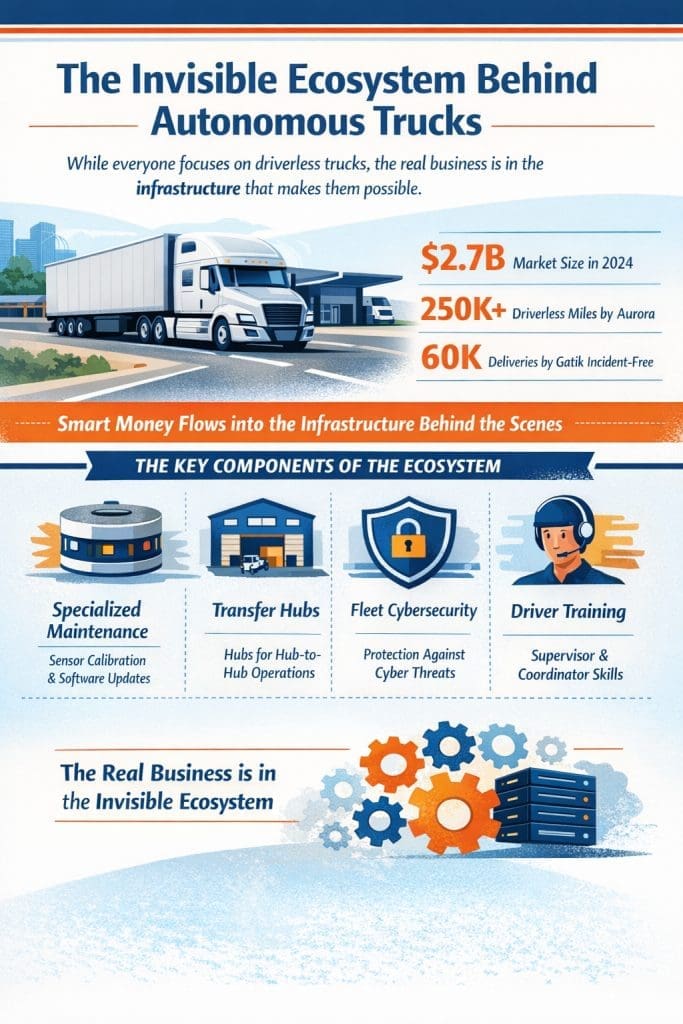
The data shows this transition is already underway. The autonomous trucking market reached $2.7 billion in 2024, while companies like Aurora have surpassed 250,000 driverless miles across Sun Belt routes. Meanwhile, Gatik has completed over 60,000 deliveries without incidents, reinforcing the operational reliability of the model.
But beyond these visible milestones, there’s a more important signal: capital is shifting.
When money moves, the industry follows
There’s a clear pattern in how technologies evolve. In the early stages, investment flows toward the “shiny object” — the product that captures attention. But as the technology matures, the focus shifts toward the infrastructure that makes it viable.
That’s exactly what’s happening in 2026 with autonomous trucks.
At CES 2026 in Las Vegas, McKinsey’s Moritz Rittstieg captured it perfectly:
“When an industry is pure hype, everyone invests in the shiny object. When it starts becoming real, money flows into the plumbing.”
In transportation, that “plumbing” is the invisible ecosystem — everything you don’t see, but without which no autonomous truck can operate at scale.
The six key components of the ecosystem
The rise of autonomy is driving a new layer of services and capabilities that are redefining the logistics business:
Specialized maintenance
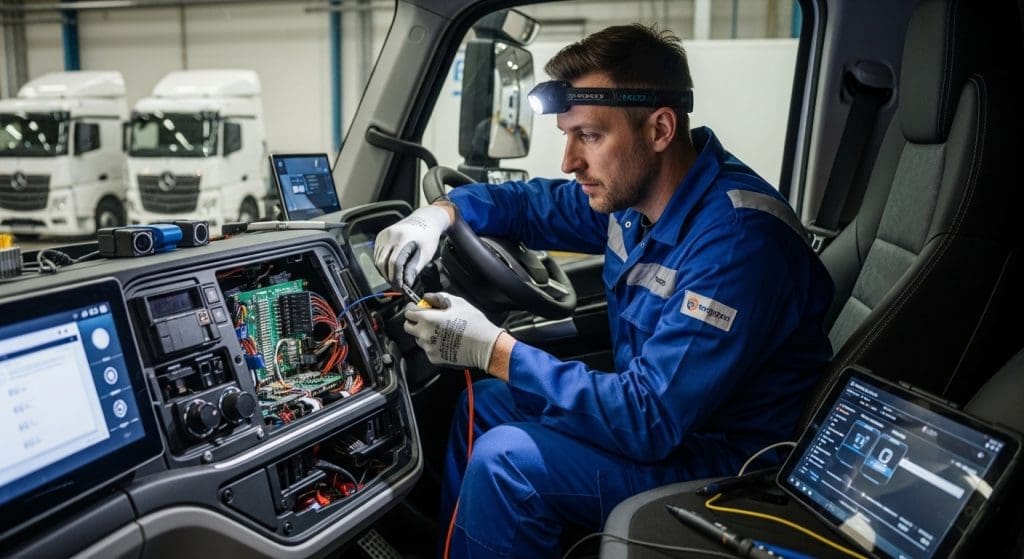
Traditional repair shops are no longer enough. Autonomous trucks require sensor calibration, LiDAR cleaning, advanced diagnostics, and continuous software updates.
Transfer hubs
The dominant operating model is hub-to-hub. Autonomous trucks handle highway segments between logistics nodes, while human drivers manage first and last mile operations. This requires dedicated physical infrastructure.
Fleet management platforms
Software becomes central. Companies need systems capable of coordinating mixed fleets — autonomous and traditional trucks — in real time, optimizing routes, timing, and operations.
Fleet cybersecurity
A connected truck is also a vulnerable one. Protecting fleets from cyber threats is becoming critical, opening a fast-growing segment within logistics.
Specialized insurance
Insurers are developing new products tailored to autonomous and hybrid operations, redefining how risk and liability are assessed.
Driver training and reskilling
The role of the driver is evolving. From operator to supervisor and coordinator of hybrid systems. This shift requires entirely new training models.
Hub-to-hub is accelerating adoption
In practice, the model gaining traction is hub-to-hub, especially across high-density freight corridors in the United States.
Aurora has already tripled its driverless routes in the Sun Belt, while Kodiak Robotics operates one of the largest autonomous fleets in the Permian Basin and is targeting long-haul expansion in 2026.
This approach limits autonomous driving to highways, reducing complexity and accelerating deployment. But it also increases reliance on the invisible ecosystem: more hubs, more coordination, and more specialized services.
A growing opportunity for the logistics sector
For many transportation companies, autonomy still feels distant. But the surrounding ecosystem is already creating tangible business opportunities.
You don’t need to operate autonomous trucks to benefit from this shift. Companies can participate through:
- Specialized technical services
- Hub infrastructure operations
- Software and platform development
- Workforce training programs
- Insurance and risk management solutions
In this sense, autonomy is not replacing the traditional industry — it is expanding and reshaping it.
The real business has already begun
Autonomous trucking won’t happen overnight. But the infrastructure behind it is already being built.
As regulations evolve, real-world deployments expand, and market confidence grows, the focus will continue shifting toward what makes the system work.
Because while autonomous trucks may be the visible face of this transformation, the real business — and the real competitive advantage — lies in the invisible ecosystem that powers them.
 Business hours: Monday to Friday from 8:00 AM to 5:00 PM. California time