 Llame al (888) 572-7520 para hablar con un agente
 Enviar mensaje a un agente
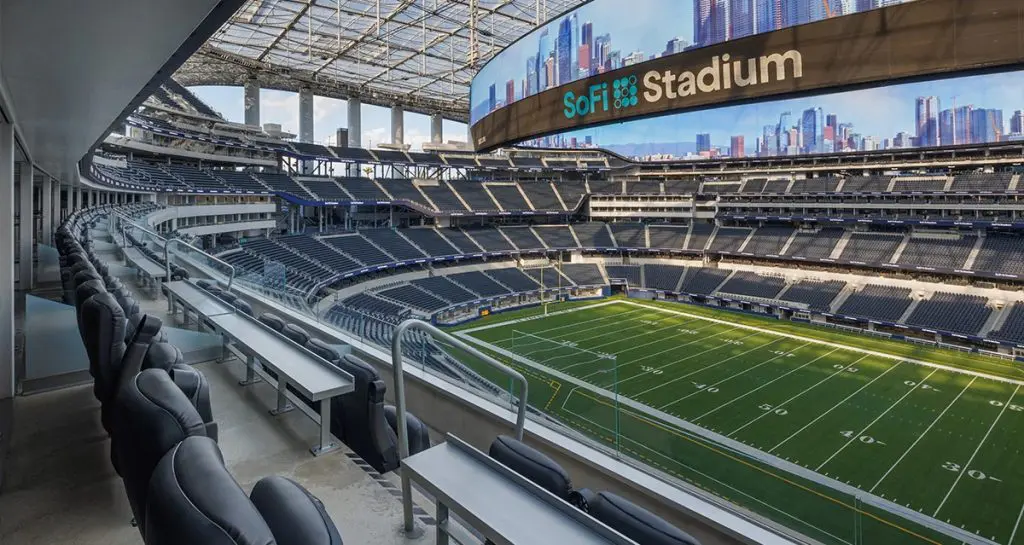

SoFi Stadium will be one of the main venues of the 2026 FIFA World Cup, an event that mobilizes not only millions of fans but also one of the largest logistics operations on the planet.
With an investment surpassing $5 billion, this stadium is not only the most expensive ever built, but also a clear example of how global-scale sports infrastructure depends on precise, sustained, and highly coordinated logistics.
A stadium shaped for the World Cup… through logistics
Although SoFi Stadium opened in 2020, its adaptation for the 2026 World Cup requires new technical and operational adjustments. During the tournament, it will be temporarily renamed “Los Angeles Stadium” and will host key matches, including decisive stages.
To meet FIFA standards, the stadium must modify its playing field, elevate its surface, and reconfigure internal spaces. Each of these changes involves transportation, assembly, and tightly controlled timelines.
And once again, logistics becomes the backbone of the operation.
Thousands of trucks behind a global icon
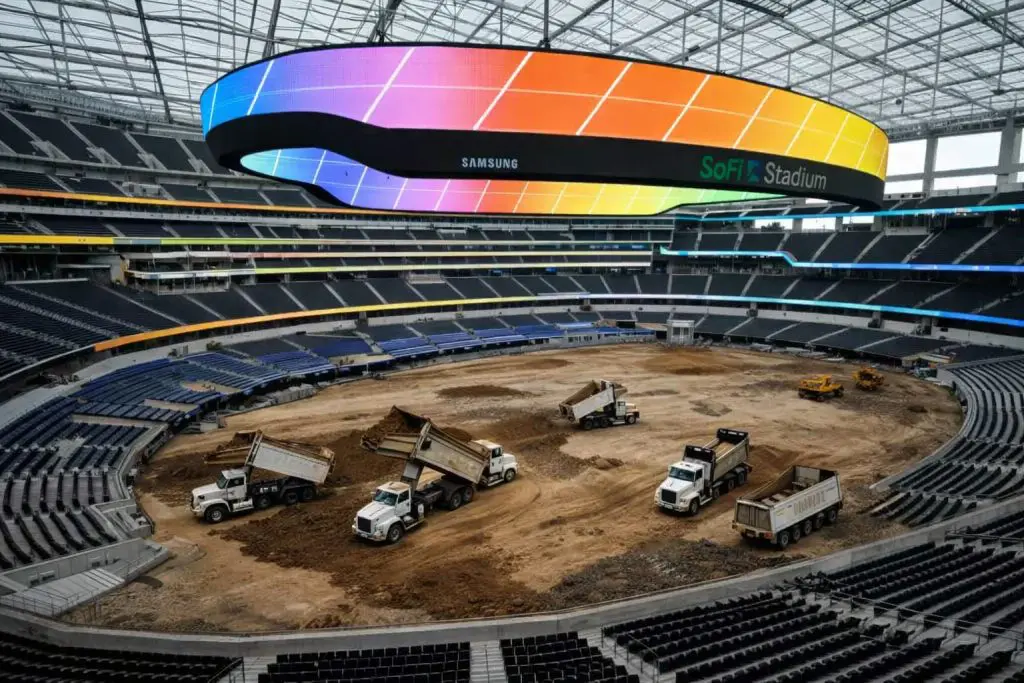
Behind the stadium lies a largely invisible story: transportation.
During its construction, the project required tens of thousands of truck trips, moving materials from across the United States to Inglewood, California.
Key logistics operations included:
- Transport of structural steel for the stadium’s framework
- Continuous operation of concrete mixer trucks
- Delivery of oversized components
- Mobilization of heavy machinery and construction equipment
Every delivery had to be perfectly timed. There was no room for error—any delay could halt entire phases of construction.

Critical timing and extreme precision
One of the greatest challenges was meeting strict deadlines.
Construction took place between 2016 and 2020, with thousands of workers relying on a constant flow of materials. This required a synchronized logistics system, where each truck had a specific schedule and role.
In a city like Los Angeles, known for heavy congestion, this meant:
- Nighttime operations
- Strict delivery windows
- Intermediate distribution hubs
- Real-time coordination systems
Punctuality wasn’t an advantage—it was a necessity.
Urban logistics in one of the most demanding environments
The stadium is located near Los Angeles International Airport (LAX), in a dense urban area with high traffic volume.
This forced planners to design a logistics strategy adapted to:
- Limited access routes
- Strict local regulations
- Heavy vehicle traffic
- Coordination with public authorities
The last mile became one of the biggest challenges. Trucks not only had to arrive—they had to arrive in the exact order and at the precise moment to avoid disrupting construction.
High-level engineering, high-complexity transport
One of the stadium’s most iconic features is its translucent roof, spanning nearly one million square feet.
Transporting the components required for this structure involved:
- Specialized escorted loads
- Detailed route planning
- Oversized transport permits
- Interstate coordination
In many cases, the logistics challenge was as complex as the engineering itself.
From construction to World Cup operations: logistics never stops
During the 2026 FIFA World Cup, the stadium will host multiple matches and events, with a capacity expandable to 100,000 spectators.
But logistics doesn’t end with construction.
Throughout the tournament, trucking operations will be essential for:
- Installation of temporary infrastructure
- International broadcasting equipment
- Food and beverage supply chains
- Security and operational logistics
- Fan zones and parallel events
Each match will effectively require its own logistics operation.
A World Cup powered by logistics
SoFi Stadium represents far more than a sports venue. It is proof that behind every major global event lies an invisible logistics network that makes it all possible.
The 2026 FIFA World Cup will not only be a spectacle on the field—it will also be a demonstration of large-scale coordination, transportation, and efficiency.
And within that system, trucks play a fundamental role: they sustain operations, ensure timing, and make the world’s biggest football event run seamlessly.
Because before the ball rolls, everything has already had to arrive—right on time.
 Business hours: Monday to Friday from 8:00 AM to 5:00 PM. California time