 Llame al (888) 572-7520 para hablar con un agente
 Enviar mensaje a un agente


The safest road systems globally are found in Northern Europe, where countries such as the Netherlands, Norway, Sweden, and Switzerland consistently lead international rankings thanks to high-quality infrastructure, strict enforcement, and a strong culture of compliance. In this context, the United States presents a unique case: a global leader in road safety technology that has yet to translate this advantage into top-tier safety outcomes.
Road safety has become a central issue for the U.S. transportation industry. With millions of trucks operating daily across the country, logistical efficiency coexists with a constant challenge: reducing accidents in an increasingly demanding and congested road network.
According to a global report by Fortune Business Insights, North America accounts for approximately 37% of the global road safety market, driven by investments in infrastructure, smart monitoring, and automated systems.
This positions the United States as one of the most advanced countries in adopting traffic safety technologies, including speed cameras, traffic signal control systems, license plate recognition, and real-time analytics platforms. However, this technological leadership does not directly translate into better safety outcomes.
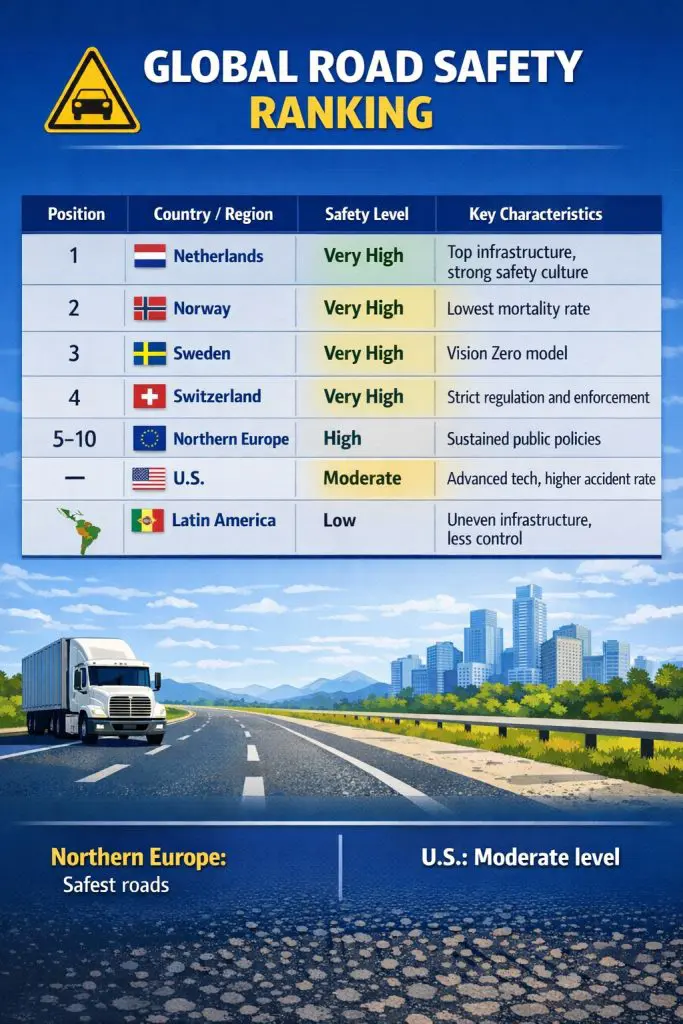
Global Ranking: Who Has the Safest Roads
Globally, the countries leading road safety rankings are those that successfully combine technology with consistent public policies and strong civic culture.
Top performers include:
The Netherlands, Norway, Sweden, and Switzerland
These nations report some of the lowest traffic fatality rates worldwide, supported by safe infrastructure, rigorous driver education, continuous enforcement, and a societal commitment to following traffic rules. In particular, the Scandinavian “Vision Zero” strategy aims to eliminate road fatalities entirely.
Where the United States Stands
The United States ranks in a middle position globally in terms of road safety. While it has one of the largest and most technologically advanced road networks in the world, it faces structural challenges that directly impact accident rates.
Key factors include:
- High traffic density on major freight corridors such as I-95, I-10, and I-5
- Long operational distances that increase exposure to risk
- Driver fatigue, especially in the trucking sector
- Regulatory differences between states
For the transportation industry, this means operating in an environment that is both highly efficient and inherently riskier compared to top-ranking countries.
Impact on the Trucking Industry
For truck drivers in the United States, road safety is a critical business variable. The most heavily traveled routes experience higher congestion levels, increasing accident risk and exposing drivers to diverse and often extreme weather conditions.
Additionally, pressure to meet increasingly tight delivery schedules—driven by the growth of e-commerce—further intensifies operational demands on drivers and fleets.
The result is a landscape where safety depends not only on infrastructure but also on operational management, logistics planning, and driver behavior.
Technology and Prevention: A Shift in Approach
The report highlights a key global shift in road safety: moving from reactive to preventive models. Today, technology enables real-time detection of violations, identification of high-risk zones, accident pattern analysis, and optimized traffic management.
In the United States, these solutions are already widely implemented through intelligent transportation systems and cloud-based platforms. However, the ongoing challenge is ensuring that these technologies produce sustained reductions in accident rates.
The U.S. Challenge Ahead
One of the main challenges for the United States is closing the gap between technological capability and real-world outcomes. While automated systems improve monitoring and enforcement, leading countries demonstrate that success depends on a comprehensive strategy that integrates:
- Driver education
- Safe infrastructure
- Consistent public policies
- A strong culture of compliance
Additionally, issues such as data privacy and regulatory complexity remain significant factors in the implementation of new technologies.
A Massive Industry with Ongoing Challenges
The United States remains one of the most advanced markets in road safety innovation, but it has yet to reach the levels achieved by countries with the safest roads in the world.
For the transportation industry and truck drivers, this means that safety will continue to be a defining factor in daily operations. The future of the sector will depend on its ability to integrate technology, regulation, and human behavior into a model that not only optimizes logistics but also reduces risks on every mile traveled.
 Business hours: Monday to Friday from 8:00 AM to 5:00 PM. California time